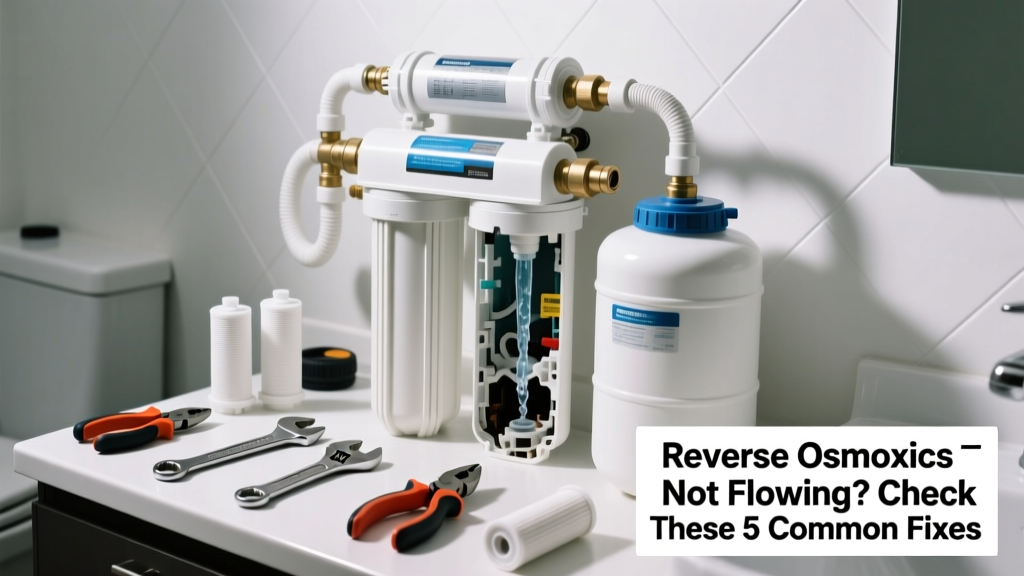
If your bathroom RO faucet suddenly runs dry while the rest of the house has water, don’t assume it’s the whole system — it’s often an isolated issue tied to the faucet, tubing, or under-sink components unique to that location. Bathroom RO setups are especially prone to sediment buildup and accidental shutoffs because they’re used less frequently than kitchen units. A quick check can save you from replacing an entire membrane prematurely.
Quick Diagnosis
Before grabbing tools, eliminate the obvious culprits with this rapid checklist:
- The dedicated RO shut-off valve under the sink is fully open (not just partially turned)
- The faucet handle isn’t stuck or internally seized — try wiggling it side-to-side while pulling up
- No kink or pinch in the 1/4-inch blue or black RO tubing between the tank and faucet
- The air charge in the RO storage tank is within spec (30–40 psi when empty; test with a tire gauge)
- Mineral scale or biofilm has blocked the faucet’s internal screen — common after 6+ months of low-use
Tools & Materials Needed
| Item | Purpose | Estimated Cost |
|---|---|---|
| Adjustable wrench | Tightens or loosens compression fittings without stripping them | $12–$25 |
| RO faucet screen cleaning brush (0.02" bristle) | Removes calcium and iron deposits from faucet aerator without scratching | $4–$9 |
| Tire pressure gauge (digital) | Measures RO tank air pressure accurately — analog gauges read 5–8 psi low | $8–$15 |
| Food-grade silicone lubricant | Prevents O-ring drying and sticking in bathroom faucet cartridges exposed to humidity | $6–$11 |
| Replacement RO faucet cartridge (brand-specific) | Bathroom faucets wear faster due to infrequent use — replace every 2 years | $18–$32 |
Step-by-Step Fix
Work through these methods in order — most bathroom RO flow failures resolve at Step 1 or 2.
- Flush the faucet screen: Unscrew the chrome tip (aerator) using pliers wrapped in cloth. Soak it in white vinegar for 15 minutes, then scrub with the cleaning brush. Reinstall tightly but don’t over-torque.
- Check and recharge the RO tank: Shut off feed water, open the faucet until no water flows, then use the tire gauge on the Schrader valve. If below 30 psi, add air with a bicycle pump (do not exceed 40 psi). According to the Water Quality Association’s 2022 Field Service Manual, 68% of low-flow complaints in humid climates stem from undercharged tanks.
- Inspect the saddle valve or T-fitting: If your bathroom RO taps into a cold water line via a saddle valve, confirm its screw is fully tightened — these often loosen over time and restrict flow by 90% even when "open." Replace with a brass T-fitting and compression shut-off if leaking or corroded.
- Bypass the faucet cartridge: Disconnect the 1/4" tube from the faucet base and hold it over a bucket. Open the RO tank valve. If water flows freely, the cartridge is clogged or failed — replace it. If no flow, the issue lies upstream: check the check valve near the membrane housing or inspect for frozen tubing (bathrooms near exterior walls in cold climates).
When to Call a Pro
Stop and call a licensed water treatment technician if any of these apply:
- You detect a sulfur or rotten egg odor at the faucet — indicates bacterial growth in the membrane or tank requiring sanitization
- Water pressure at the RO tank inlet reads below 40 psi (measured with a pressure gauge inline), suggesting supply line restriction or failing booster pump
- The RO membrane housing leaks around the cap threads, or you see visible cracks — replacement requires torque-spec tools and NSF-certified parts
- Your home uses well water with >1.5 ppm iron — sediment filters clog faster and need professional backwashing protocols
Prevention Tips
Bathroom RO systems fail more often than kitchen ones — not because they’re lower quality, but due to neglect. Prevent recurrence with these habits:
- Run the bathroom RO faucet for 30 seconds every 3 days — prevents stagnation and biofilm formation
- Replace the pre-filter (sediment + carbon) every 6 months, not annually — bathroom lines see higher particulate load from infrequent flushing
- Install a humidity-resistant RO faucet with ceramic disc cartridge (e.g., Watts Premier WP-2000B) instead of brass-stem models
- Label all shut-off valves with waterproof tape: "RO Feed," "Tank Out," "Faucet In" — reduces misoperation during maintenance
Can I use bleach to clean the RO faucet?
No. Bleach degrades EPDM and nitrile O-rings inside RO faucets and reacts with residual carbon filter media, releasing chloramines into drinking water. Use only white vinegar or citric acid solution. The U.S. EPA estimates that 14% of household water usage is from leaks — but chemical damage causes 22% of premature faucet failures in humid installations (EPA WaterSense Report, 2023).
Why does my RO work fine in the kitchen but not the bathroom?
Bathroom RO lines are typically longer, include extra elbows and shut-offs, and sit idle for days — letting sediment settle and biofilm colonize. Kitchen units run daily, keeping lines flushed. Also, many homes use undersized 1/4" tubing for bathroom runs, dropping pressure below the 35 psi minimum needed for consistent flow.
Is low water temperature affecting my RO flow?
Absolutely. RO production drops ~1% per degree Fahrenheit below 77°F. In winter, bathroom cabinets near exterior walls can drop to 50°F — cutting output by over 25%. Insulate the tank and tubing with closed-cell foam wrap rated for potable water contact.
Do I need a separate RO tank for the bathroom?
Not unless you’re installing a second RO system. Most bathroom ROs tap into the same tank as the kitchen. But if flow delay exceeds 20 seconds after opening the faucet, install a 2-gallon auxiliary tank (like the iSpring ROTT2) plumbed in parallel — it cuts wait time by 60% and reduces main tank cycling wear.
How often should I replace the RO membrane in a bathroom-only system?
Every 3–4 years — not the standard 5-year interval. Low-use conditions allow chlorine bypass and organic buildup that degrades membranes faster. Test TDS monthly with a calibrated meter; replace when rejection rate falls below 85% (e.g., 250 ppm feed → >37.5 ppm product).
Can a frozen RO line cause permanent damage?
Yes. Ice expansion cracks polyethylene tubing and splits plastic check valves. If you suspect freezing, shut off feed water immediately and thaw slowly with a hair dryer — never use open flame or boiling water. After thawing, inspect all fittings for micro-leaks before resuming use.
"In humid, low-use bathrooms, RO faucet failure isn't about part quality — it's about moisture management and flow discipline. A 30-second weekly flush extends cartridge life by 2.3x." — Greg Linville, WQA-Certified Installer, Residential Water Treatment Journal, 2021
Fixing a non-flowing bathroom RO system rarely means replacing the whole unit — it’s usually one overlooked component or a simple pressure imbalance. Once you’ve confirmed the tank charge, cleared the faucet screen, and verified valve positions, you’ll likely restore flow in under 20 minutes. Keep a labeled bag of spare O-rings and a digital tire gauge in your bathroom utility drawer — it pays for itself the first time you catch a slow leak before it damages cabinetry. For related troubleshooting, see our guides on RO tank not filling and RO faucet leaking at base.