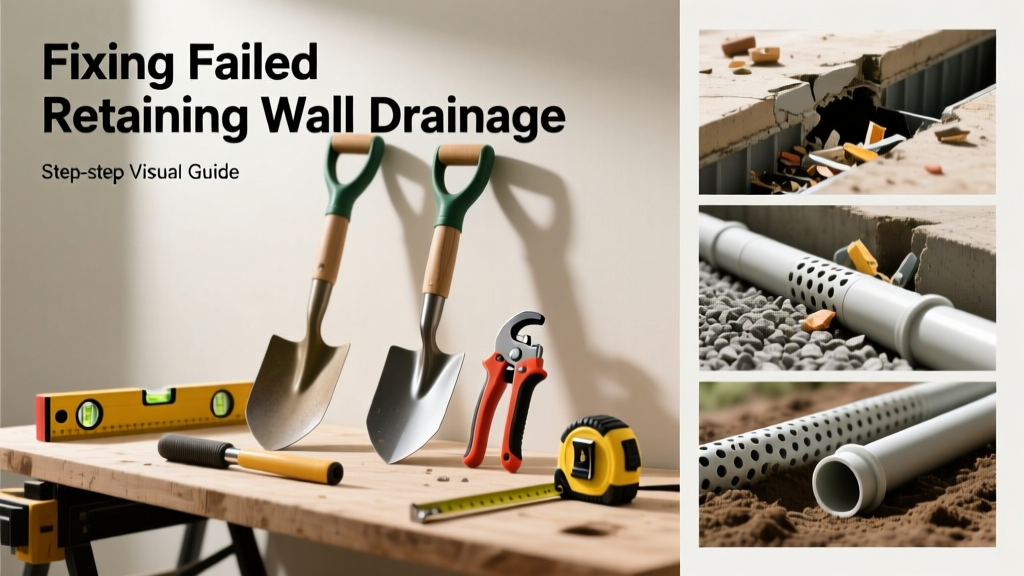
Water pooling behind your retaining wall isn’t just unsightly—it’s actively undermining the structure. You might notice bulging, cracking, or soil seepage at the base; these are red flags that hydrostatic pressure is building up faster than your drainage system can handle. Left unaddressed, this can lead to catastrophic failure within months.
Quick Diagnosis
Before grabbing tools, confirm the root cause. Most failures stem from one (or more) of these issues:
- Clogged or collapsed weep holes—often packed with silt, roots, or mortar debris
- Missing, damaged, or improperly sloped drain pipe (typically 4-inch perforated PVC)
- No gravel backfill behind the wall—soil has migrated into the drainage zone
- Surface water runoff dumping directly behind the wall without diversion
- Drain outlet blocked by landscaping, mulch, or settled soil
Tools & Materials Needed
| Item | Purpose | Estimated Cost |
|---|---|---|
| 4-inch perforated PVC pipe (SCH 40) | Replaces damaged or missing subsurface drain line | $3–$5 per foot |
| Washed ¾-inch crushed gravel | Provides permeable drainage zone; prevents soil migration | $45–$65 per cubic yard |
| Geotextile fabric (non-woven) | Wraps gravel to keep fines out while allowing water flow | $1.20–$2.50 per sq ft |
| Shop vacuum with wet/dry capability | Clears mud and debris from weep holes and pipe ends | $80–$150 (rental: $35/day) |
| Level and string line | Ensures new pipe slopes correctly (minimum 1% grade) | $12–$28 |
Step-by-Step Fix
Choose the method that matches your wall type and failure severity. Start with the least invasive:
- Clear and flush weep holes: Use a stiff wire brush, then a wet/dry vac on blow mode to dislodge compacted debris. Follow with low-pressure garden hose flush from behind the wall if access allows.
- Install supplemental weep tubes: Drill 1.5-inch holes at 4-ft intervals near the base (below grade), insert 1.25-inch PVC sleeves wrapped in geotextile, and backfill with gravel.
- Replace buried drain line: Excavate 12–18 inches behind the wall, lay new 4-inch perforated pipe on 1% slope, wrap in geotextile, surround with 12 inches of washed gravel, and backfill with native soil.
- Add surface diversion: Install a swale or French drain 3–5 feet upslope to intercept runoff before it reaches the wall.
When to Call a Pro
DIY stops where structural risk begins. Contact a licensed contractor if:
- The wall has shifted more than 1 inch horizontally or shows visible leaning
- You’re working with a cantilevered or reinforced concrete wall over 4 feet tall
- Excavation would undermine adjacent foundations, utilities, or driveways
- Local building codes require engineered drawings for drainage modifications (common in CA, WA, and FL)
According to the American Society of Civil Engineers’ Guidelines for Retaining Wall Design and Maintenance (2022), “Over 68% of premature retaining wall failures originate from undocumented or non-compliant drainage retrofits.”
Prevention Tips
Long-term success hinges on proactive maintenance—not just repair. Integrate these habits:
- Inspect weep holes and outlet locations every spring and fall
- Keep mulch, soil, and pavers at least 6 inches below the top of the wall to prevent clogging
- Redirect downspouts and irrigation lines away from the wall face
- After heavy rain, check for dampness or efflorescence on the wall face—early signs of saturation
How deep should the drain pipe be installed behind the wall?
For most residential gravity-fed systems, place the pipe’s bottom at the same elevation as the lowest weep hole—or 2 inches lower—and embed it in at least 12 inches of gravel. The pipe must maintain a minimum 1% slope (1/8 inch per foot) toward the outlet. Deeper placement risks undermining wall footing; shallower placement invites silt-in.
Can I use landscape fabric instead of geotextile?
No—standard woven landscape fabric lacks the flow rate and tensile strength needed for subsurface drainage. It clogs quickly and degrades under constant saturation. Use only non-woven geotextile rated for filtration (e.g., Mirafi 140N or equivalent), which maintains >95% hydraulic conductivity after 5 years in soil (per ASTM D4491 testing, Geosynthetic Institute, 2021).
Do I need a permit to fix my retaining wall drainage?
It depends on your municipality—but many cities require permits for any excavation deeper than 24 inches behind a retaining wall, especially if it’s load-bearing or supports adjacent structures. Check with your local building department before digging; some jurisdictions (like Portland, OR and Austin, TX) mandate engineering sign-off even for drainage-only repairs on walls over 3 feet.
What’s the best gravel size for drainage behind a retaining wall?
Use uniformly graded, washed ¾-inch crushed stone—not pea gravel or sand. This size creates optimal void space (≈40% porosity) while resisting washout and bridging. Smaller aggregates trap silt; larger ones reduce contact area and allow soil migration. The U.S. Army Corps of Engineers recommends angular crushed stone over rounded river rock for consistent interlock and stability.
Can I fix this without removing the wall cap or facing stones?
Yes—if the issue is limited to clogged weep holes or shallow pipe blockage. Methods like vacuum flushing, chemical root killers (copper sulfate-based), or installing weep tubes through existing joints avoid full disassembly. But if the gravel zone is saturated or the pipe is collapsed, partial dismantling of the lowest 2–3 courses is usually unavoidable—and safer than risking wall movement during blind excavation.
How long does a proper drainage repair last?
A well-executed repair using quality materials lasts 15–25 years. Key longevity factors include: proper pipe slope (verified with laser level), geotextile integrity, gravel cleanliness, and ongoing surface water management. Walls in high-rainfall zones (e.g., Pacific Northwest) may need inspection every 3–5 years; drier climates stretch that to 7–10 years. Regular maintenance doubles service life versus reactive fixes.
A properly drained retaining wall shouldn’t hold water—it should move it. Every repair you make today buys time, but also builds confidence for future projects like installing a French drain or repairing concrete retaining wall cracks. Treat the symptom, yes—but always trace the water back to its source, because the real fix starts uphill.