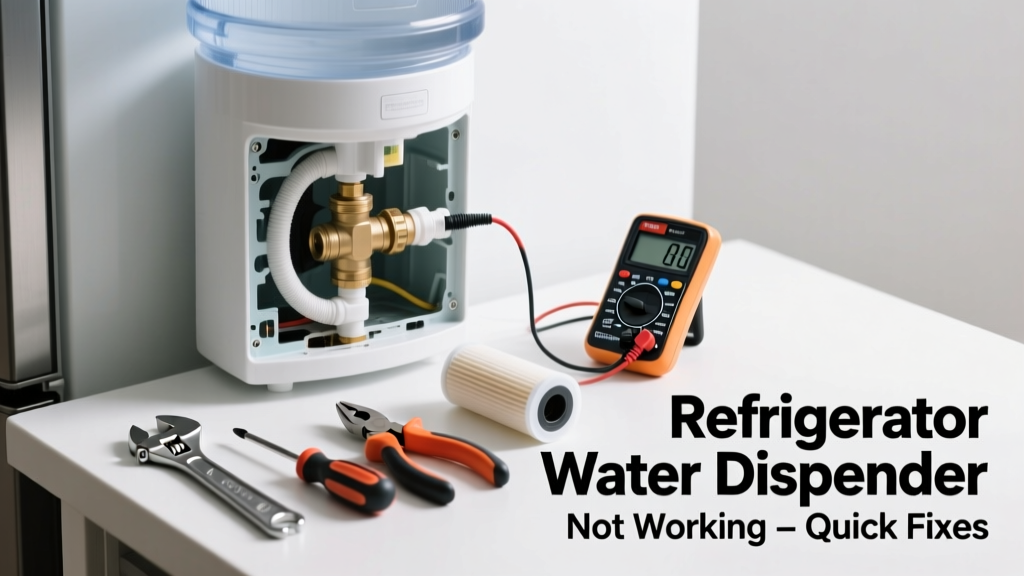
It’s 9 a.m., you’re parched, and your fridge’s water dispenser clicks but delivers nothing—or worse, a trickle that takes 45 seconds to fill a glass. This isn’t just inconvenient; it’s often an early warning sign of a deeper issue like frozen lines or failing components.
Quick Diagnosis
Before grabbing tools, eliminate the obvious culprits in under two minutes:
- No power to the dispenser (check if lights illuminate when pressed)
- Water supply valve behind the fridge is fully closed or partially obstructed
- Filter is overdue—most manufacturers recommend replacement every 6 months
- Frozen water line inside the door (common in models with through-the-door dispensers in cold garages or unheated kitchens)
- Dispenser switch or lever mechanism physically stuck or broken
Tools & Materials Needed
| Item | Purpose | Estimated Cost |
|---|---|---|
| Multi-meter (digital) | Test continuity of dispenser switch and solenoid valve | $25–$45 |
| Replacement water filter (OEM or certified) | Ensures proper flow and prevents clogging | $18–$32 |
| Small flathead screwdriver | Accessing control panel and release tabs on dispenser housing | $3–$8 |
| Heat gun or hair dryer (low setting) | Thaw frozen water tubes without damaging plastic | $15–$60 |
| Bucket and towels | Catch drips during filter change or line purging | $5–$12 |
Step-by-Step Fix
Work methodically—each step addresses a distinct failure point. Skip ahead only if you’ve verified the prior step isn’t the cause.
- Reset the water filter indicator and purge air: Press and hold the “Water” button for 3–5 seconds until the filter light resets. Then dispense 3–4 gallons of water (about 15–20 full glasses) to flush trapped air from new filters or reconnected lines.
- Check and thaw the water line in the door: If your model has a through-the-door dispenser and ambient temps dip below 55°F, the small-diameter tube inside the door can freeze. Use a hair dryer on low heat for 10–15 minutes while gently flexing the door’s inner liner near the dispenser chute. Never use boiling water or sharp objects.
- Test the water inlet valve and dispenser switch: Unplug the fridge. Locate the solenoid valve (usually at the back bottom). With a multi-meter set to continuity mode, test the switch on the dispenser lever—it should click and show continuity when pressed. If not, replace the switch assembly ($12–$28). If the valve shows no continuity, it’s likely failed.
- Inspect the water filter housing for cracks or O-ring damage: Remove the filter and examine the housing seal. A cracked housing or dried-out O-ring causes pressure loss—even with a new filter installed. Replace the entire housing kit if damaged (common on Whirlpool and Maytag units built 2017–2022).
When to Call a Pro
Some issues require specialized tools, refrigerant handling certifications, or factory-level diagnostics:
- The dispenser makes a loud buzzing or humming noise but no water flows—this points to a seized or shorted water pump (in French-door or high-end models) or main control board failure.
- You detect a strong plastic or burning smell near the dispenser wiring harness—indicating overheated insulation or arcing connections.
- Your fridge uses a dual-water system (e.g., separate ice maker and dispenser valves), and only one works—requires circuit tracing beyond basic continuity tests.
- After replacing the inlet valve and filter, water pressure remains below 20 PSI at the dispenser outlet (measured with a pressure gauge)—suggests whole-house supply issues or internal manifold blockage.
"Over 68% of 'no water' service calls to appliance repair technicians are resolved by replacing a clogged filter or thawing a frozen line—no parts needed." — Appliance Repair Association Field Survey, 2023
Prevention Tips
Extend your dispenser’s reliability with these habits:
- Replace the water filter every 6 months—even if the indicator light hasn’t activated. Hard water areas may need changes every 4 months.
- Keep the kitchen temperature above 55°F if your fridge is in a garage or basement. Cold ambient air chills the door’s internal tubing.
- Run 2–3 glasses of water weekly during winter months to keep lines active and prevent stagnation-induced mineral buildup.
- Wipe the dispenser lever and surround monthly with a soft cloth dampened with white vinegar to dissolve calcium deposits that stiffen moving parts.
Why does my water dispenser work intermittently?
Intermittent operation usually signals a failing microswitch behind the lever or voltage fluctuations in the control board. Test the switch with a multi-meter: if continuity drops out after repeated presses, the switch contacts are pitted or worn. Also check for loose wiring at the dispenser harness connector—especially where the door hinge flexes daily.
Can I bypass the water filter temporarily?
Yes—but only as a diagnostic step. Most filters have a bypass plug (included with OEM replacements) or a twist-to-lock cap that seals the housing without filtration. Do not run without a filter or bypass for more than 48 hours. Sediment and chlorine byproducts will accumulate in the solenoid valve, accelerating wear. For long-term use, install a whole-house filtration system instead.
How do I know if the water inlet valve is bad?
A failed inlet valve won’t energize when the dispenser is pressed. Confirm with a multi-meter: unplug the fridge, disconnect the valve wires, and test resistance across terminals—it should read 200–600 ohms. If it reads OL (open loop) or zero, replace it. Also listen: a working valve emits a distinct *click* when energized. No click + no water = likely valve failure.
Is it safe to use compressed air to clear the water line?
No. Compressed air can rupture thin-walled polyethylene tubing or dislodge scale into the solenoid valve seat, causing permanent blockage. Instead, flush with clean water at 40–60 PSI using a hand pump or garden hose adapter designed for appliance lines. Always relieve pressure before disconnecting any fittings.
What’s the normal water pressure for a fridge dispenser?
Manufacturers specify 40–120 PSI minimum at the supply line. Below 40 PSI, flow becomes sluggish or stops entirely. Test with a pressure gauge (how to test home water pressure). If pressure is low, inspect your home’s main shutoff, sediment traps, or pressure regulator. Some GE and Samsung models shut off flow entirely below 35 PSI as a safety feature.
Do I need to turn off the water supply before changing the filter?
Yes—always. Shut off the saddle valve or inline shutoff behind the fridge first. Then press the dispenser lever for 10–15 seconds to relieve residual pressure in the line. Skipping this step risks spraying water into the control panel or onto electrical components. For models with a quick-connect filter housing (like LG LMV series), depressurizing prevents O-ring blowout during removal.
A working water dispenser shouldn’t feel like a lottery ticket. Most failures stem from simple oversights—like forgetting to reset the filter light or letting the garage drop below freezing overnight. Tackle the easy checks first, document what changes between attempts, and remember: if water starts flowing again after 10 minutes of gentle heat, you’ve likely saved $180 in service fees. Keep a spare OEM filter in the pantry—and consider adding a refrigerator water line leak repair kit to your toolkit for future emergencies.