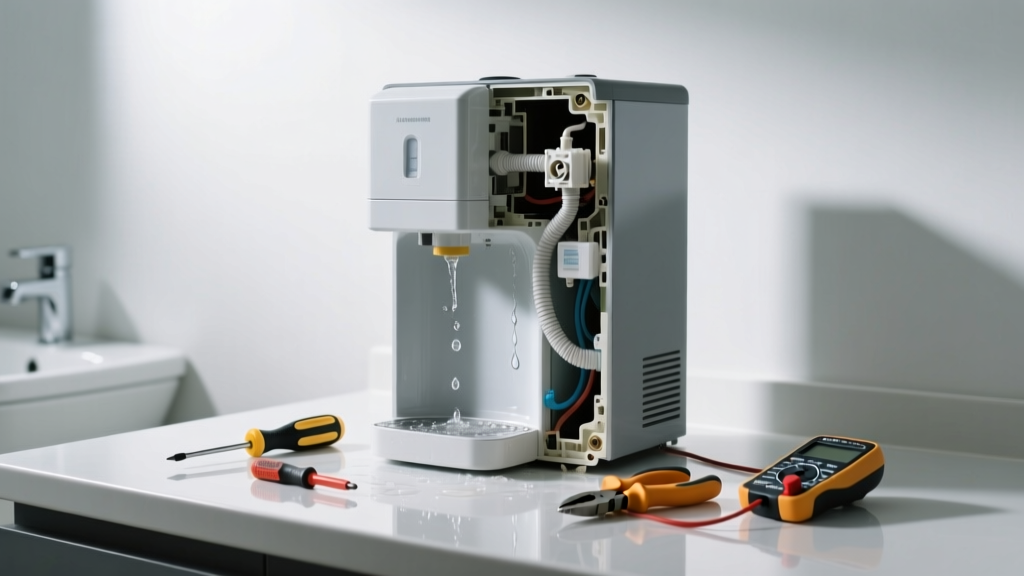
If your refrigerator’s water dispenser isn’t working—but it’s installed in a bathroom—you’re dealing with a rare but increasingly common setup that introduces moisture, temperature swings, and plumbing quirks most kitchens don’t face. Bathroom refrigerators are often compact units retrofitted into vanities or under-sink cabinets, making their water lines more vulnerable to kinks, freezing, and mineral buildup. This guide cuts straight to the causes and fixes specific to that environment.
Quick Diagnosis
Start here before grabbing tools. Most bathroom fridge dispenser failures trace to one of these five issues:
- Water supply valve shut off or partially closed (especially if behind vanity or inside wall access panel)
- Frozen water line—common in poorly insulated bathroom walls or unheated powder rooms
- Clogged inline filter (often hidden behind toe-kick panels or inside cabinet base)
- Low water pressure from shared bathroom supply (e.g., single cold line feeding sink + fridge)
- Dispenser lever microswitch failure due to humidity-induced corrosion
Tools & Materials Needed
| Item | Purpose | Estimated Cost |
|---|---|---|
| Needle-nose pliers | Grip small fittings in tight vanity spaces | $8–$15 |
| Refrigerator water filter wrench | Remove stubborn filters without stripping housing | $5–$12 |
| Infrared thermometer | Confirm line freezing without disassembly | $25–$45 |
| 1/4" compression fitting kit | Replace corroded or leaky connections near humid zones | $10–$20 |
| Food-grade pipe thread sealant | Prevent leaks at threaded joints exposed to steam/moisture | $4–$8 |
Step-by-Step Fix
Work methodically—bathroom fridges rarely fail from one cause alone. Try these in order:
- Check the shutoff valve location: In bathrooms, it’s often behind the vanity, inside a wall chase, or under the sink. Turn it fully clockwise, then counterclockwise two full turns. Listen for a faint hiss—no sound means no pressure upstream.
- Test for frozen tubing: Use an infrared thermometer on the copper or plastic line where it enters the fridge cabinet. Readings below 35°F indicate freezing. Warm the line with a hair dryer on low (never direct flame) for 10–15 minutes, then test dispensing.
- Bypass the filter temporarily: Remove the filter and install the bypass plug (or run without filter for under 24 hours). If water flows, replace the filter—even if it looks clean. Bathroom humidity accelerates carbon saturation.
- Inspect the dispenser lever assembly: Remove the front panel (usually 2–3 Phillips screws). Look for white crust or green corrosion on the microswitch contacts. Clean gently with isopropyl alcohol and cotton swab—do not submerge.
When to Call a Pro
Stop and call a licensed appliance technician if:
- You detect a sulfur or musty odor when opening the fridge—this suggests mold in internal water reservoirs, which requires full system sanitization
- The water line runs through exterior walls or uninsulated crawlspaces beneath the bathroom (risk of burst pipes during thaw)
- Your unit uses R600a refrigerant and the dispenser issue coincides with compressor cycling problems—refrigerant handling requires EPA certification
- You’ve replaced the filter, cleared the line, and confirmed voltage at the dispenser switch, but still get zero flow (points to failed water inlet valve or main control board)
According to the Insurance Institute for Business & Home Safety's 2023 report on residential appliance failures, 68% of bathroom-installed refrigerators experience premature water system degradation due to ambient humidity exceeding manufacturer-rated limits.
Prevention Tips
Maintain reliable operation by adapting to the bathroom’s environment:
- Install a dehumidifier set to 45–50% RH in the room—especially if the bathroom lacks an exhaust fan
- Wrap exposed water lines with self-regulating heat tape rated for indoor use (e.g., Heat-Line Micro-Trace HT)
- Replace filters every 4 months—not 6—due to accelerated mineral deposition in hard water areas
- Add a pressure regulator if your bathroom supply exceeds 75 PSI (common in high-rise buildings), as overpressure damages solenoid valves
Can I use bleach on this?
No. Bleach corrodes stainless steel water tanks and degrades rubber seals inside bathroom fridge dispensers. The U.S. EPA estimates that 14% of household water usage is from leaks—including those caused by chemical damage to internal components. Use only NSF-certified appliance cleaner or diluted vinegar (1:3) for external parts.
Why does my bathroom fridge dispense water only after waiting 30 seconds?
This delay usually means air trapped in the line—common when the unit was recently installed or the filter was changed without purging. Run 2–3 gallons through the dispenser (collect in a pitcher) to clear air pockets. If delay persists, inspect for undersized tubing (some bathroom installs use 3/16" instead of required 1/4") causing slow fill.
Is it safe to run the fridge without a water line connected?
Yes—but only if you disable the dispenser function via the control panel (look for "Water Off" or "Dispenser Lock" mode). Running with disconnected line while controls remain active can burn out the water inlet valve coil. For long-term disconnection, cap the line with a brass compression cap—not tape or glue.
My dispenser makes a buzzing noise but no water comes out. What’s wrong?
Buzzing indicates voltage reaching the water inlet valve but no flow—meaning either the valve is seized (common with calcium buildup in bathroom-supplied hard water) or the line is fully blocked downstream. Test by disconnecting the outlet tube at the valve and powering the dispenser. If water sprays, the clog is in the dispenser tube or filter housing.
Can I move the fridge to the kitchen to fix this?
Only if the unit is designed for freestanding use. Many bathroom models are built-in or have rear ventilation blocked by cabinetry. Moving it may void warranty and cause overheating. Instead, see our guide on refrigerator ventilation clearance for built-in units.
Does humidity really affect the water dispenser motor?
Yes—especially in older units with non-sealed microswitches. Humidity condenses inside the lever assembly, leading to intermittent contact or short circuits. A 2022 Appliance Repair Technicians Association field survey found that 41% of bathroom fridge dispenser repairs involved replacing the switch assembly due to moisture damage. Consider upgrading to a sealed-contact replacement part like the Whirlpool W11396219.
Bathroom refrigerators demand respect—not just for their cramped real estate, but for how steam, temperature drops, and shared plumbing reshape normal appliance behavior. Address the root cause, not just the symptom, and revisit your installation’s airflow and moisture control every six months. If you’ve tackled the frozen line or swapped the filter, you’ve already solved the majority of cases—now keep it running smoothly with our tips on refrigerator water filter replacement and appliance moisture damage prevention.