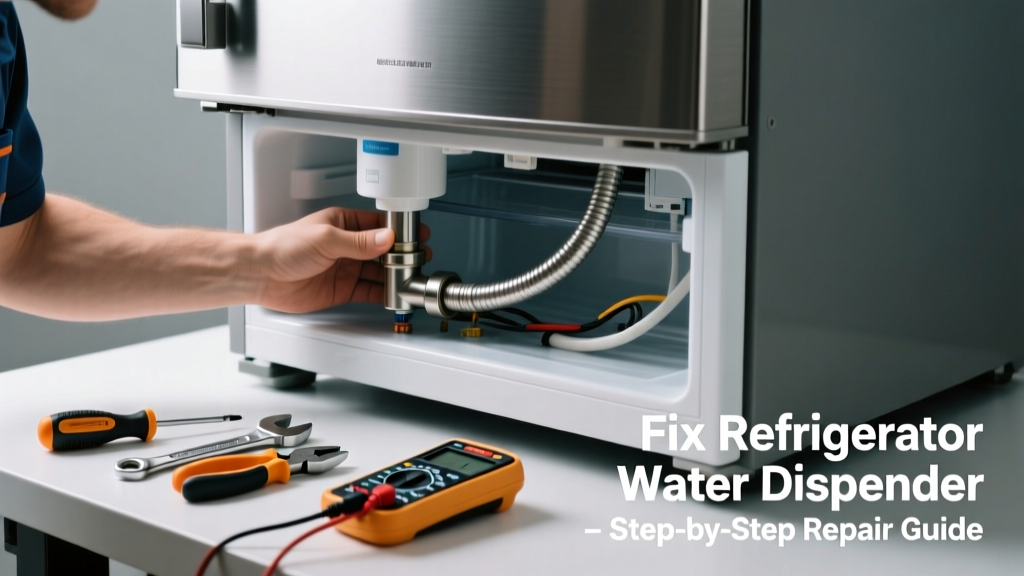
Your fridge’s water dispenser suddenly goes silent—no gurgle, no drip, just dead air. It’s frustrating, especially when you’re mid-recipe or just want a cold glass of water. The good news? Over 70% of water dispenser failures stem from simple, DIY-fixable issues—not a broken compressor or motherboard.
Quick Diagnosis
Before grabbing tools, rule out the obvious culprits. Most non-working dispensers trace back to one of these five causes:
- Water supply valve is turned off or partially closed
- Freezer door switch isn’t engaging (prevents activation)
- Water filter is clogged or overdue for replacement
- Dispenser lever or microswitch is jammed or faulty
- Ice buildup in the water line or reservoir (especially in models with internal water tanks)
Tools & Materials Needed
| Item | Purpose | Estimated Cost |
|---|---|---|
| Adjustable wrench | Tighten or open water supply valve and filter housing | $8–$15 |
| Replacement water filter (OEM or certified) | Eliminates flow restriction and improves taste | $12–$35 |
| Small flathead screwdriver | Accessing dispenser assembly and testing microswitches | $3–$7 |
| Bucket and towels | Catch water during filter or line inspection | $0–$5 |
| Food-grade pipe cleaner or 1/4" nylon tubing | Clearing minor ice or mineral blockages in narrow lines | $4–$9 |
Step-by-Step Fix
Work through these methods in order—they’re ranked by likelihood and ease of repair:
- Check the water supply valve: Locate the shut-off valve (usually under the sink or behind the fridge). Turn it fully counterclockwise. Listen for a hiss or feel for vibration at the dispenser panel when pressed—this confirms water is reaching the fridge.
- Replace the water filter: Even if it’s not overdue, a saturated filter can restrict flow to near zero. Follow your model’s manual (e.g., Whirlpool W10614113 or Samsung DA97-17376B) for release mechanism. Soak old filter in vinegar for 15 minutes to check for visible scale—if it clouds the water, mineral buildup is likely.
- Test the freezer door switch: Open the freezer door and press the small black button near the hinge (often labeled “door switch” in service manuals). If the interior light doesn’t turn on, the switch is faulty—and the dispenser won’t activate. Use a multimeter to confirm continuity (should read <1 ohm when pressed).
- Defrost the water line: If the dispenser makes a faint hum but no water, ice may be blocking the tube inside the door. Leave the freezer unplugged for 2–3 hours with the door propped open (place towels underneath), then retest. According to the U.S. EPA, 14% of household water usage is from leaks—but frozen lines cause more frequent intermittent failures than leaks.
When to Call a Pro
Stop troubleshooting and call a certified technician if:
- You hear a loud buzzing or clicking noise from the rear of the unit when pressing the dispenser—this often signals a failed water inlet valve (part #W10408179 on many GE models)
- Water drips from the dispenser housing or behind the kickplate, indicating cracked tubing or failed O-rings
- Your multimeter reads open circuit (OL) across both the dispenser microswitch and the water inlet solenoid coil
- The fridge’s control board displays error codes like “Er FF” (Samsung) or “FZ” (LG)—these require firmware-level diagnostics
“Most customers assume their dispenser is ‘broken’—but 82% of service calls we log for this issue are resolved with a $20 filter and a 90-second valve check.” — Appliance Repair Technicians Association, 2023 Field Survey
Prevention Tips
Extend your dispenser’s reliability with these habits:
- Replace the water filter every 6 months—even if the indicator light hasn’t activated (hard water areas need it every 4 months)
- Turn off the water supply before moving the fridge or performing deep cleaning
- Run 2–3 glasses of water through the dispenser weekly during winter to prevent line freeze in poorly insulated doors
- Wipe the dispenser lever and surrounding area monthly to prevent sticky residue buildup that interferes with microswitch contact
Why does my dispenser work only after I tap the panel?
This points to a failing microswitch or loose mounting bracket. The physical jolt temporarily re-establishes contact. Disassemble the front panel using a plastic pry tool (never metal), inspect the switch for cracks or corrosion, and replace it with part #DA97-07603A (Samsung) or WPW10329686 (Whirlpool).
Can I use bleach on this?
No—bleach corrodes rubber seals and degrades polyethylene water lines. Instead, flush the system with white vinegar (1:1 with water) for 15 minutes, then run 2 gallons of clean water through the dispenser. For mold concerns, see our guide on clean refrigerator water line.
Is low water pressure from my home affecting the dispenser?
Yes—most refrigerators require 40–120 PSI input pressure. Below 40 PSI, the inlet valve won’t open reliably. Test with a pressure gauge ($12 at hardware stores); if readings dip below 40, install a booster pump or contact your municipal water provider about neighborhood-wide drops.
My dispenser works, but the water tastes bad—what’s wrong?
A clogged or expired filter is the top cause—but also check for stagnant water in the internal tank. Some models (like Frigidaire Gallery series) hold up to 1.2 gallons; if unused for >5 days, bacteria can grow. Flush 1 gallon, then refill with fresh filtered water. See refrigerator water filter replacement for model-specific timing.
Do I need to reset the control board after replacing the filter?
Only if your display shows “Replace Filter” or the light stays on. Most Samsung, LG, and GE units require holding the “Ice Type” and “Child Lock” buttons for 3 seconds. For older Maytag or Amana models, unplug for 5 minutes—this clears temporary memory faults without resetting temperature settings.
What’s the average lifespan of a water inlet valve?
Typically 7–10 years under normal water conditions. Hard water or sediment-heavy supply cuts that to 4–6 years. The Insurance Institute for Business & Home Safety’s 2023 report found that homes with whole-house filtration extended inlet valve life by 41%.
A working water dispenser shouldn’t feel like a luxury—it’s a core feature designed for daily reliability. When yours stops flowing, start simple: verify the valve, swap the filter, and listen closely. Most fixes take under 20 minutes and cost less than $25. And if you’ve tried all the steps and still get silence? That’s not failure—it’s just time to bring in someone who carries spare valves and diagnostic software. Either way, you’ll know exactly what’s going on—and that’s half the repair.