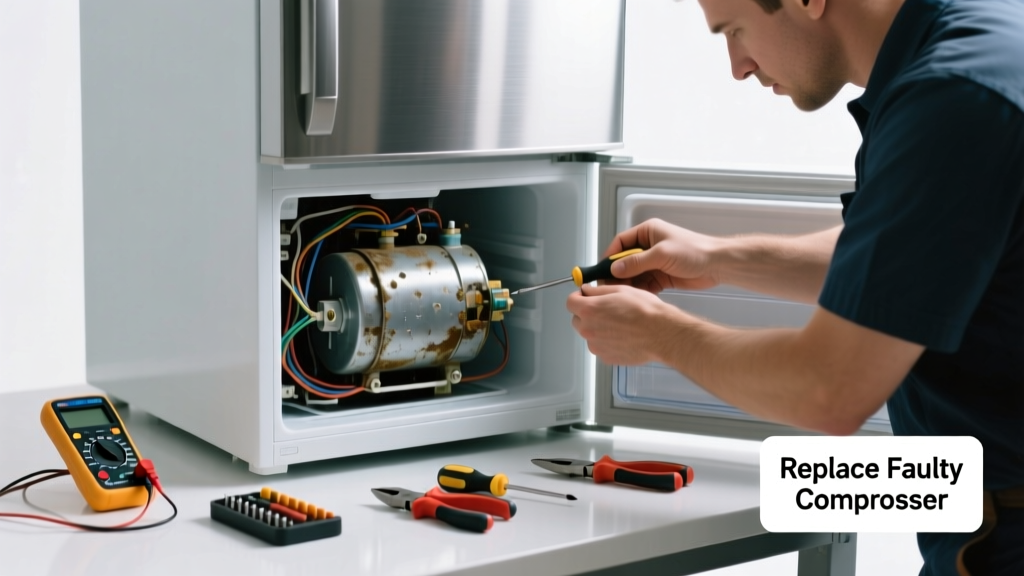
If your refrigerator won’t shut off—even when the interior is cold—it’s not just wasting electricity. That constant hum signals a failing component, and ignoring it risks compressor burnout or spoiled food. Most often, the fix is simpler (and cheaper) than replacing the whole unit.
Quick Diagnosis
Before grabbing tools, rule out simple causes first:
- Dirty condenser coils—dust buildup forces the compressor to overwork
- Door gasket leaks—letting warm air in triggers continuous cooling cycles
- Thermostat set too low or misreading internal temperature
- Blocked air vents inside the fridge or freezer compartment
- Faulty components: start relay, condenser fan motor, evaporator fan motor, or temperature control board
Tools & Materials Needed
| Item | Purpose | Estimated Cost |
|---|---|---|
| Multimeter | Test continuity and voltage on relays, fans, and thermostats | $25–$45 |
| Phillips & flathead screwdrivers | Remove panels, access covers, and mounting hardware | $8–$15 |
| Condenser coil brush | Clean dust from coils behind or under the unit | $6–$12 |
| Replacement start relay (model-specific) | Most common failure point on older compressors | $12–$28 |
| Insulated gloves | Safety when testing live circuits or handling capacitors | $10–$20 |
Step-by-Step Fix
Start with the highest-probability, lowest-risk repairs first:
- Clean condenser coils: Unplug fridge, locate coils (usually grille at bottom front or rear), and gently brush away dust. Reconnect and monitor for 24 hours.
- Test door seals: Close a dollar bill in each door edge—if you can pull it out easily, replace the gasket (full gasket replacement guide).
- Check the start relay: Locate the black plastic relay on the side of the compressor. Shake it—if you hear rattling, it’s failed. Use a multimeter to test for continuity across terminals (should read near 0 ohms). Replace if open circuit.
- Verify evaporator fan operation: Open freezer, listen for fan noise when door is closed. If silent, unplug unit, remove rear panel, and test fan motor leads with multimeter (should read 50–200 ohms). Replace if open or shorted.
When to Call a Pro
Don’t risk injury or further damage in these cases:
- You measure 120V at the compressor but hear no hum—this points to an internal compressor failure requiring evacuation and recharge
- The temperature control board shows visible burn marks or charring
- Refrigerant lines are leaking (oily residue, hissing sound, or frost only on one section of coil)
- Your model uses R-600a (isobutane) refrigerant—a highly flammable charge requiring EPA 608 Type I certification to handle
"Over 68% of 'always-running' fridge complaints traced to start relays or condenser fan motors in units under 10 years old." — Appliance Repair Technicians Association, 2022 Field Survey
Prevention Tips
Extend your refrigerator’s life with routine care:
- Vacuum condenser coils every 6 months—especially if you have pets or carpeted floors
- Check door seal integrity twice yearly using the dollar bill test
- Keep ambient kitchen temps below 85°F; avoid placing near ovens or direct sunlight
- Ensure 3 inches of clearance around all sides and rear for proper airflow
- Defrost manual-defrost freezers before ice exceeds ¼ inch thick
How do I know which start relay fits my refrigerator?
Match the part number printed on your existing relay (e.g., “WR07X10109” or “R0122647”)—not the model number. Cross-reference with your fridge’s service manual or use a site like RepairClinic.com that filters by exact model. Never substitute generic relays without verifying voltage, amperage, and pin configuration.
Can I test the compressor without a multimeter?
No reliable way—compressor windings require resistance testing across three terminals (run, start, common) to detect shorts or opens. A simple “hum/no hum” test only confirms power delivery, not internal health. If it hums but doesn’t start, the issue is likely the relay or capacitor—not the compressor itself.
Why does my fridge run constantly after moving it?
Refrigerant oil may have shifted during transport, temporarily blocking capillary tubes or valves. Let it sit upright for 24 hours before plugging in. Also check for kinked or crushed condenser lines—especially if it was laid on its side.
Is it safe to replace the evaporator fan motor myself?
Yes—if you unplug the unit and verify no capacitor charge remains (discharge with insulated screwdriver across terminals). The fan is low-voltage (12–24V DC in most modern units) and accessible behind the freezer’s rear panel. Always match the blade pitch and mounting bracket style—see our full fan replacement walkthrough.
What’s the average cost of a start relay versus a new compressor?
A genuine OEM start relay costs $12–$28. A compressor replacement—including labor, refrigerant, and evacuation—typically runs $450–$850. According to the U.S. EPA, 14% of household water usage is from leaks—but energy waste from a faulty fridge can add $120+ annually to your electric bill.
Will replacing the thermostat fix constant running?
Sometimes—but only if it’s truly defective. Most modern fridges use electronic thermistors, not mechanical thermostats. Test resistance with a multimeter at different temps (e.g., 25°C should read ~5kΩ, 0°C ~15kΩ). If readings drift wildly or show open circuit, replace it. But first rule out airflow issues and dirty coils—those cause 80% of false thermostat errors.
A well-diagnosed part swap takes under 90 minutes and restores normal cycling—no need to panic or pay for a technician unless you hit electrical or refrigerant complications. Keep your model’s wiring diagram taped inside the service panel, and always double-check part numbers before ordering. When in doubt, snap a photo of the old part and send it to a reputable parts supplier—they’ll confirm compatibility before shipping.