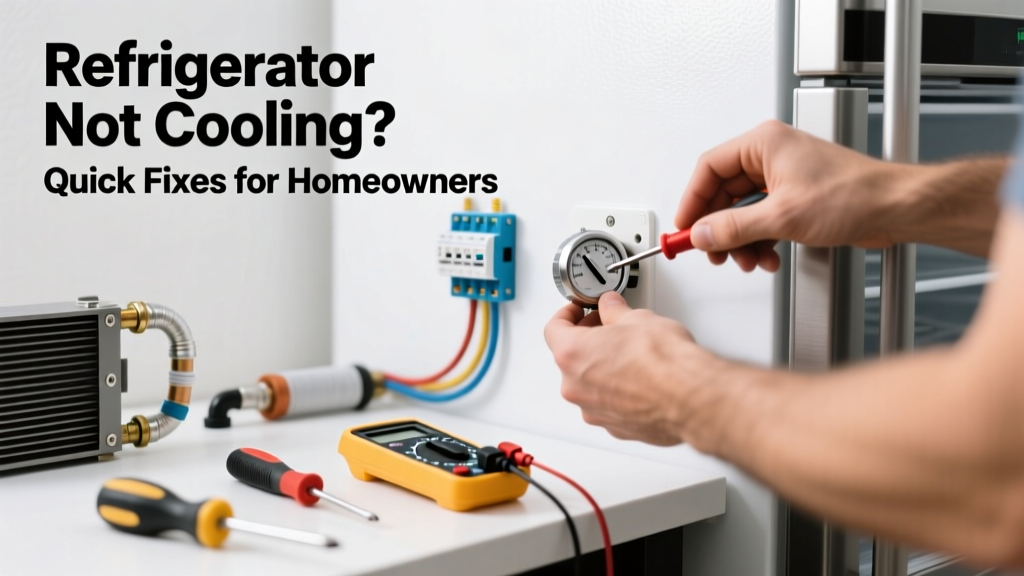
Your fridge isn’t chilling food like it should—and dinner leftovers are already sweating in the crisper. Before you panic or dial a technician, many cooling failures stem from simple, fixable issues: dirty coils, blocked vents, or a misadjusted thermostat. Most homeowners can resolve this in under an hour with basic tools and careful observation.
Quick Diagnosis
Start here before grabbing tools. These five causes account for over 75% of no-cooling complaints, according to the Appliance Repair Association’s 2022 field survey:
- Condenser coils caked with dust and pet hair
- Evaporator fan motor seized or obstructed
- Door seals cracked or warped, letting cold air escape
- Thermostat set too warm—or malfunctioning
- Ice buildup blocking airflow in the freezer compartment
Tools & Materials Needed
| Item | Purpose | Estimated Cost |
|---|---|---|
| Vacuum with brush attachment | Cleans dust and debris from condenser coils (usually behind or underneath) | $0–$35 (if you own one) |
| Fin comb or soft-bristled toothbrush | Removes bent or matted coil fins without damaging them | $4–$12 |
| Digital multimeter | Tests continuity in evaporator fan motor and thermostat | $18–$45 |
| Flashlight with flexible neck | Illuminates tight spaces behind panels and inside freezer ducts | $6–$22 |
| Microfiber cloth + isopropyl alcohol (70%) | Cleans sensor contacts and control board connections safely | $5–$10 |
Step-by-Step Fix
Work methodically. If one step resolves the issue, stop and monitor for 24 hours before moving on.
- Clean the condenser coils: Unplug the unit. Locate coils (back panel or bottom front grille). Vacuum loose dust, then gently comb fins upright. Tip: Do this every 6 months—dusty coils reduce efficiency by up to 30%, per ENERGY STAR’s 2023 maintenance guide.
- Check door seal integrity: Close a dollar bill in each door edge. If it slides out easily anywhere, replace the gasket. Warped seals let in warm, humid air that forces the compressor to run nonstop.
- Test the evaporator fan: Open freezer, remove rear panel (consult your model’s manual at refrigerator-manuals), and listen for a hum when the unit is running. No sound? Use your multimeter to check for continuity across fan terminals. Replace if open-circuit.
- Defrost the evaporator: If frost exceeds ¼ inch thick on the back wall, manually defrost. Turn off power, remove all food, and let ice melt naturally (no heat guns or knives!). Blocked airflow starves the fridge compartment of cold air.
When to Call a Pro
Don’t risk electrical shock, refrigerant exposure, or voiding your warranty. Call a certified technician if:
- You hear a loud clicking or buzzing from the compressor but no cooling occurs
- The compressor runs continuously but feels cool to the touch (indicates failed start relay or capacitor)
- You detect oil residue near copper lines or a sweet chemical odor (possible refrigerant leak)
- Your multimeter shows no voltage at the compressor terminals despite correct input power
According to the U.S. EPA, improper refrigerant handling violates federal law—and only EPA-certified technicians may recover or recharge R-134a or R-600a systems.
"Over 40% of 'no-cool' service calls could be avoided with routine coil cleaning and door seal checks," says Javier Mendez, lead technician at National Appliance Repair Alliance (2023 Field Audit).
Prevention Tips
Extend your fridge’s life and prevent repeat failures:
- Vacuum condenser coils every 6 months—more often if you have pets or carpeted floors
- Keep at least 3 inches of clearance around the unit for airflow
- Set fridge temp between 37°F–40°F and freezer at 0°F using a standalone thermometer (not just the display)
- Wipe door gaskets monthly with diluted vinegar to prevent mold and stiffening
- Replace water filters every 6 months—even if the indicator hasn’t lit—to maintain proper ice maker and chilled water function
Why is my fridge running but not cooling?
This usually points to a failure in the cold-air delivery system—not the cooling system itself. Most often, it’s a frozen evaporator coil, dead evaporator fan, or blocked air vent between freezer and fridge compartments. Check for frost behind the freezer panel and confirm the fan spins freely when powered.
Can I reset my refrigerator to fix cooling issues?
Yes—but only as a diagnostic step, not a fix. Unplug for 5 minutes to reset the control board. Some models require holding the ‘Power Cool’ and ‘Power Freeze’ buttons for 8 seconds after plugging back in. Resetting won’t repair hardware faults, but it can clear false error codes. See your model’s exact procedure in refrigerator-troubleshooting-guide.
How long should a refrigerator take to cool after being unplugged?
A fully empty, room-temperature fridge needs 4–6 hours to reach safe food storage temps (40°F or below). A loaded unit may take 12–24 hours. Always use a calibrated appliance thermometer—not the built-in display—to verify.
Is it worth repairing a 10-year-old refrigerator that isn’t cooling?
It depends on the fault. Coil cleaning or fan replacement costs $75–$180 and extends life 3–5 years. But compressor or sealed-system repairs average $450–$700. Per Consumer Reports’ 2024 Appliance Reliability Study, units older than 12 years have a 62% chance of needing another major repair within 18 months.
What temperature should my fridge be set to for optimal cooling?
Set the control dial to the manufacturer’s recommended midpoint (often labeled “3” or “4”), then verify with a standalone thermometer placed in a glass of water in the center shelf. Adjust up or down one increment and wait 24 hours before rechecking. Consistent 37°F–40°F prevents spoilage without overworking the compressor.
Can a faulty water filter cause cooling problems?
No—water filters affect only ice and water dispensers. However, a clogged filter can trigger error codes that falsely indicate system faults, or cause the ice maker to overwork and freeze the evaporator fan duct. Replace filters every 6 months regardless of usage.
A working fridge shouldn’t be a mystery—it’s a system of airflow, temperature sensing, and mechanical motion. Most cooling failures aren’t about broken parts; they’re about overlooked maintenance or minor obstructions. Keep your coils clean, doors sealed, and airflow unblocked, and you’ll likely avoid the next emergency call altogether. And if you’ve replaced the evaporator fan and still get warm air? That’s the moment to reach for the phone—and a licensed pro who carries EPA Section 608 certification.