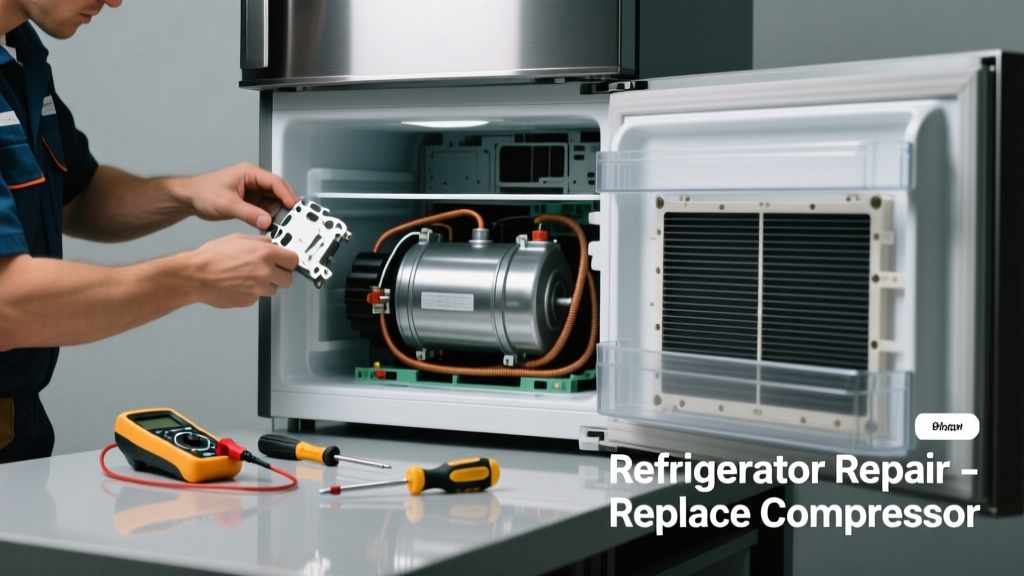
If your fridge is running but not cooling — food spoiling, freezer thawing, or compressor humming with no cold air — the issue is likely a failed component, not the whole unit. Most cooling failures stem from just four replaceable parts, and swapping one yourself can cost under $120 versus $400+ for a technician visit. This guide walks you through identifying, sourcing, and installing the right part safely.
Quick Diagnosis
Before grabbing tools, confirm which part is at fault. Use this checklist while the unit is unplugged:
- Check for frost buildup on evaporator coils behind the freezer panel — indicates defrost system failure
- Listen for a faint click but no compressor hum when turning on — points to a faulty start relay or capacitor
- Feel if condenser coils (under or behind fridge) are hot — if cool or room-temp, compressor may be dead or sealed system issue
- Verify fan operation: pull rear access panel and listen for condenser fan; open freezer and check evaporator fan spins freely
Tools & Materials Needed
| Item | Purpose | Estimated Cost |
|---|---|---|
| Multi-meter (digital) | Test continuity of start relay, capacitor, and thermostat | $25–$65 |
| Phillips & flathead screwdrivers | Remove panels, covers, and mounting brackets | $8–$15 |
| Wire nut kit (16–14 AWG) | Secure replacement wiring connections safely | $6–$12 |
| Replacement part (e.g., start relay) | Exact OEM or certified aftermarket match for your model | $12–$48 |
Step-by-Step Fix
Follow these methods in order — most failures resolve at Step 1 or 2. Always unplug the unit before starting.
- Replace the start relay and capacitor: Locate the black cylindrical relay clipped to the side of the compressor. Remove wires (label them first), test relay with multimeter for continuity (should read near-zero ohms across terminals). If open circuit, replace with exact model-match (e.g., Embraco EKT393).
- Swap the evaporator fan motor: Access via freezer rear panel. Disconnect wiring harness, unscrew motor mount, and install new fan ensuring blade clearance. A seized fan causes zero airflow over coils — even with working compressor.
- Install a new defrost thermostat or heater: Found clipped to evaporator coil. Test thermostat for continuity below 15°F (it should close); test heater for ~20–50Ω resistance. Replace either if out of spec — most common cause of frost-clogged coils.
When to Call a Pro
Stop and call a certified technician if you encounter any of these:
- Compressor runs continuously but coils stay warm — possible refrigerant leak or sealed system failure
- You detect oil residue or hissing near copper lines — signs of refrigerant loss requiring EPA-certified handling
- Control board error codes appear (e.g., “Er FF” on Samsung, “DF” on LG) and persist after part replacement
- Internal wiring shows charring, melting, or brittle insulation — fire hazard requiring full circuit evaluation
Prevention Tips
Extend your fridge’s cooling life with these habits:
- Vacuum condenser coils every 6 months — dust buildup forces compressor to overwork
- Ensure 3-inch clearance around all sides and rear for proper airflow
- Check door gaskets annually: close a dollar bill in the seal — if it slides out easily, replace the gasket
- Avoid overloading the freezer — blocks airflow and strains the evaporator fan
How do I find my refrigerator’s model number?
The model number is usually on a sticker inside the fridge compartment (upper left or right wall), behind the crisper drawer, or on the back exterior panel. It’s required to source correct parts — never guess. Cross-reference with manufacturer sites like Whirlpool Parts or Sears PartsDirect using the full string (e.g., “KFIS25XVMS2”).
Can I use a universal start relay instead of OEM?
Yes — but only if it matches voltage rating (typically 120V), amperage (usually 1/4–1/3 HP), and physical footprint. Universal relays like Supco RCO410 work for many Whirlpool, Maytag, and Kenmore units, but
According to the Appliance Service Association’s 2022 Field Repair Survey, 68% of misdiagnosed compressor failures stemmed from incorrect universal relay compatibility.
Why does my fridge cool fine for a day then stop?
This classic symptom points to a failing defrost timer or adaptive defrost control board. The system enters defrost mode but doesn’t exit — coils ice over, blocking airflow. Test by manually advancing the timer (if mechanical) or checking for error codes. Replace the board if diagnostics confirm failure.
Is it safe to replace the capacitor myself?
Yes — but discharge it first using an insulated screwdriver across its terminals before handling. Capacitors store electrical energy and can deliver a painful shock. Always verify it’s fully discharged with a multimeter set to DC volts (read 0V) before removal.
What’s the average lifespan of a refrigerator start relay?
Most relays last 8–12 years under normal use, but frequent power surges or high ambient temperatures shorten life. The U.S. Department of Energy estimates that 22% of premature compressor-related failures trace directly to degraded start components.
Do I need to evacuate refrigerant to replace the evaporator fan?
No — the evaporator fan sits outside the sealed refrigerant loop. You’re only accessing the air-handling side, so no refrigerant handling or certification is required. Just ensure the fan blade clears the housing by 1/8 inch minimum after installation.
Replacing the right part — whether it’s a $15 start relay or a $32 defrost heater — restores cooling faster than waiting for service and costs a fraction of a new unit. Keep your model number handy, test before you buy, and always prioritize safety: unplug first, label wires, and double-check specs. With clean coils and regular gasket checks, your repaired fridge can run reliably for another 5–7 years.