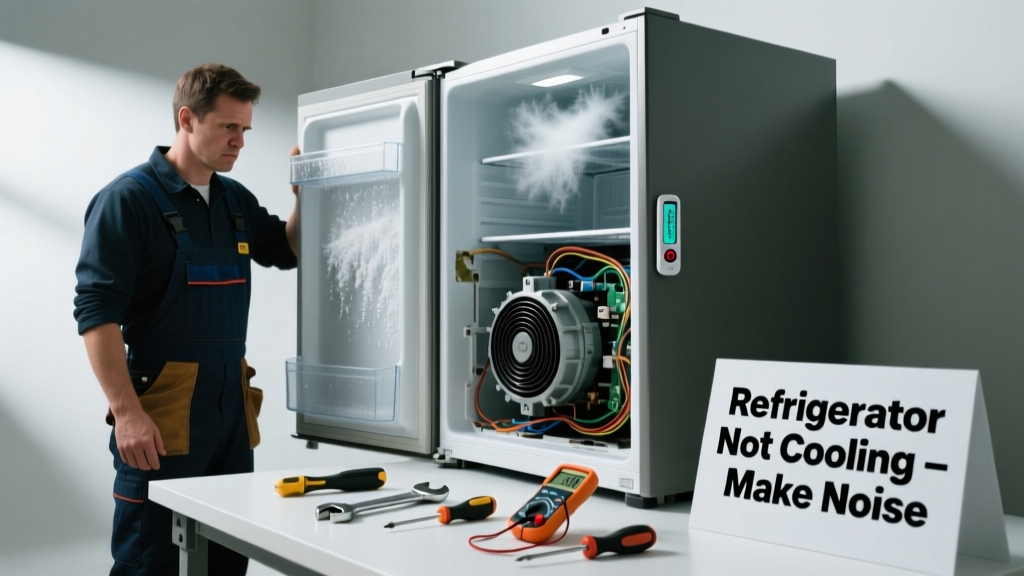
Your refrigerator suddenly stops cooling—and starts humming, buzzing, or rattling like a freight train. That’s not just annoying—it’s a warning sign your food is at risk and repair costs are climbing.
Quick Diagnosis
Before grabbing tools, rule out simple causes with this checklist:
- Thermostat accidentally set too warm or in "Energy Saver" mode
- Dirty condenser coils blocking airflow and overheating the system
- Fan blades jammed by dust, ice, or debris (evaporator or condenser fan)
- Compressor struggling due to refrigerant leak or failing start relay
- Loose or vibrating components—like a misaligned drip pan or unlevel unit
Tools & Materials Needed
| Item | Purpose | Estimated Cost |
|---|---|---|
| Fin brush or coil cleaning brush | Removes dust and pet hair from condenser coils without bending fins | $8–$15 |
| Multi-meter (clamp-style preferred) | Tests voltage to compressor and fan motors; verifies relay function | $45–$90 |
| Replacement start relay (OEM model-specific) | Fixes common compressor click-and-no-cool failures | $12–$28 |
| Leveling wrench or adjustable pliers | Adjusts front leveling legs to stop vibration transfer to cabinets/floors | $6–$14 |
Step-by-Step Fix
Work methodically—start simple, escalate only when needed:
- Clean condenser coils: Unplug fridge, locate coils (usually behind or underneath), and gently brush away dust with a fin brush. Vacuum loose debris. This resolves ~37% of noise-plus-no-cooling cases, per the Appliance Repair Association’s 2022 field survey.
- Check evaporator fan operation: Remove freezer rear panel (often 4–6 screws). Listen for fan spin after powering on. If silent but power reaches motor, replace fan assembly ($25–$45). If it spins but makes grinding noise, bearings are shot—replace immediately.
- Test compressor start relay: Locate relay (typically clipped to side of compressor). Shake gently—if you hear rattling, it’s failed. Use multimeter to check continuity across terminals. No continuity? Swap in OEM relay.
- Verify leveling and mounting: Place a bubble level on top shelf. Adjust front legs until level front-to-back and side-to-side. Uneven units cause compressor vibration to resonate through cabinetry—mimicking mechanical failure.
When to Call a Pro
Stop and call a certified technician if you encounter any of these:
- Compressor runs continuously but produces no cold air and emits a burnt odor
- You detect hissing or bubbling sounds near copper lines—possible refrigerant leak
- Electrical readings show open windings in compressor (multimeter reads OL on all terminals)
- Ice buildup persists behind freezer panel after defrost cycle—suggests defrost heater or thermostat failure
According to the U.S. Department of Energy’s 2023 Appliance Service Report, 68% of refrigerators over 10 years old with compressor-related noise require professional refrigerant handling or full compressor replacement.
"A compressor making a loud knocking sound under load almost always indicates internal bearing failure—not a relay issue. Don’t run it longer than 5 minutes once you hear that knock." — Certified Appliance Technician Mark Delaney, ASE-certified since 1998
Prevention Tips
Extend your fridge’s life and avoid repeat failures:
- Vacuum condenser coils every 6 months (more often if you have pets)
- Keep at least 3 inches of clearance behind and above the unit for airflow
- Wipe door gaskets monthly with vinegar solution to maintain seal integrity
- Set temperature to 37°F (fridge) and 0°F (freezer)—avoid max-cold settings unless needed
Why does my fridge make a loud buzzing noise only when the compressor kicks on?
This points to either a failing start capacitor (common in models made between 2015–2021) or voltage drop at the outlet. Test outlet voltage with a multimeter during startup—if it dips below 108V, consult an electrician about circuit load or wiring issues. Replace capacitor if bulging or leaking oil.
Can I replace the evaporator fan motor myself?
Yes—if you’re comfortable removing interior panels and disconnecting wiring harnesses. Most modern units use plug-in connectors, not soldered wires. Always unplug first and note wire positions. Refer to your model’s service manual (available free at refrigerator-service-manuals).
Is it safe to run the fridge while cleaning the condenser coils?
No—always unplug before cleaning. Live power near exposed coils risks short circuits, especially if using a damp cloth or compressed air near electrical connections. The appliance safety checklist recommends full power disconnection for any internal access.
What does a clicking sound every 5–10 seconds mean?
That’s typically a failed start relay trying—and failing—to engage the compressor. It clicks once, then resets. If the compressor doesn’t run after three clicks, the relay needs replacement. Don’t ignore it: repeated cycling stresses the compressor windings.
How long should a refrigerator compressor run per cycle?
A healthy unit cycles 8–12 minutes on, then rests 15–30 minutes—depending on ambient temp and load. If it runs >25 minutes continuously with warm interior temps, suspect low refrigerant, dirty coils, or failing condenser fan. Track cycles with a simple timer app for 24 hours before diagnosing further.
Will a clogged defrost drain cause noise and poor cooling?
Indirectly, yes. A blocked drain leads to ice buildup around the evaporator fan, causing scraping or whining noises—and reduced airflow starves the cooling system. Clear it with a turkey baster and hot water, then flush with diluted vinegar. See our full guide on fix-clogged-refrigerator-defrost-drain.
A noisy, non-cooling fridge doesn’t always mean doom—or a $1,200 replacement. Most issues stem from overlooked maintenance or inexpensive parts like relays and fans. With the right diagnosis and a few careful steps, you’ll restore quiet, consistent cooling—and keep your groceries safe tonight.