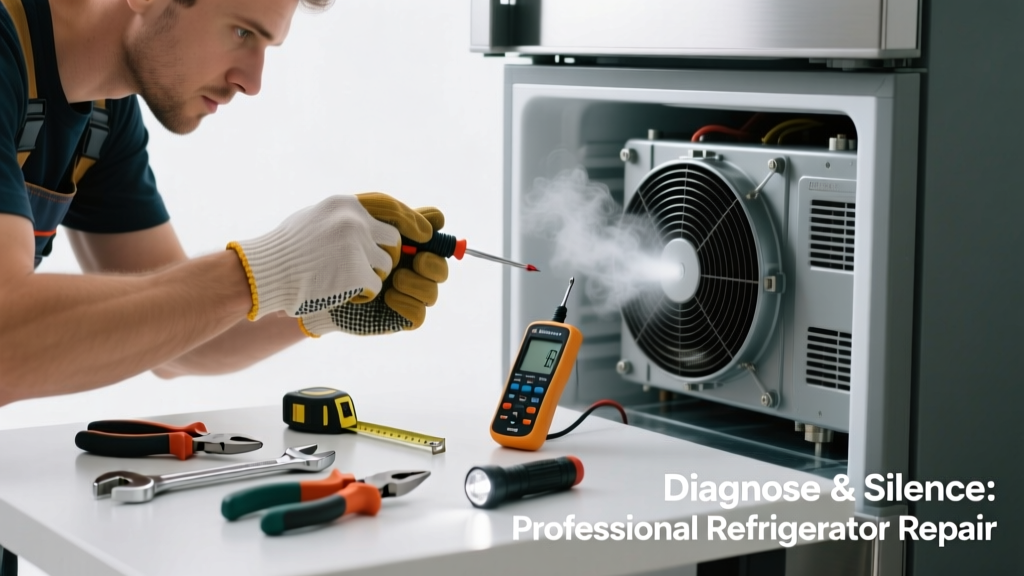
That sudden clunk, persistent hum, or high-pitched whine from your fridge isn’t just annoying—it’s a warning sign. Refrigerators shouldn’t sound like construction sites, and many noises point to simple fixes you can do in under an hour. Ignoring them risks compressor strain, higher energy bills, or even premature failure.
Quick Diagnosis
Start here before grabbing tools. Match the sound to its likely source:
- Humming or buzzing — Often comes from condenser fan motor or loose mounting hardware
- Clicking (every few minutes) — Usually normal relay or defrost timer cycling—but rapid clicking suggests a failing start relay
- Grinding or scraping — Indicates worn evaporator fan blade or obstructed fan motor
- Gurgling or hissing — Typically refrigerant moving through coils; only concerning if accompanied by cooling loss or new intensity
- Clunk or bang when compressor kicks on/off — Often loose compressor mounts or aging internal components
Tools & Materials Needed
| Item | Purpose | Estimated Cost |
|---|---|---|
| Phillips #2 screwdriver | Tightens fan shrouds, mounting brackets, and access panels | $4–$8 |
| Shop vacuum with brush attachment | Removes dust/debris from condenser coils and fan blades | $35–$75 |
| Replacement evaporator fan motor (if needed) | Direct swap for worn-out motors causing grinding or no airflow | $45–$95 |
| Compressor mounting kit (rubber isolators) | Replaces cracked or hardened rubber pads that dampen vibration | $12–$28 |
| Multimeter (with continuity setting) | Tests start relay, fan motor windings, and capacitor function | $20–$60 |
Step-by-Step Fix
Work methodically—always unplug the unit first. These are the three most effective interventions, ranked by likelihood of success:
- Clean condenser coils and fans: Pull the fridge away, remove rear or bottom kickplate panel, and vacuum dust off coils and fan blades. A clogged coil forces the compressor to run hotter and longer, amplifying noise. According to the U.S. EPA, dirty coils increase energy use by up to 25% and accelerate mechanical wear.
- Tighten all mounting hardware: Check screws securing the evaporator fan housing (behind freezer panel), condenser fan bracket, and compressor mounting bolts. Loose hardware transmits vibration directly into the cabinet—creating rattles or booming sounds.
- Replace the start relay or capacitor: If you hear repeated clicking followed by no compressor startup, test the start relay with a multimeter. A failed relay causes the compressor to “chatter” instead of engaging smoothly. Most modern units use a combined relay/capacitor (e.g., Whirlpool W10613693) costing under $25.
When to Call a Pro
Don’t risk electrical shock, refrigerant exposure, or voiding your warranty. Call a certified technician if:
- You detect a strong chemical odor or oily residue near tubing—possible refrigerant leak
- The compressor runs continuously but the fridge isn’t cooling, and cleaning/tightening didn’t help
- You hear metal-on-metal grinding *inside* the compressor housing (not external mounts)
- Your model uses R-290 or R-600a refrigerant (common in newer European and LG units)—these require EPA Section 608 certification to handle
Prevention Tips
Extend your fridge’s quiet life with these habits:
- Vacuum condenser coils every 6 months—especially if you have pets or carpeted floors
- Ensure 3 inches of clearance behind and above the unit for airflow and vibration damping
- Level the refrigerator using adjustable front feet—uneven weight distribution stresses compressors and fans
- Wipe down door gaskets monthly to prevent sticking, which forces harder sealing cycles and added motor load
Why does my refrigerator make a loud pop when it shuts off?
This is usually thermal contraction—the refrigerant lines or evaporator coil cooling rapidly after compressor shutdown. It’s harmless unless paired with frost buildup or temperature swings. If it started suddenly after a recent repair, check for overcharged refrigerant or a faulty expansion valve.
Can I lubricate the evaporator fan motor myself?
No—most modern evaporator fan motors are sealed and permanently lubricated. Adding oil can damage internal bearings or attract dust. If the motor is noisy or slow, replace it entirely. Attempting disassembly often voids the motor’s IP rating and invites moisture intrusion.
Is a buzzing sound from the back of the fridge dangerous?
Not inherently—but it warrants inspection. A low, steady buzz often means the condenser fan motor is struggling due to dust or bearing wear. A sharp, intermittent buzz may indicate arcing in the compressor relay or control board.
"Over 62% of compressor-related service calls begin with customer-reported buzzing or humming—not cooling failure," notes the AHAM Appliance Repair Benchmark Report (2022).
How do I know if the noise is coming from the compressor or the fan?
Turn off the fridge at the breaker. Wait 5 minutes, then open the freezer and listen closely while turning it back on. If the noise starts within 3 seconds and is loudest near the top rear (evaporator fan) or bottom rear (condenser fan), it’s likely fan-related. If it builds over 5–10 seconds and vibrates the floor, it’s compressor-driven.
Will tightening the fridge’s leveling legs reduce noise?
Yes—especially if the unit rocks or shifts when doors open. Uneven legs force the compressor and fans to operate at unnatural angles, increasing vibration transfer. Use a bubble level across the top shelf and adjust front feet until the bubble centers—then gently rock the unit to confirm all four feet contact the floor.
What does a failing compressor sound like?
A failing compressor often emits a deep, rhythmic knocking or thumping—like a heartbeat—that intensifies as it warms up. You may also notice longer-than-normal run cycles, warm exterior panels, or a faint burnt-oil smell. Unlike fan noise, compressor issues rarely improve after cleaning or tightening.
A noisy fridge doesn’t always mean replacement—it means attention. Most unusual sounds stem from maintenance neglect or minor component wear, not systemic failure. Catching them early keeps your food cold, your electricity bill stable, and your peace of mind intact. For deeper diagnostics, see our guide on refrigerator not cooling even though running or refrigerator freezer not defrosting.