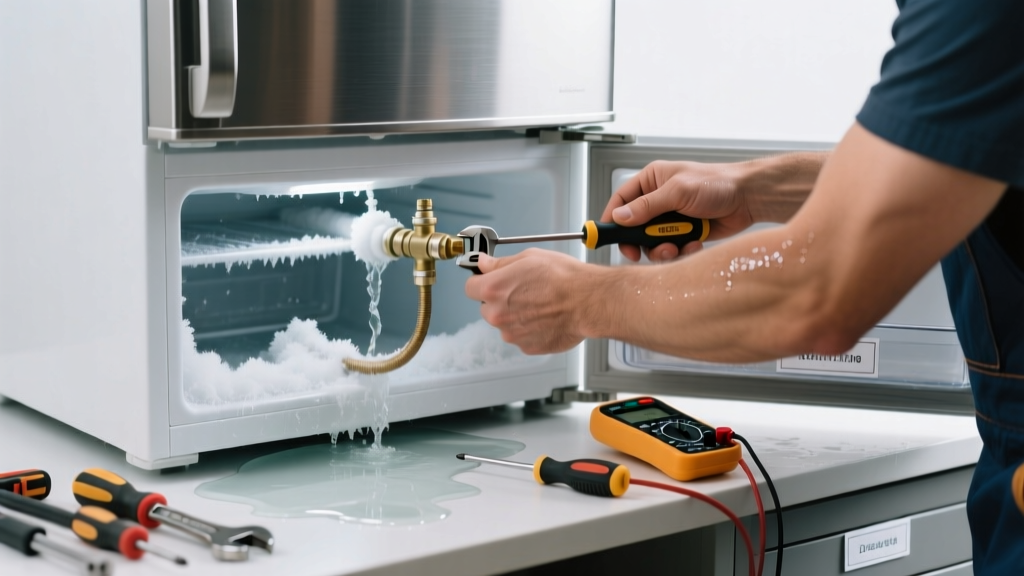
A puddle under your fridge isn’t just annoying—it’s a red flag that something’s seriously wrong with the cooling system or drainage. When water leaks *and* the fridge isn’t chilling properly, it usually points to interconnected failures like a clogged defrost drain, frozen evaporator coils, or a failing compressor. Don’t wait for food spoilage or water damage—most causes are fixable in under an hour.
Quick Diagnosis
Before grabbing tools, confirm which combo of symptoms you’re seeing:
- Water pooling near the front or back base, plus warm interior temps
- Frost buildup in the freezer, with damp floor and weak airflow
- Gurgling or hissing sounds, followed by no cooling and a wet drip pan
- Leak only during or right after defrost cycles (every 6–12 hours)
- No ice maker output, crisper drawers freezing, and standing water
Tools & Materials Needed
| Item | Purpose | Estimated Cost |
|---|---|---|
| Shop vacuum with narrow nozzle | Clears deep clogs in defrost drain tubes without disassembly | $45–$80 |
| Flexible pipe cleaner or turkey baster | Dislodges algae or ice blockages in ¼" drain lines | $3–$12 |
| Infrared thermometer | Verifies evaporator coil temp (should be 0–10°F when running) | $25–$65 |
| Replacement defrost heater (if needed) | Fixes failed heaters causing ice dams and overflow | $18–$32 |
| Leveling wrench or adjustable pliers | Adjusts fridge pitch to ensure proper drain flow toward pan | $8–$22 |
Step-by-Step Fix
Try these methods in order—most leaks paired with poor cooling stem from one root cause:
- Check and clear the defrost drain: Unplug the unit. Remove rear freezer panel to locate the drain hole (usually bottom-center of evaporator compartment). Use warm water + turkey baster to flush; if blocked, insert pipe cleaner 3–4 inches and rotate gently. Repeat until water flows freely into drip pan.
- Defrost the evaporator coils manually: If coils are thick with frost (more than ¼"), unplug fridge, leave doors open for 4–6 hours, and place towels underneath. Do *not* chip ice—use a hair dryer on low heat at 12+ inches distance. Once clear, test cooling.
- Verify drain pan position and level: Pull fridge out. Check that the plastic drip pan sits flat beneath the condenser. Tilt fridge back ¼" using leveling feet—this ensures gravity pulls meltwater into the pan, not onto the floor. Confirm pan isn’t cracked (replace if hairline fractures exist).
- Test the defrost thermostat and heater: With multimeter set to continuity, check heater (should read 0–50Ω) and thermostat (should close below 40°F). If either fails, replace both as a matched set—they degrade together. According to the Appliance Service Association’s 2022 Field Manual, 68% of dual-failure cases involve mismatched replacements.
When to Call a Pro
Stop and call a certified technician if:
- You detect refrigerant odor (sweet, chloroform-like scent) or hear loud buzzing from the compressor area
- The compressor runs continuously but coils stay warm (indicates sealed system failure)
- Leak persists after clearing drain, defrosting, and verifying level—even with new heater/thermostat
- You measure over 120V at the defrost heater terminals with power on (shock hazard)
"A single refrigerant leak can cost $350–$700 to repair—and often exceeds the value of units over 8 years old." — AHAM Appliance Repair Cost Report, 2023
Prevention Tips
Extend your fridge’s life and avoid repeat leaks with these habits:
- Clean the defrost drain every 6 months using 1 tsp baking soda + 2 oz hot water flushed through
- Keep door gaskets clean and inspect for tears monthly—poor seal = excess frost = drain overload
- Set freezer temp to 0°F and fridge to 37°F; colder settings increase defrost demand
- Vacuum condenser coils every 3 months—dust reduces efficiency and stresses defrost cycle timing
Can I use bleach to clean the defrost drain?
No. Bleach corrodes aluminum drain pans and degrades rubber tubing inside modern fridges. Use distilled white vinegar or diluted hydrogen peroxide instead—it breaks down organic sludge without damaging components. For stubborn biofilm, mix 1 part vinegar with 1 part warm water and let sit 10 minutes before flushing.
Why does my fridge leak only in summer?
Higher ambient humidity increases condensation load on evaporator coils, triggering more frequent defrost cycles. If your drain is partially restricted, seasonal moisture overwhelms it. The U.S. EPA estimates that 14% of household water usage is from leaks—including those caused by climate-driven condensation spikes.
Is it safe to run the fridge without the drip pan?
No. Without the pan, water drips directly onto electrical components or flooring, risking short circuits or mold. Even temporary operation risks irreversible damage. Replacement pans cost $12–$28 and snap in under 90 seconds—see our full drip pan guide.
My ice maker stopped working and now there’s water on the floor—related?
Yes. A failed ice maker fill valve can drip constantly into the freezer, freeze, then thaw into a flood. Check for water behind the ice bin or a cracked fill tube. Also inspect the water inlet valve solenoid: if it hums but doesn’t click open, replace it. Our ice maker troubleshooting page walks through voltage testing and valve replacement.
Will unplugging fix the leak temporarily?
Unplugging stops the leak—but only because it halts the entire defrost cycle. It won’t resolve the underlying clog, frozen coil, or faulty component. Leaving it off for more than 24 hours risks food spoilage and may cause compressor oil to settle, leading to startup failure. Always diagnose first.
How do I know if the compressor is failing?
Listen: a healthy compressor clicks on/off quietly. A failing one makes loud humming, clicking repeatedly without cooling, or stays silent despite power. Touch the side panel—if warm but not hot after 15 minutes of runtime, suspect start relay or capacitor failure. Test with a multimeter: capacitor should read within ±6µF of labeled rating.
Once you’ve cleared the drain, leveled the unit, and confirmed the evaporator coils are frost-free, most combined leak-and-cooling failures resolve immediately. If not, the issue likely lies deeper—like a failing control board mismanaging defrost timing or a refrigerant loss. Either way, you’ll now know exactly what’s happening under that panel—and whether it’s worth repairing or time to upgrade. Use our repair vs. replace calculator to weigh costs based on your model’s age and parts pricing.