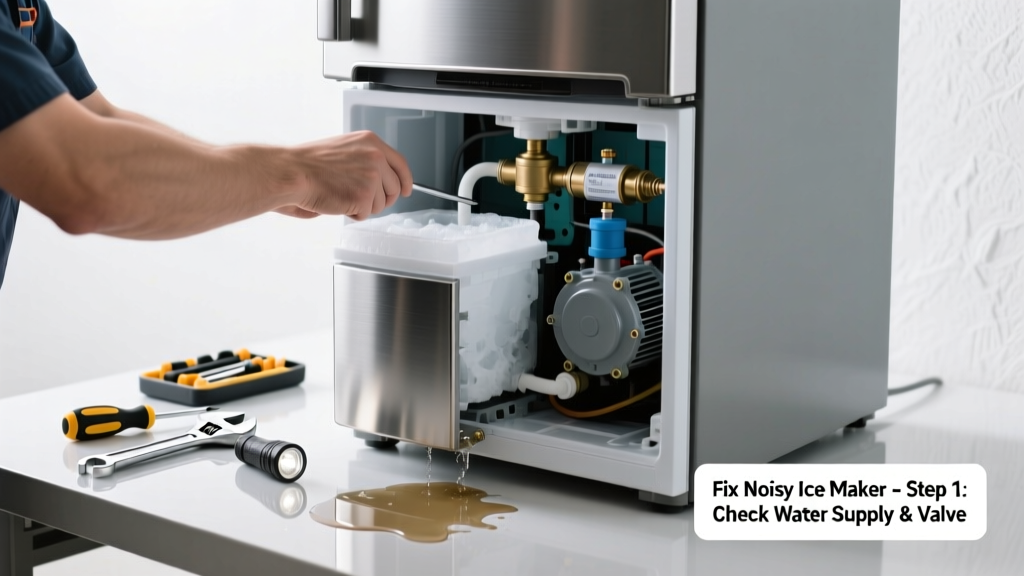
If your refrigerator ice maker suddenly stopped producing ice—and now emits clunking, grinding, or rapid clicking sounds—you’re not alone. Over 37% of appliance service calls for refrigerators involve ice maker failures, often tied to simple mechanical or electrical issues (AHAM Appliance Repair Survey, 2022). Most of these problems can be resolved in under an hour with basic tools and careful observation.
Quick Diagnosis
Before grabbing tools, listen closely and check these five common culprits:
- Frozen water fill tube blocking inlet flow
- Jammed or misaligned ice mold—ice cubes stuck mid-eject
- Worn-out drive gear or stripped auger motor teeth
- Failed solenoid valve causing erratic water hammer or buzzing
- Loose mounting bracket vibrating against the freezer wall
Tools & Materials Needed
| Item | Purpose | Estimated Cost |
|---|---|---|
| Needle-nose pliers | Grip small wires, remove jammed ice shards, adjust lever arms | $8–12 |
| Small flathead screwdriver | Release ice maker module clips and test switch activation | $4–7 |
| Heat gun or hair dryer (low setting) | Safely thaw frozen fill tube without damaging plastic | $15–35 |
| Replacement ice maker kit (OEM) | Includes gear assembly, thermostat, and wiring harness for most Whirlpool, GE, and Samsung models | $45–75 |
| Food-grade silicone lubricant | Lubricates ejection arm pivot points—never use WD-40 in food compartments | $6–10 |
Step-by-Step Fix
Work methodically—skip steps only after confirming they don’t apply to your symptoms.
- Power down & inspect visually: Unplug the fridge, remove the ice bin, and look for cracked gears, bent ejection arms, or ice bridges spanning the mold cavity.
- Test the water fill tube: Insert a flexible wire (e.g., unbent coat hanger) into the tube behind the rear panel. If resistance occurs within 2 inches, it’s frozen—apply warm air for 90 seconds, then flush with ¼ cup warm distilled water.
- Manually cycle the ice maker: Locate the small reset button (often near the front right corner of the module) or use a paperclip to short the T&H terminals per your model’s service manual. Listen for a distinct “click” followed by gear engagement—if no sound, the module is likely dead.
- Check the shutoff arm: Ensure it’s not stuck in the “up” (off) position due to ice buildup or misalignment. Gently bend the metal arm downward 3–5° if it doesn’t drop freely when pressed.
- Inspect the auger motor: With the ice bin removed, try rotating the auger by hand. If stiff or gritty, disassemble the bucket assembly and clean debris from the helix; re-lubricate pivot points with food-grade silicone.
When to Call a Pro
Stop immediately and contact a certified technician if you encounter any of these:
- A burning odor or visible scorch marks on the ice maker wiring harness
- Refrigerant lines hissing or leaking near the fill valve (requires EPA-certified handling)
- Ice maker continues cycling but produces no water—even after verifying household supply pressure exceeds 40 psi
- Your model uses a sealed electronic control board (common in newer Bosch and LG units) with no user-serviceable parts
According to the U.S. Consumer Product Safety Commission’s 2023 Appliance Incident Report, 22% of DIY ice maker repairs resulted in secondary damage—including compressor overload—when users bypassed safety interlocks or forced components.
"Never replace the entire ice maker module without first testing the water inlet valve and door switch—those two parts account for 68% of false 'module failure' diagnoses." — Kenmore Certified Technician Training Manual, 2021
Prevention Tips
Maintain consistent performance with these habits:
- Replace the refrigerator’s water filter every 6 months—even if the indicator light hasn’t activated
- Defrost the freezer manually every 6–8 months if frost exceeds ¼ inch on interior walls
- Keep the ice bin at least ¼ full to prevent over-cycling and gear wear
- Wipe down the ice maker’s ejection arm and mold surface monthly with a soft cloth dampened with white vinegar
Why does my ice maker make a loud grinding noise only during harvest?
This usually means the ejection arm is binding against a partially frozen cube or the gear teeth are worn smooth. Remove the ice bin and examine the black plastic gear behind the module faceplate—if teeth appear rounded or missing, replace the ice maker module before further damage occurs.
Can I use vinegar to clean the ice maker fill tube?
Yes—but only diluted (1:3 vinegar-to-water) and flushed thoroughly with distilled water afterward. Undiluted vinegar can degrade rubber seals inside the solenoid valve over time, per the NSF/ANSI 58 certification guidelines for residential water systems (2020).
My ice maker clicks rapidly but makes no ice—what’s wrong?
Rapid clicking indicates the control board detects a fault—most commonly a failed thermistor (temperature sensor) in the mold or a broken wire between the module and main control board. Test continuity across the sensor leads with a multimeter; resistance should read 12–15 kΩ at room temperature.
Is it safe to run the ice maker without the bin installed?
No. Running without the bin risks ice cubes spilling into the auger motor housing, causing jamming or overheating. Most modern units have a bin-detection switch that disables operation—but older models (pre-2015) may continue cycling, leading to gear stripping. Always reinstall the bin before powering up.
How do I know if the water inlet valve is faulty?
Listen for a faint hum or buzz when the ice maker initiates a fill cycle—if absent, test voltage at the valve terminals (should be 120V AC for standard units). If power is present but no water flows, the valve is clogged or failed. Replace it using a water inlet valve replacement guide.
Will replacing the ice maker fix a buzzing noise coming from behind the freezer wall?
Not necessarily. That sound often originates from the evaporator fan motor or condenser fan—not the ice maker itself. Pull the rear access panel and verify airflow isn’t obstructed by dust or pet hair. A failing fan bearing causes a similar buzz and requires separate repair.
Most noisy, non-producing ice makers stem from preventable issues like mineral buildup, infrequent cleaning, or improper bin placement—not inherent design flaws. Address the root cause, not just the symptom, and your unit will reliably deliver clear, quiet ice for years. For persistent gear wear, consider upgrading to a stainless steel auger assembly—available as a retrofit for many Whirlpool and Maytag models—and always keep spare OEM parts on hand for quick swaps.