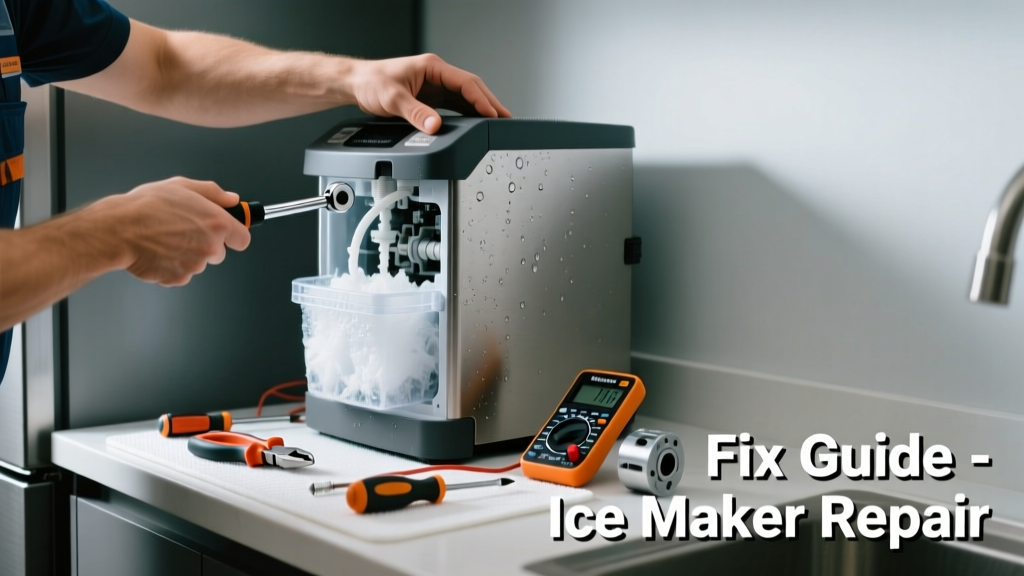
Your ice maker stopped dumping cubes—but the fridge still chills fine. That sudden silence from the freezer compartment is more than annoying; it’s a red flag that something’s off with water flow, power, or mechanical function. Most kitchen ice maker failures aren’t catastrophic—just stubbornly fixable with basic tools and 20 minutes.
Quick Diagnosis
Before grabbing tools, eliminate the obvious culprits:
- The ice maker switch is turned off (often a small lever or button inside the freezer)
- Freezer temperature is above 0°F (−18°C)—ice makers won’t cycle if it’s too warm
- Water supply valve behind the fridge is shut or partially closed
- Fill tube leading into the ice mold is frozen solid (common in older units or after long disuse)
- Ice bin is jammed or overfilled, triggering the auto-shutoff arm
Tools & Materials Needed
| Item | Purpose | Estimated Cost |
|---|---|---|
| Needle-nose pliers | Grip and reposition the shutoff arm or release stuck ice cubes | $8–$15 |
| Small hair dryer or heat gun | Thaw a frozen fill tube without cracking plastic components | $12–$35 |
| Multi-meter (digital) | Test continuity of the water inlet valve and ice maker module | $20–$60 |
| Replacement water filter (if overdue) | Clogged filters reduce pressure below the 20 PSI minimum needed for fill cycles | $15–$30 |
| Food-grade silicone lubricant | Lubricate gear mechanisms in mechanical ice makers (e.g., Whirlpool models) | $6–$12 |
Step-by-Step Fix
Work through these methods in order—they address ~90% of kitchen ice maker failures:
- Reset the ice maker: Turn off the unit at the wall, unplug it, wait 5 minutes, then plug back in. Press and hold the reset button (if present) for 10 seconds—some GE and Samsung models require this to clear error states.
- Check and thaw the fill tube: Locate the thin rubber or plastic tube entering the ice mold (usually near the top rear of the freezer). Gently squeeze it—if rigid, it’s frozen. Use a hair dryer on low heat (never direct flame) for 2–3 minutes while rotating the nozzle.
According to the U.S. EPA’s 2023 WaterSense report, 14% of household water usage stems from leaks—including those caused by cracked or burst fill tubes due to improper thawing.
- Verify water pressure and filter: Replace the water filter if it’s older than 6 months—even if the dispenser works, low pressure may stall the ice maker’s fill cycle. Confirm water pressure at the supply line is ≥20 PSI using a pressure gauge (sold at hardware stores).
- Inspect the shutoff arm: On most Whirlpool, Maytag, and Frigidaire units, a metal or plastic arm must be in the "down" position to signal "ready to make ice." If jammed up by ice or misaligned, gently lower it with pliers—don’t force it.
When to Call a Pro
Stop DIY if you encounter any of these:
- You hear a loud buzzing or humming from the ice maker but no movement—this often signals a failed motor or gear assembly requiring manufacturer-specific parts
- Water pools under the fridge or drips from the freezer ceiling—indicating a ruptured fill valve or cracked water line
- Your multimeter shows no continuity across the water inlet valve terminals *and* voltage at the connector—suggesting a control board fault (common in LG and newer Samsung units)
- The ice maker produces only crushed ice or irregular shapes consistently—points to thermistor or sensor calibration issues beyond field adjustment
Prevention Tips
Extend your ice maker’s life with these habits:
- Replace the water filter every 6 months—not just when the indicator light comes on
- Set freezer temperature between −2°F and 0°F; warmer temps cause slow freezing and jamming
- Empty and clean the ice bin monthly with vinegar-water solution (1:1) to prevent mineral buildup and mold
- Turn off the ice maker during extended vacations (more than 1 week) to avoid stagnant water in lines
- Check the supply valve annually—turn it fully open, then back ¼ turn to prevent seizing
Why does my ice maker work intermittently?
Intermittent operation usually points to marginal water pressure or a failing thermostat inside the ice maker head assembly. If the unit cycles once every 24 hours instead of every 90–120 minutes, test the water pressure first—then inspect the thermostat contacts with a multimeter. A reading outside 0.5–2.0 ohms indicates replacement is needed.
Can I use bleach on the ice maker mold?
No—bleach corrodes stainless steel molds and degrades plastic components. Instead, use a mixture of 1 part white vinegar to 1 part warm water, scrub with a soft nylon brush, and rinse thoroughly with distilled water. For stubborn biofilm, run two empty freeze cycles with vinegar water before resuming ice production. See our guide on clean refrigerator ice maker safely.
Is it safe to defrost the fill tube with hot water?
Not recommended. Pouring boiling or even very hot water risks cracking the brittle plastic or rubber fill tube—especially on models older than 2015. Use a hair dryer on low heat or wrap a warm (not hot) damp towel around the tube for 5 minutes. Always disconnect power before attempting either method.
How do I know if the water inlet valve is bad?
If the ice maker doesn’t fill but the water dispenser works, the valve may still be functional—many units have dual solenoids (one for dispenser, one for ice maker). To test: listen for a faint click when the ice maker initiates a cycle. No click? Check voltage at the valve’s terminals with a multimeter during a cycle. No voltage means a control board issue; voltage with no click means the solenoid is failed. Replacement valves cost $25–$45 and are model-specific—check your serial number against the refrigerator parts finder.
What if the ice maker makes noise but no ice?
This typically means the ejection heater isn’t activating—so cubes freeze solid to the mold and never release. The heater element or its thermostat may be open-circuit. On Whirlpool units, test continuity across pins 1 and 2 on the ice maker module; on LG models, check the “H” terminal on the main control board. If continuity fails, replace the heater assembly ($35–$65) or full module ($85–$140).
Does a clogged drain cause ice maker failure?
No—clogged defrost drains affect freezer cooling and cause frost buildup, but they don’t directly stop ice production. However, excessive frost can insulate the ice maker’s temperature sensor, tricking it into thinking the freezer is too warm. Clear the drain (located under the evaporator coil) if you see frost accumulating on the rear freezer wall or hear gurgling during defrost cycles.
A working ice maker saves time, reduces plastic bag waste, and keeps drinks properly chilled—especially during summer or gatherings. Most fixes take less time than waiting for a service call, and nearly all involve parts under $50. Keep your freezer temp stable, change that filter religiously, and treat the fill tube like a delicate artery—not a pipe to brute-force thaw. You’ll get back those clinking cubes faster than you’d think.