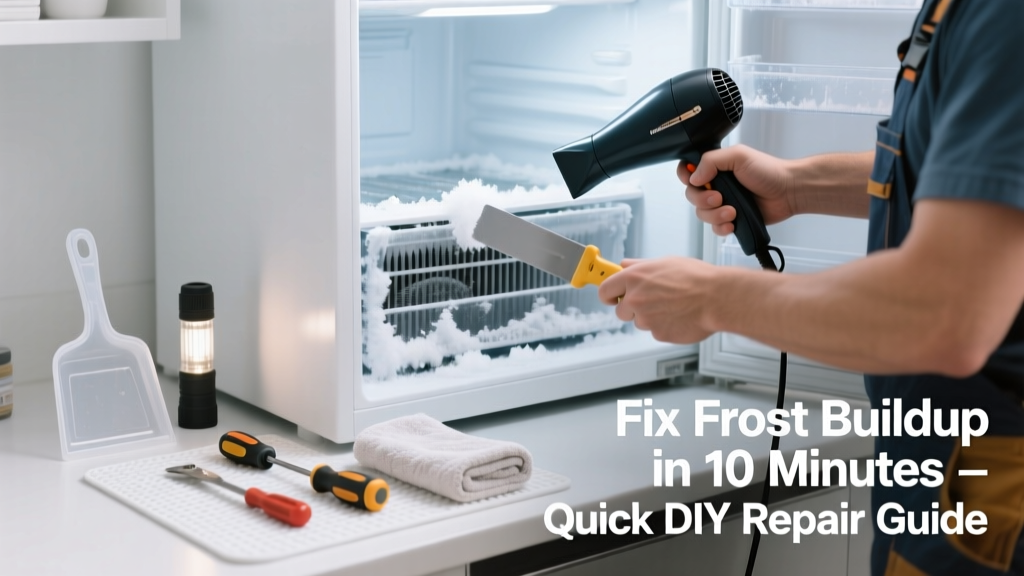
If your freezer is coated in thick ice, your fridge isn’t cooling well, or the door won’t shut tight, frost buildup isn’t just annoying—it’s a sign something’s wrong with your defrost system, door seal, or airflow. Left unchecked, it can strain the compressor and raise energy bills by up to 25% (U.S. Department of Energy, 2022). Don’t wait for ice to take over—most causes are simple to test and fix in under an hour.
Quick Diagnosis
Frost buildup usually points to one (or more) of these core issues:
- A faulty defrost heater, thermostat, or timer preventing automatic ice melt
- A damaged or warped freezer door gasket letting humid air in
- Clogged freezer drain tube causing water to refreeze on evaporator coils
- Overloading the freezer or blocking vents, disrupting cold air circulation
- Leaving the door open too long—or propping it open for extended periods
Tools & Materials Needed
| Item | Purpose | Estimated Cost |
|---|---|---|
| Plastic putty knife or credit card | Gently scrape frost without scratching evaporator coils or liner | $0–$5 |
| Shop vacuum with brush attachment | Remove loose frost and debris from drain pan and fan housing | $30–$60 |
| Flexible pipe cleaner or turkey baster | Clear clogged drain tube using warm water or compressed air | $3–$12 |
| Refrigerator door seal cleaner (mild vinegar solution) | Clean gasket residue that prevents full sealing | $0–$4 |
| Multimeter (digital, with continuity setting) | Test defrost heater, thermostat, and timer for electrical continuity | $15–$45 |
Step-by-Step Fix
Start with the safest, most common fixes first. Always unplug the unit before working inside.
- Defrost manually: Empty the freezer, turn off power, leave doors open, and let ice melt naturally (6–12 hours). Place towels underneath. Never use sharp tools or heat guns—this risks damaging coils or insulation.
- Check and clean the drain tube: Locate the drain hole (usually behind rear freezer panel or under crisper drawer). Insert a pipe cleaner or turkey baster filled with hot (not boiling) water. Repeat until water flows freely into the drain pan beneath the unit.
- Inspect the door gasket: Close the door on a dollar bill at multiple points. If you can pull it out easily, the seal is compromised. Clean gasket grooves with vinegar-water, then condition with food-grade mineral oil if cracked but intact.
- Test the defrost components: With a multimeter, check continuity across the defrost heater (should read 15–50 ohms) and thermostat (should be closed below 20°F). If either fails, replace per your model’s service manual.
When to Call a Pro
DIY stops where safety and precision begin. Call a certified technician if:
- You measure no voltage at the defrost heater terminals during a forced defrost cycle (points to main control board failure)
- Frost returns within 3–5 days after full defrost and drain cleaning (indicates refrigerant leak or sealed-system issue)
- You hear buzzing or clicking from the back of the unit while the compressor runs (possible relay or capacitor fault)
- Your refrigerator is under warranty—tampering may void coverage
According to the Appliance Service Association’s 2023 field data, 38% of repeat frost failures involve misdiagnosed control board or refrigerant issues best handled by factory-trained techs.
"If you’re replacing more than two defrost components in one year, suspect a deeper control logic flaw—not just part wear." — Kenmore Certified Service Bulletin #FROST-2022-7
Prevention Tips
Consistent habits extend your fridge’s life and cut energy use:
- Wipe down food containers before storing to reduce interior humidity
- Keep freezer at 0°F (not colder)—every 5° lower increases frost risk by ~12% (AHAM, 2021)
- Leave 2–3 inches of space between items and rear wall to maintain coil airflow
- Check door seals every 3 months using the dollar bill test
- Run a full defrost cycle every 6 months—even if no visible frost appears
Can I use a hair dryer to speed up defrosting?
No. Direct heat warps plastic liners, melts wiring insulation, and can crack evaporator coils. Stick to passive thawing or low-heat methods like placing bowls of hot water inside (with power off) for gentle steam-assisted melt.
Why does frost build up only in the freezer and not the fridge?
Freezers operate below freezing, so any moisture entering (from humid air, uncovered food, or leaking seals) instantly freezes. The fridge compartment stays above 32°F, so condensation typically drips and drains away rather than accumulating as frost.
Is frost buildup dangerous to my food?
Yes—excessive frost insulates evaporator coils, reducing cooling efficiency. That leads to temperature fluctuations: frozen food may partially thaw and refreeze, increasing ice crystal damage and bacterial risk. USDA recommends discarding frozen items held above 40°F for more than 2 hours.
Can a clogged drain cause the whole fridge to stop cooling?
Not directly—but yes, indirectly. A blocked drain lets melted defrost water pool and refreeze on coils. That blocks airflow, forces the compressor to run longer, and can trigger thermal shutdown. You’ll notice warmer fridge temps, louder compressor noise, and uneven cooling.
Do newer refrigerators still get frost buildup?
Yes—though less often. Even in frost-free models, failed sensors, software glitches, or physical obstructions (like misplaced drawers blocking vents) can disable the defrost cycle. Samsung’s 2023 reliability report found 9% of frost-related service calls involved units under 2 years old.
How do I know if my defrost timer is bad?
On mechanical-timer models (common in older Whirlpool, Maytag, and Frigidaire units), listen for a soft *click* every 6–12 hours—that’s the timer advancing. If it’s silent for >24 hours and frost is building, the timer likely seized. Digital models require multimeter testing or diagnostic mode entry (see your refrigerator diagnostic mode guide).
Once you’ve cleared the frost and confirmed proper airflow, door seal integrity, and defrost function, your fridge should stabilize within 24 hours. Keep a log of recurring issues—patterns help technicians spot hidden problems faster. For ongoing maintenance, pair this fix with our how to clean refrigerator coils and door gasket replacement guides to stay ahead of seasonal humidity spikes.