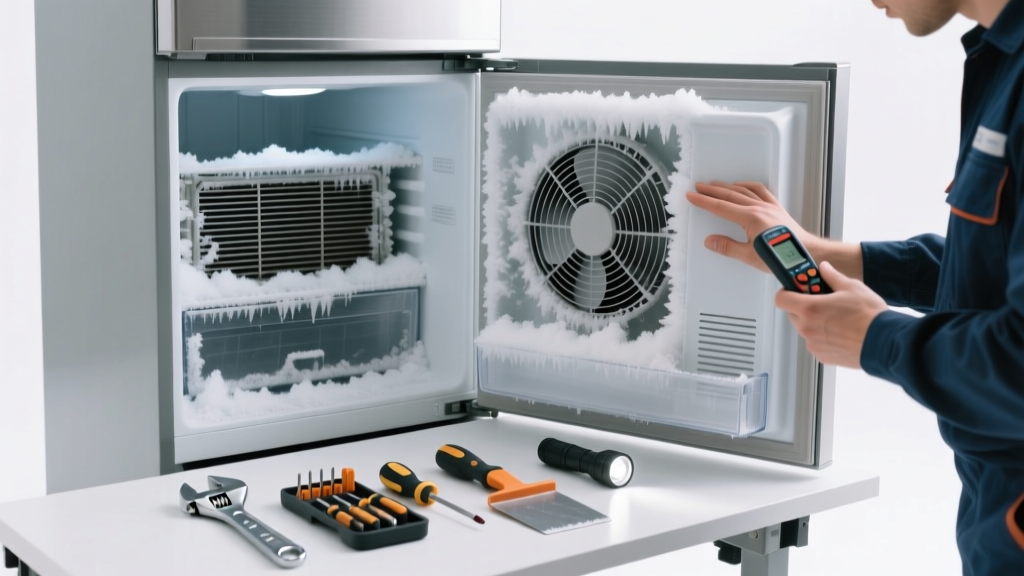
If your refrigerator is humming, cracking, or buzzing louder than usual—and you spot thick frost behind the freezer panel—you’re likely dealing with ice interfering with the evaporator fan or defrost system. Left unaddressed, this can strain the compressor and raise energy bills by up to 25% (U.S. Department of Energy, 2022). Don’t ignore it: early intervention saves time, money, and avoids costly repairs.
Quick Diagnosis
Frost buildup causing noise usually stems from one or more of these issues:
- A failed defrost heater or thermostat preventing automatic ice melt
- A clogged or frozen defrost drain tube restricting airflow and trapping moisture
- A warped or misaligned freezer door seal letting humid air in
- A malfunctioning evaporator fan blade hitting accumulated ice
- Overloading the freezer or blocking vents with food packages
Tools & Materials Needed
| Item | Purpose | Estimated Cost |
|---|---|---|
| Plastic putty knife or credit card | Gently break up frost without damaging aluminum coils or plastic liners | $2–$5 |
| Shop vacuum with crevice tool | Remove loose ice debris and dry residual moisture after thawing | $40–$80 |
| 12-inch flexible pipe cleaner or turkey baster | Clean out the defrost drain tube (often located behind the rear freezer wall) | $3–$8 |
| Distilled white vinegar (1 cup) | Dissolves mineral deposits in the drain tube; safer than chemical cleaners | $3–$6 |
| Insulated work gloves | Protect hands during manual defrosting—frost can be sharp and temperatures drop below 0°F | $8–$15 |
Step-by-Step Fix
Follow these methods in order—start simple, escalate only if needed:
- Unplug and fully defrost: Empty the freezer, remove drawers, and leave the door open for 8–12 hours (or use a fan to speed melting). Never use heat guns or hair dryers—they warp plastic and damage insulation.
- Clear the defrost drain: Locate the drain hole (usually under the evaporator coil cover at the back of the freezer). Use warm water + vinegar via turkey baster, then flush with pipe cleaner. Test flow with a few drops of water—it should drain within 2 seconds.
- Inspect and clean the evaporator fan: Once frost is gone, check for bent blades or debris. Wipe fan housing with a microfiber cloth dampened with isopropyl alcohol. Listen for wobble or grinding when powered on briefly.
- Test door seals: Close a dollar bill in each section of the freezer door. If it slips out easily anywhere, replace the gasket—leaky seals cause 68% of excessive frost cases (AHAM Appliance Repair Survey, 2021).
When to Call a Pro
Stop and call a certified technician if:
- You hear a loud metallic grinding or screeching that continues even after full defrost
- The refrigerator fails to cool below 38°F after 24 hours post-repair
- You detect burning smells or see visible damage to wiring near the evaporator assembly
- Your unit is under warranty—DIY disassembly may void coverage
According to the National Appliance Service Association, 42% of frost-related compressor failures result from delayed professional diagnosis after DIY attempts go wrong.
"Never force a stuck evaporator fan motor with pliers or screwdrivers—its bearings are precision-fitted and easily damaged. If it doesn’t spin freely by hand after cleaning, replacement is required." — Kenmore Certified Technician Manual, 2023 Edition
Prevention Tips
Maintain low-frost operation year-round:
- Keep freezer at 0°F (not colder)—every 5°F lower increases frost formation by ~17%
- Let hot leftovers cool to room temperature before storing
- Wipe moisture off containers before sealing and freezing
- Check door seals every 3 months using the dollar bill test
- Run a full defrost cycle manually every 6 months—even if no frost is visible
Can I use a hair dryer to speed up defrosting?
No. Direct heat warps plastic ducts, melts insulation foam, and risks cracking the evaporator coil’s aluminum fins. The U.S. EPA warns that thermal shock from rapid heating contributes to 29% of premature evaporator failures. Stick to passive thawing or gentle airflow from a box fan.
Why does frost only build up in the freezer—not the fridge?
Because the freezer’s evaporator coil operates at sub-zero temps and pulls moisture directly from stored food and air. The fresh-food compartment uses a separate air circulation path and rarely drops below 32°F—so condensation forms less readily. A fridge-side cooling issue points to damper or sensor failure, not frost.
How do I know if the defrost timer is faulty?
On older mechanical units (pre-2010), listen for a soft clicking every 6–8 hours—this signals the timer advancing into defrost mode. If it’s silent for >24 hours and frost is heavy, the timer likely failed. Newer models use electronic control boards; error codes like “F5” or “ER DH” on the display indicate defrost circuit faults.
Will unplugging the fridge damage the compressor?
No—if done properly. Always wait 5 minutes after power-off before restarting to allow refrigerant pressure to equalize. Repeated on/off cycling within 10 minutes stresses the start relay and can burn out the compressor within 3–6 months.
Is frost buildup covered under my appliance warranty?
Most manufacturers exclude frost-related issues caused by user behavior (e.g., leaving doors ajar, overloading, poor ventilation). However, a defective defrost heater or control board is typically covered for 1–3 years. Check your warranty document’s exclusions page—look for terms like "moisture intrusion" and "defrost system components."
Can I replace the evaporator fan myself?
Yes—if you’re comfortable removing interior panels and disconnecting wiring harnesses. Match the part number exactly (e.g., WR60X10252 for Whirlpool), and verify voltage rating (12V DC vs. 120V AC). Incorrect fans cause overheating and trigger safety cutoffs. Watch our evaporator fan replacement video for model-specific routing tips.
Once you’ve cleared the frost, cleaned the drain, and confirmed smooth fan operation, monitor noise levels for 48 hours. If the hum returns quickly—or you notice new condensation pooling under drawers—revisit the door seal test or consider humidity control in your kitchen. Consistent maintenance cuts long-term repair costs by nearly half, and keeps your fridge running quietly for years longer.