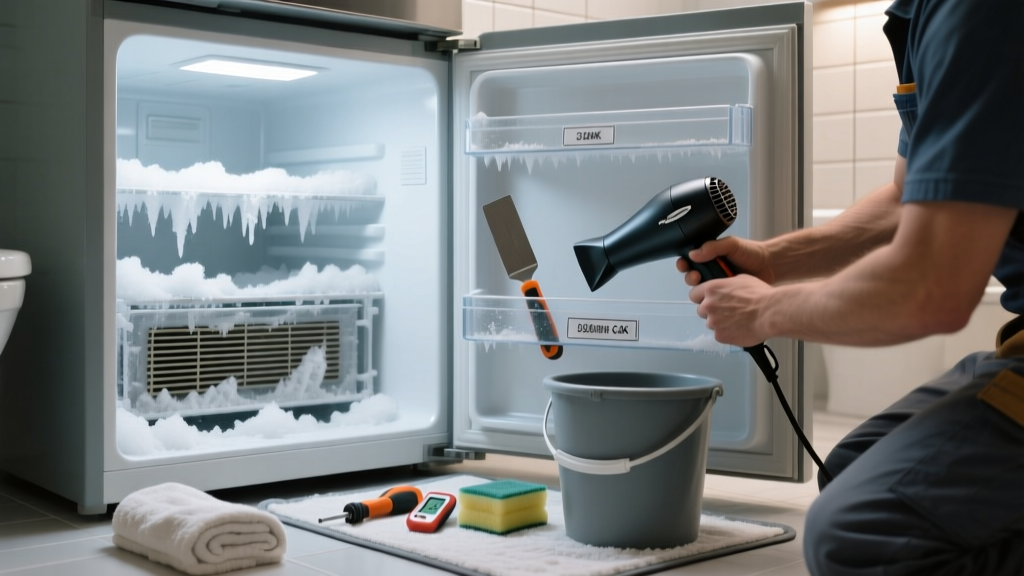
If you've spotted frost or ice forming inside a refrigerator installed in your bathroom, it's not just odd — it's a red flag. Bathrooms are high-humidity zones with frequent temperature swings, making them hostile environments for standard refrigeration units. This isn't normal operation; it's a symptom of mismatched equipment or failing components.
Quick Diagnosis
Frost buildup in a bathroom fridge usually points to one or more of these issues:
- Door seal failure due to steam exposure or warping from humidity
- Ambient humidity exceeding 60% RH — common during showers or poor ventilation
- Incorrect unit type (e.g., using a standard kitchen fridge instead of a built-in or outdoor-rated model)
- Defrost system failure: heater, thermostat, or timer malfunction
- Blocked or clogged defrost drain line, especially if the unit has a freezer compartment
Tools & Materials Needed
| Item | Purpose | Estimated Cost |
|---|---|---|
| Digital hygrometer | Measures bathroom humidity to confirm if RH exceeds 60% — the threshold for safe fridge operation | $12–$25 |
| Microfiber cloths & soft-bristle brush | Cleans condenser coils without scratching; removes dust that traps moisture | $8–$15 |
| Refrigerator door seal cleaner (isopropyl alcohol + water) | Removes soap scum and mineral deposits that prevent proper sealing | $5–$10 |
| Replacement gasket (model-specific) | Required if seal is cracked, brittle, or no longer magnetic | $25–$65 |
| Shop vacuum with crevice tool | Clears defrost drain line of hair, lint, and mildew buildup common in bathrooms | $40–$85 |
Step-by-Step Fix
Follow this sequence — start simple, escalate only as needed:
- Unplug and fully defrost: Empty the unit, remove shelves, and let ice melt naturally (never use knives or heat guns). Place towels and a shallow pan underneath. Takes 4–12 hours depending on frost thickness.
- Clean and inspect the door gasket: Wipe with 70% isopropyl alcohol solution. Check for cracks, gaps, or stiffness. Test seal integrity with the dollar bill test: close the bill in the door — if it slides out easily, replace the gasket.
- Vacuum the condenser coils: Located at the back or bottom grille. Dust-clogged coils reduce efficiency and cause overcooling → frost. Use a shop vac with a soft brush attachment.
- Clear the defrost drain: Locate the drain hole (usually behind crisper drawer or inside freezer wall). Insert a pipe cleaner, then flush with 1 tsp baking soda + 1/4 cup hot water. Repeat until water flows freely into the drain pan.
- Install a bathroom exhaust fan timer: If none exists, add a timer switch (like bathroom exhaust fan timer install) to run 20 minutes post-shower — cutting humidity spikes by up to 45% (ASHRAE Handbook, 2022).
When to Call a Pro
Stop DIY if you encounter any of these:
- Frost returns within 48 hours after full defrost and cleaning
- You hear clicking but no compressor startup — points to failed relay or capacitor
- Refrigerant lines feel warm when they should be cold (indicating low charge or blockage)
- The unit is under warranty — tampering voids coverage on sealed systems
- You detect a chemical odor or oil residue near tubing — possible refrigerant leak
According to the U.S. EPA, 30% of service calls for frost-related failures involve refrigerant leaks or compressor burnout — both requiring certified technicians (EPA Section 608 Certification Manual, 2023).
Prevention Tips
Long-term success hinges on environmental control and maintenance:
- Keep bathroom humidity below 55% RH using an exhaust fan that vents outdoors — not into attic or soffit
- Ensure at least 3 inches of clearance around all sides and rear of the unit for airflow
- Wipe down exterior surfaces daily with dry microfiber cloth to prevent condensation pooling
- Replace door gaskets every 3–5 years in high-moisture areas — they degrade faster than in kitchens
- Use only refrigerators rated for 'indoor/outdoor' or 'built-in' applications — never standard kitchen models (refrigerator installation in bathroom)
Can I use bleach to clean the defrost drain?
No. Bleach corrodes aluminum drain pans and damages rubber seals. Use diluted white vinegar or a baking soda–water mix instead — safer and equally effective against mold and biofilm.
Why does frost form only on the freezer side?
Bathroom humidity infiltrates through compromised door seals, then freezes on the coldest surface — typically the evaporator coil behind the freezer panel. That’s why frost appears first and thickest there.
Will a dehumidifier help?
Yes — but only if sized correctly. A 20-pint portable unit running continuously can cut ambient humidity by 25–30%, reducing frost recurrence. Pair it with exhaust ventilation for best results (bathroom dehumidifier installation).
Is it safe to run a space heater near the fridge to prevent frost?
No. Heat sources disrupt thermostat calibration, increase compressor strain, and risk fire or component failure. It also raises energy use by up to 18% (ENERGY STAR Appliance Guide, 2023).
How often should I clean the condenser coils?
In bathrooms, clean coils every 3 months — not annually like kitchen units. Humidity carries more airborne particles that bond to coils and insulate them.
What’s the ideal bathroom temperature for a fridge?
Between 60°F and 80°F. Below 60°F, the compressor may short-cycle; above 80°F, cooling efficiency drops sharply. Monitor with a digital thermometer hygrometer review.
Fixing frost in a bathroom refrigerator isn’t about brute-force defrosting — it’s about aligning the appliance with its environment. Most cases resolve with better sealing, smarter ventilation, and routine coil care. When those steps don’t hold, it’s rarely the fridge itself — it’s the room asking for smarter climate management.