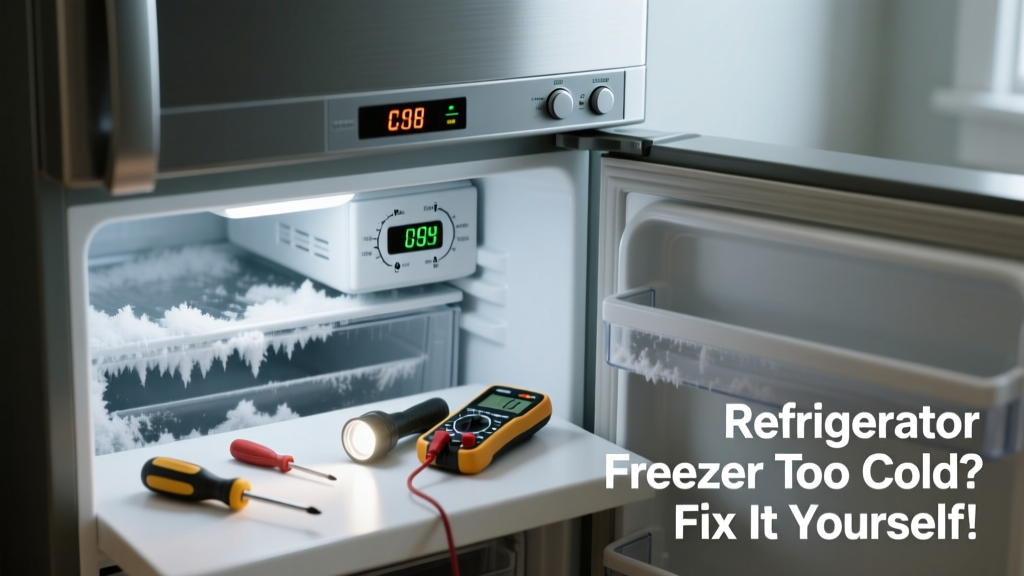
Your freezer is freezing everything solid—including the lettuce in the crisper drawer—and your fridge section feels like a meat locker. That’s not normal operation, and it’s rarely just a thermostat quirk. A refrigerator running too cold usually points to a specific control or sensor failure—not a failing compressor.
Quick Diagnosis
Before grabbing tools, rule out simple causes:
- Thermostat or control board sending incorrect signals to the evaporator fan or compressor
- Faulty thermistor (temperature sensor) in the freezer compartment reading 5–10°F lower than actual
- Stuck-open damper door between fridge and freezer, flooding the fresh food section with cold air
- Defrost system failure causing ice buildup on the evaporator coil, tricking sensors into overcooling
- Incorrect temperature setting—check both controls; some models default to -5°F if reset
Tools & Materials Needed
| Item | Purpose | Estimated Cost |
|---|---|---|
| Digital multimeter | Test thermistor resistance and verify voltage at damper motor | $25–$45 |
| Phillips #2 screwdriver | Remove control panel, evaporator cover, and damper assembly | $8–$12 |
| Small flathead screwdriver | Release plastic clips on control housing and damper housing | $5–$9 |
| Fin comb or soft brush | Clear frost from evaporator coils without damaging aluminum fins | $6–$15 |
| Replacement thermistor (model-specific) | Common failure point; check part number on old unit or use manufacturer lookup | $12–$28 |
Step-by-Step Fix
Start with the most likely culprits—don’t jump straight to replacing the main control board.
- Check and recalibrate temperature settings: Confirm both fridge and freezer dials are set to factory defaults (typically 37°F / 0°F). Wait 24 hours after adjustment before evaluating.
- Test the freezer thermistor: Unplug the unit. Locate the thermistor (usually clipped near evaporator coil or behind rear freezer wall). Use a multimeter to measure resistance—it should read ~10kΩ at 32°F, ~15kΩ at 0°F. If off by >10%, replace it.
- Inspect the air damper assembly: Open the freezer, remove the rear panel, and locate the damper (a small plastic door near the top center). Manually move it—listen for grinding or binding. If stuck open, clean debris and lubricate the pivot with silicone-based grease (never oil).
- Verify defrost cycle function: Check for frost buildup on evaporator coils (behind freezer back panel). If thick frost covers coils, test defrost heater (should read 20–50Ω) and defrost thermostat (should be closed below 15°F). Replace either if failed.
When to Call a Pro
Some issues require specialized equipment or refrigerant handling:
- Compressor running continuously with no temperature change—even after replacing thermistor and damper motor
- Control board showing error codes you can’t clear (e.g., “ER FF” on LG, “F5” on Whirlpool)
- Refrigerant leak confirmed by oil residue or hissing sound near copper lines
- No voltage reaching the damper motor or evaporator fan (points to wiring harness fault or main board failure)
According to the U.S. EPA estimates that 14% of household water usage is from leaks—but for refrigerators, the equivalent waste is energy: a malfunctioning thermostat can increase power draw by up to 22%, per the Appliance Standards Awareness Project’s 2022 efficiency audit.
Prevention Tips
Extend your refrigerator’s life and avoid repeat failures:
- Clean condenser coils every 6 months—dust buildup forces the system to overcompensate
- Keep the door seals clean and inspect for cracks yearly; a torn gasket lets warm air in, confusing sensors
- Avoid overloading the freezer—blocked airflow triggers erratic cooling behavior
- Reset the control board annually: unplug for 5 minutes, then hold “Power Cool + Power Freeze” for 5 seconds on Samsung units (or consult your manual)
Why does my freezer get colder when the fridge is set higher?
This happens when the air damper fails open. The freezer’s cold air flows freely into the fridge, so the freezer thermostat never cycles off—keeping it artificially cold while the fridge warms up. You’ll often hear a faint whirring or clicking from the damper area when this occurs.
Can I bypass the thermistor to test it?
No—bypassing creates false readings and may damage the control board. Instead, simulate its resistance using a precision resistor (e.g., 10kΩ for 32°F) and monitor the display or compressor behavior. Never short the leads.
Is frost in the freezer always a sign of trouble?
No—light, even frost is normal. But if you see thick, white, fluffy frost on the evaporator coils—or ice bridging the back wall to the shelves—that indicates a defrost failure, not excessive cold. That’s a different repair path than thermostat or sensor issues.
How long should I wait after adjusting the temperature?
Allow at least 24 hours for stabilization. Fridges don’t respond instantly—the cold mass in walls and contents buffers changes. Monitor with a standalone thermometer placed in a glass of water in the center shelf.
Will resetting the refrigerator fix a too-cold freezer?
Sometimes—but only if the issue is software-related (e.g., firmware glitch on newer smart models). Resetting won’t fix hardware failures like a broken thermistor or seized damper motor. Most resets require unplugging for 5+ minutes and pressing specific button combos.
What’s the safest way to defrost a frozen damper motor?
Unplug the unit, remove the freezer’s rear panel, and apply a hair dryer on low heat from 12 inches away for 2–3 minutes. Never use boiling water or metal tools—thermal shock or punctured coils will cause permanent damage.
A too-cold freezer isn’t just inconvenient—it stresses components, wastes energy, and risks freezing food beyond safe storage limits. Most fixes take under 90 minutes and cost less than $40 in parts. If you’ve verified the thermistor, damper, and defrost system and still see erratic behavior, it’s time to pull the service manual—or call someone who’s already memorized it. For related help, see our guides on refrigerator not cooling enough and refrigerator making humming noise.