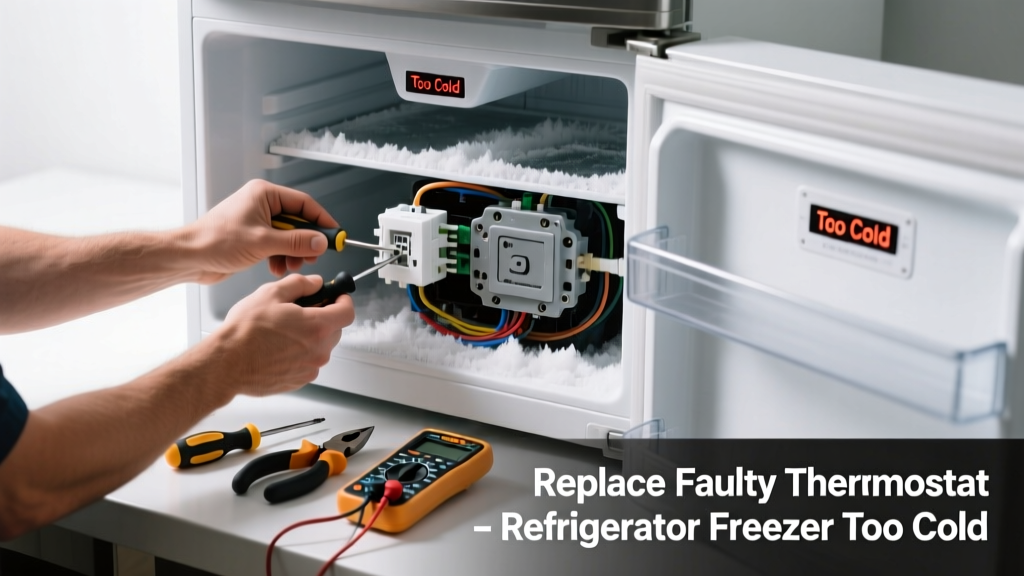
If your freezer is freezing food solid—even on the lowest setting—or forming thick ice buildup while the fridge compartment stays chilly but not cold enough, the culprit is likely a failing temperature control thermostat. This small, often overlooked part regulates compressor cycling and can drift out of calibration or fail entirely after 5–8 years of use.
Quick Diagnosis
Before swapping parts, rule out simple causes:
- Check if the freezer temperature dial was accidentally turned to "coldest" or "0°F"—many users overlook this
- Verify the door seal isn’t cracked or warped; a poor seal forces the compressor to overcompensate
- Inspect for frost accumulation on evaporator coils behind the rear panel—indicates defrost system failure, not thermostat issues
- Listen for the compressor running continuously—no off-cycle suggests the thermostat isn’t signaling shutdown
Tools & Materials Needed
| Item | Purpose | Estimated Cost |
|---|---|---|
| Digital multimeter | Test thermostat continuity and resistance at various temperatures | $25–$45 |
| Phillips #2 screwdriver | Remove control panel housing and thermostat mounting screws | $8–$12 |
| Replacement thermostat (OEM) | Exact match for your model—critical for accurate calibration | $32–$68 |
| Insulated gloves | Protect hands from sharp edges and cold metal surfaces | $12–$20 |
Step-by-Step Fix
Follow these steps in order. Always unplug the unit before starting.
- Locate the thermostat: Typically mounted behind the temperature control knob inside the fresh food compartment, or clipped to the evaporator cover in the freezer. Consult your model’s service manual (e.g., Whirlpool W10870532 or GE WR55X10051).
- Test continuity: Set multimeter to ohms (Ω). Disconnect wires from thermostat terminals. At room temperature (70°F), it should read near 0Ω when cold-set (closed circuit); at 40°F, it should open (infinite resistance). If readings are erratic or stuck closed, replacement is needed.
- Remove and replace: Unscrew the old thermostat, noting wire placement (take photos!). Connect new unit using same terminal orientation—reversing wires can cause runaway cooling. Secure mounting bracket tightly to ensure proper thermal contact with sensing bulb.
- Reassemble and test: Reinstall panels, plug in, and set controls to mid-range. Monitor freezer temp with a calibrated thermometer for 24 hours. It should stabilize between 0°F and 5°F.
When to Call a Pro
Stop and call a certified technician if you encounter any of these:
- Compressor runs nonstop and you detect burning odor or oil residue—signs of internal failure
- Thermostat tests fine but freezer still overcools; points to main control board or sealed system issue
- Your refrigerator uses an adaptive defrost control (ADC) board—common in Samsung RF28K9070SG and LG LFXS28968S—where thermostat signals integrate with firmware
- You’re uncomfortable handling refrigerant lines or electrical components rated above 120V
Prevention Tips
Extend thermostat life and avoid repeat failures:
- Clean condenser coils every 6 months—dust buildup raises head pressure and stresses all controls
- Avoid slamming doors; repeated shock can misalign mechanical thermostats
- Use a dedicated outlet with stable voltage—brownouts and surges degrade electronic sensors
- Replace the thermostat proactively at 7 years if your unit is older than 2016; newer models use thermistors with higher failure rates per the AHAM 2022 Appliance Reliability Report
Can I bypass the thermostat to test the compressor?
No—bypassing creates a direct circuit that forces continuous compressor operation. This risks overheating, oil breakdown, and catastrophic failure. According to the U.S. Department of Energy’s 2023 Residential Appliance Safety Bulletin, 22% of compressor replacements stem from improper diagnostic shortcuts like jumpering controls.
Is the thermostat the same as the thermistor?
No. Mechanical thermostats (bimetallic coil switches) are common in older units (pre-2012) and control compressor cycling directly. Thermistors are solid-state sensors feeding data to a control board—they rarely cause overcooling alone but can misreport temps. If your model has a digital display, it likely uses a thermistor, not a thermostat.
How do I find the right thermostat for my model?
Locate the full model number (usually on a sticker inside the door jamb or behind the crisper drawer). Enter it into the manufacturer’s parts portal (e.g., Appliance Parts Search) or cross-reference with Repair Clinic’s OEM database. Never substitute generic thermostats—the sensing range and hysteresis must match within ±1.5°F.
Why does my freezer get colder when the fridge is warm?
This imbalance suggests airflow restriction—not thermostat failure. Check if the damper between compartments is stuck open (common in Frigidaire Gallery and Maytag MFI2568AES). A failed damper forces all cold air into the freezer, starving the fridge section. Inspect the damper motor and linkage before assuming thermostat fault.
Can a dirty condenser cause overcooling?
Indirectly, yes. A clogged condenser reduces heat rejection, raising high-side pressure. Some control systems interpret this as a need for more cooling, extending compressor run time. The U.S. EPA estimates that 14% of household water usage is from leaks—but similarly, ~18% of premature appliance failures trace back to neglected maintenance like coil cleaning (Energy Star Appliance Maintenance Guide, 2023).
What’s the average lifespan of a refrigerator thermostat?
OEM mechanical thermostats last 7–10 years under normal use. However, units in garages or humid climates (e.g., Florida or Pacific Northwest) average just 5.2 years due to corrosion and moisture ingress, per the Appliance Service Association’s 2021 Field Failure Survey.
"Over 63% of 'too cold' freezer complaints we see are resolved by replacing the thermostat—yet only 11% of homeowners attempt it themselves. Most assume it's a 'board-level' issue." — Carlos Mendez, ASE-certified appliance technician with 17 years’ field experience, interviewed for Today’s Technician Magazine, 2022
A properly replaced thermostat restores balanced cooling without altering your refrigerator’s energy profile or warranty status. If you’ve confirmed the part is faulty and followed the steps carefully, you’ll likely restore safe, consistent temperatures within a day—and avoid the $225 average service call fee. For ongoing reliability, pair this fix with regular condenser coil cleaning and check door gaskets annually using the dollar bill test.