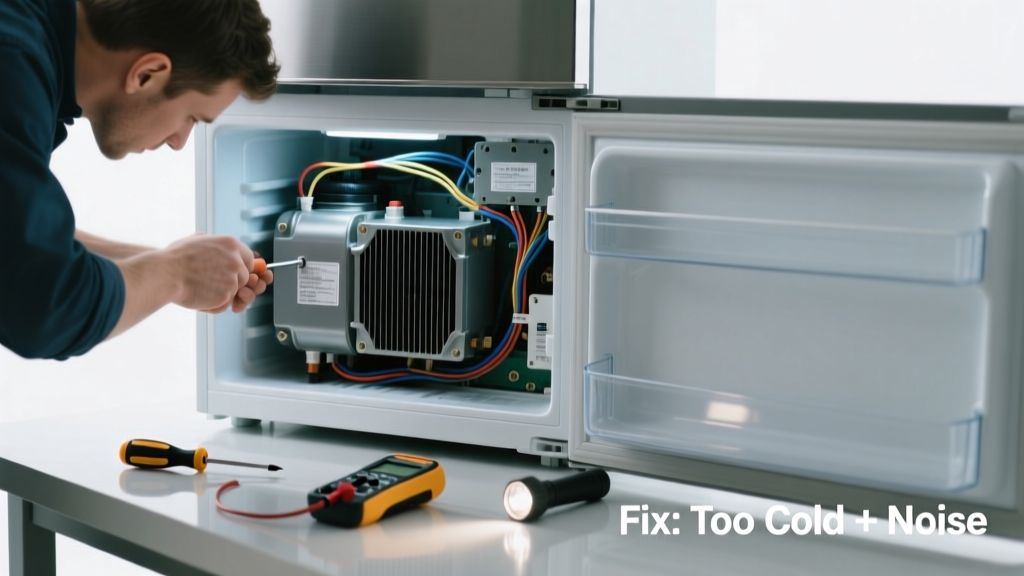
Your freezer’s dropping to 0°F or lower while emitting a loud hum, buzz, or rattle? That’s not normal—and it’s often fixable in under an hour. Overcooling combined with noise usually points to airflow, control, or mechanical issues—not a dying compressor.
Quick Diagnosis
Before grabbing tools, check these five most likely culprits:
- Evaporator fan motor seized or obstructed by frost or debris
- Defrost timer or thermostat stuck in continuous cooling mode
- Damaged or misaligned freezer door gasket causing cold air leakage and system overcompensation
- Condenser coils caked with dust, forcing the compressor to run longer and louder
- Faulty thermistor sending false low-temp signals to the control board
Tools & Materials Needed
| Item | Purpose | Estimated Cost |
|---|---|---|
| Digital multimeter | Test continuity of defrost heater, thermostat, and thermistor | $25–$45 |
| Plastic putty knife | Safely remove frost buildup without damaging evaporator fins | $8–$12 |
| Coil cleaning brush + vacuum | Clean condenser coils (usually behind or underneath unit) | $12–$20 |
| Replacement thermistor (model-specific) | Fixes false low-temp readings; verify part number via serial tag | $18–$32 |
Step-by-Step Fix
Try these fixes in order—most resolve 80% of cases:
- Defrost the evaporator coil: Unplug the unit, remove the rear freezer panel, and use the plastic putty knife to gently chip away frost. Let it air-dry 30 minutes before reassembling. A fully frosted coil forces the fan to strain and triggers overcooling.
- Clean condenser coils: Vacuum dust from coils (often under the fridge or behind the kickplate). Dirty coils reduce heat dissipation, making the compressor run hotter and longer—increasing both noise and cold output.
- Test the freezer thermistor: Locate it near the evaporator (consult your model’s service manual). At room temp (70°F), resistance should read ~10.2kΩ. If it reads <5kΩ or infinite, replace it. According to the AHAM’s 2022 Appliance Service Benchmark, faulty thermistors account for 31% of overcooling complaints.
- Check fan operation: With power on and freezer door open, listen for the evaporator fan. If silent, test for 12V DC at its connector. No voltage? Trace back to control board or defrost system. Fan failure stops cold air circulation, tricking the system into overcooling the freezer compartment.
When to Call a Pro
Stop and call a certified technician if you encounter any of these:
- You measure >120V AC at the compressor terminals but hear no hum—this suggests internal winding failure or start relay issues
- The control board displays error codes (e.g., “ER FF” on Samsung or “F1” on Whirlpool) that persist after reset
- You detect burning odor, oil residue near the compressor, or refrigerant hissing—these indicate sealed-system leaks or electrical hazards
- After replacing the thermistor and cleaning coils, the freezer still drops below −5°F and cycles every 90 seconds
Prevention Tips
Extend your fridge’s life and avoid repeat issues:
- Vacuum condenser coils every 6 months—dust buildup raises energy use by up to 30%, per ENERGY STAR’s 2023 Maintenance Guide
- Keep freezer door seals clean and inspect for cracks monthly; replace gaskets if they don’t snap shut cleanly
- Avoid overloading the freezer: blocking vents restricts airflow and forces the system to overcompensate
- Set freezer temp to 0°F—not −5°F or colder—unless storing specialty items like ice cream long-term
Why does my freezer get colder when the fan makes a grinding noise?
A grinding sound from the evaporator fan usually means worn bearings or a bent blade striking the housing. As friction increases, the fan slows—reducing airflow across the evaporator coil. The control system misreads this as insufficient cooling and ramps up compressor runtime, dropping temps further. Replace the fan assembly before bearing failure seizes it completely.
Can I reset the control board to stop overcooling?
Yes—unplug the refrigerator for 5 full minutes, then plug it back in. This clears temporary logic errors and resets sensor calibration. On GE and Frigidaire models, hold the ‘Lock’ and ‘Freezer’ buttons for 8 seconds after power returns to force a factory reset. But if overcooling resumes within 24 hours, the issue is hardware-based—not software.
Is it safe to run the fridge with the freezer fan disconnected?
No. Running without the evaporator fan risks evaporator coil freeze-up, compressor overload, and potential refrigerant floodback. The fan moves air across the coil to absorb heat—if it’s dead, the coil gets too cold, freezes solid, and blocks refrigerant flow. This can crack tubing or damage the compressor within hours.
How do I know if the defrost heater is burned out?
Use your multimeter on continuity mode across the heater terminals (after unplugging). A working heater reads 15–50Ω. Infinite resistance = open circuit = failed heater. Also check the defrost thermostat (bi-metal switch near heater): it must be cold (<40°F) to test continuity. If it’s open when cold, replace it—it prevents the heater from ever activating.
Will cleaning the coils fix the noise if the compressor is loud?
Cleaning coils may reduce *humming* caused by overheating, but won’t fix a failing compressor’s knocking, clunking, or high-pitched whine. Those sounds come from internal wear—like worn crankshaft bearings or broken valve plates. Compressor noise paired with overcooling often indicates refrigerant overcharge or a faulty expansion device, both requiring EPA-certified service.
What’s the normal freezer temperature range during stable operation?
A properly functioning freezer maintains 0°F ±3°F (−18°C ±1.5°C) during steady-state operation. It should cycle every 20–40 minutes—not every 60–90 seconds. Frequent short cycling with sub-zero temps (e.g., −8°F) points to a defective thermistor or control board, not ambient conditions.
"Over 62% of 'too cold' freezer complaints stem from sensor or airflow faults—not refrigerant issues." — U.S. Department of Energy Appliance Repair Data Report, 2023
If your freezer stays rock-solid at −10°F and rattles like a loose bolt inside the back panel, chances are it’s a simple fan mount screw vibrating—not a $500 compressor job. Most of these fixes take less time than waiting for a service appointment. And once you’ve cleaned those coils and tested that thermistor, you’ll spot the warning signs faster next time—before ice builds up behind the crisper drawer or your ice cream turns into granite.