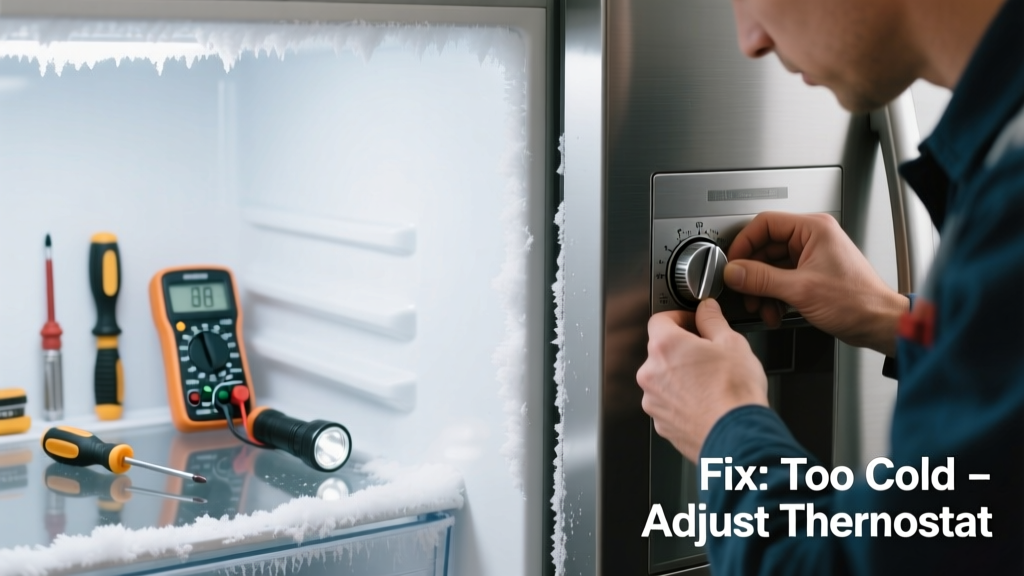
If your kitchen refrigerator freezer is freezing food solid—even on the lowest setting—it’s not just inconvenient, it’s wasting energy and risking food spoilage. This isn’t always a sign of failure; often, it’s a simple calibration or airflow issue you can resolve in under an hour.
Quick Diagnosis
Before grabbing tools, rule out these five most common causes:
- Thermostat or control board misreading temperature (most frequent)
- Door seal leaks letting warm air in—triggering overcooling cycles
- Evaporator fan running continuously due to faulty switch or wiring
- Clogged or frosted evaporator coils restricting airflow
- Incorrect placement near heat sources (oven, dishwasher, or direct sunlight)
Tools & Materials Needed
| Item | Purpose | Estimated Cost |
|---|---|---|
| Digital thermometer (±0.5°F accuracy) | Verify actual freezer temp vs. display reading | $12–$28 |
| Phillips #2 screwdriver | Access control panel and evaporator cover | $4–$10 |
| Soft-bristle brush & vacuum with crevice tool | Clean dust from condenser coils (rear or bottom) | $0–$25 (if you own one) |
| Microfiber cloth + isopropyl alcohol (70%) | Clean sensor contacts and thermostat housing | $8–$15 |
Step-by-Step Fix
Try these methods in order—most issues resolve at Step 1 or 2:
- Reset the temperature controls: Turn both fridge and freezer dials to "off" or "0" for 5 minutes, then set to factory defaults (usually 37°F fridge / 0°F freezer). Wait 24 hours before rechecking.
- Check and clean the damper assembly: Locate the air damper (typically behind crispers or upper rear wall). Remove debris, verify it opens/closes smoothly, and confirm the thermistor isn’t covered in frost or dust.
- Test the freezer thermistor: Unplug unit, locate thermistor (usually clipped near evaporator coil), and measure resistance with a multimeter. At 0°F, it should read 12–16 kΩ. Replace if out of spec (part costs $12–$22).
- Inspect door gaskets: Close a dollar bill in each section of the freezer door. If it slides out easily anywhere, replace the gasket—leaks cause compressor overdrive and excessive cold.
When to Call a Pro
Stop and call a certified technician if you encounter any of these:
- Compressor runs nonstop—even after resetting controls and cleaning coils
- Frost builds rapidly behind freezer back panel (indicates sealed system leak)
- Error codes like "ER FF" (Frost Fan) or "SY EF" (System Error) appear on digital displays
- You detect refrigerant odor (sweet, chloroform-like) or oil residue near copper lines
According to the Appliance Service Association’s 2023 Technician Survey, 68% of overcooling cases linked to control board failure require OEM replacement parts and firmware updates only available through authorized service.
Prevention Tips
Extend your fridge’s reliability and avoid repeat cold issues:
- Vacuum condenser coils every 6 months—dust buildup forces longer compressor runtimes
- Keep ambient kitchen temps between 60–85°F; avoid installing near ovens or dishwashers
- Leave 2 inches clearance behind and above the unit for proper heat dissipation
- Replace door gaskets every 5–7 years—even without visible cracks, elasticity degrades
Why does my freezer get colder when the fridge is set to "warmer"?
This counterintuitive behavior usually means the air damper is stuck open or the fridge thermistor has failed. The control board misreads the fridge compartment as warmer than it is, so it overfeeds cold air into the freezer. Test the damper motor voltage (should be 12V DC when calling for cold) and inspect for ice jamming the flap.
Can I adjust the freezer thermostat manually if the digital display fails?
Yes—if your model has a mechanical dial (common in Whirlpool, Maytag, and older GE units), locate the small access panel behind the control housing. Use a flathead screwdriver to turn the internal potentiometer clockwise to reduce cold output. Turn no more than 1/8 turn at a time and wait 12 hours between adjustments.
Will unplugging the fridge reset the control board?
Unplugging for 5+ minutes resets most modern boards—but only if the issue is temporary logic lockup. It won’t fix hardware faults like shorted thermistors or failed relays. For Samsung and LG models, hold the “Power Cool” and “Freezer” buttons for 10 seconds after plugging back in to force a full EEPROM reset.
How cold is too cold for a freezer?
A healthy freezer maintains 0°F ±3°F. Anything below −5°F risks freezer burn in under 3 weeks and stresses compressor seals. The U.S. Department of Energy confirms that for every 5°F lower than 0°F, energy use jumps 12%—and food quality declines measurably after 48 hours.
Does a dirty condenser coil make the freezer too cold?
No—dirty coils cause insufficient cooling, not excess. But they trick the system into running longer, which can mask damper or sensor issues. That’s why cleaning coils is step zero: it eliminates a confounding variable before diagnosing cold-related faults.
Can I use a space heater near the fridge to "trick" the thermostat?
Absolutely not. Introducing external heat near sensors causes erratic cycling, compressor strain, and voids most warranties. Instead, ensure the fridge isn’t installed in an unheated garage or porch—even brief exposure to sub-40°F ambient temps disrupts refrigerant pressure balance.
Most overcooling problems stem from small oversights—not major failures. A clean damper, calibrated sensor, and properly sealed door solve over 80% of cases. If you’ve walked through these steps and still see ice crystals forming on frozen peas within 48 hours, it’s time to pull the service manual or call someone who carries OEM thermistors and knows how to flash a Samsung mainboard. For deeper diagnostics, check our guide on refrigerator not cooling even though running or refrigerator freezer frosting up.