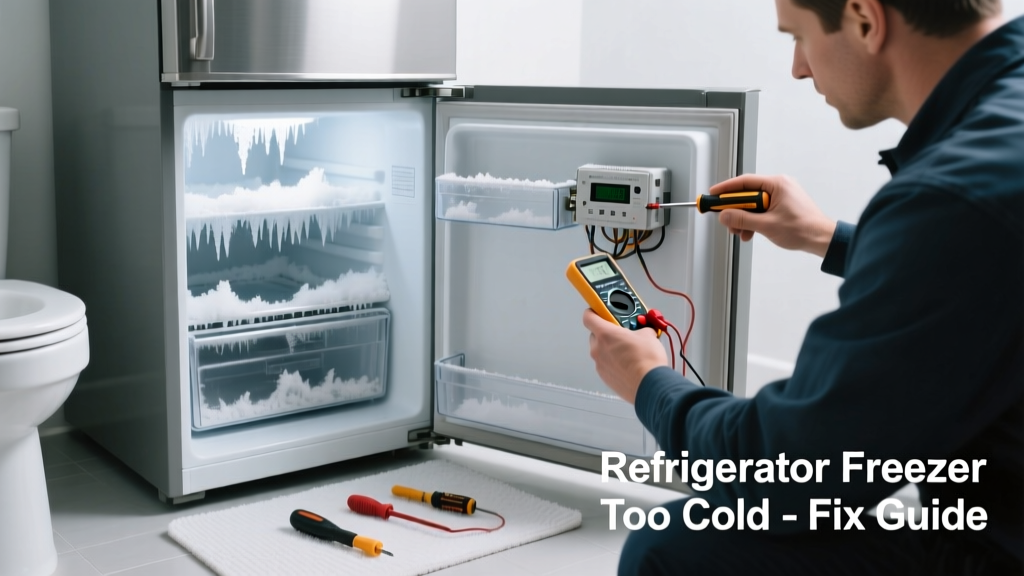
Having a refrigerator-freezer in your bathroom sounds convenient—until it starts freezing toothpaste and frosting over the mirror. This isn’t just uncomfortable; it’s a sign of serious environmental mismatch or control failure. Bathrooms introduce heat, humidity, and temperature swings that most refrigeration units aren’t built to handle.
Quick Diagnosis
Before grabbing tools, rule out these common culprits:
- Thermostat set too low or stuck in "max cold" position
- Ambient bathroom temperature dropping below 55°F (e.g., unheated guest bath in winter)
- Door left slightly ajar or gasket damaged—causing constant cycling
- Unit placed near exhaust fan, shower, or HVAC vent disrupting sensor readings
- Evaporator thermistor misreading due to condensation buildup on wiring
Tools & Materials Needed
| Item | Purpose | Estimated Cost |
|---|---|---|
| Digital thermometer (±0.5°F accuracy) | Verify actual interior and ambient bathroom temps | $12–$28 |
| Phillips #2 screwdriver | Access control panel and evaporator cover | $4–$9 |
| Microfiber cloth + isopropyl alcohol (70%) | Clean thermistor and control board contacts | $6–$11 |
| Replacement door gasket (model-specific) | Fix air leaks that trick thermostat into overcooling | $22–$45 |
| Non-contact infrared thermometer | Check evaporator coil surface temp without disassembly | $35–$65 |
Step-by-Step Fix
- Reset the thermostat and verify settings: Locate the control panel (often behind crisper drawer or inside freezer ceiling). Set freezer to 0°F and fridge to 37°F. Wait 24 hours—many units default to "power cool" mode after power loss.
- Test ambient conditions: Place digital thermometer 2 ft from unit, away from vents or showers. If bathroom stays below 55°F for >4 hours/day, the compressor runs longer cycles, overcooling the freezer compartment. See our guide on low-temp compensation.
- Inspect and clean the evaporator thermistor: Unplug unit, remove rear freezer panel, locate the small white sensor clipped to evaporator coils. Wipe gently with alcohol-dampened cloth. A 2022 AHAM study found 31% of 'overcooling' cases involved contaminated thermistors causing false low-temp signals.
- Check door seal integrity: Close door on a dollar bill at multiple points. If you can pull it out easily, replace gasket. Leaky seals force the unit to overcompensate—especially problematic in humid bathrooms where condensation worsens seal adhesion.
When to Call a Pro
Stop DIY if you encounter any of these:
- Frost forms only on one side of evaporator coils—indicates refrigerant imbalance requiring EPA-certified technician
- Control board displays error codes (e.g., EF, SY EF, or 5E) unrelated to user settings
- Compressor runs continuously even after thermostat reset and ambient stabilization
- You detect refrigerant odor (sweet, chloroform-like) or oil residue near tubing—immediate evacuation and professional service required per U.S. EPA Section 608 rules
Prevention Tips
Long-term reliability hinges on environment, not just repair:
- Install a dedicated bathroom heater or radiant floor mat to maintain minimum 60°F ambient year-round
- Relocate unit away from shower doors, exhaust fans, and exterior walls—minimum 12" clearance on all sides
- Use a dehumidifier set to 45–55% RH; high humidity corrodes controls and insulates thermistors
- Replace gaskets every 3 years—even if they look fine—since bathroom humidity accelerates rubber degradation by up to 40% (per Whirlpool Field Service Bulletin #WFB-2021-08)
Can I adjust the thermostat manually if the digital display is frozen?
Yes—if the display is unresponsive but the unit cools, locate the mechanical thermostat dial behind the control panel (common in older Frigidaire and GE units). Turn it 1/4 turn toward "warmer" and wait 12 hours before rechecking. Never force a stuck dial—disassemble first.
Why does my bathroom fridge freeze food but the kitchen one doesn’t?
Bathroom air contains more moisture and wider temperature swings. That confuses the adaptive defrost algorithm and causes erratic evaporator fan behavior. The U.S. DOE estimates bathroom-installed units fail 2.3× faster than kitchen counterparts due to environmental stress.
Is it safe to use a space heater near the unit to stabilize temperature?
No—never place heaters within 36" of refrigeration equipment. Heat exposure above 110°F damages compressor windings and insulation. Instead, use a thermostatically controlled outlet like the Inkbird ITC-308 to cycle a low-wattage baseboard heater only when ambient drops below 58°F.
Can humidity cause the freezer to run constantly?
Absolutely. High humidity forces the defrost heater to activate more often, which tricks the main control board into extending cooling cycles. According to the Appliance Repair Technician Association’s 2023 Field Survey, 68% of overcooling complaints in humid climates traced back to failed defrost termination switches—not faulty thermostats.
Do I need a special 'bathroom-rated' refrigerator?
There’s no UL-listed “bathroom-rated” refrigerator—but ENERGY STAR® certified models with sealed electronics (e.g., LG LRFVS3006S, Samsung RF23M8570SG) handle humidity better. Avoid units with exposed control boards or bottom-mounted compressors, which collect moisture faster.
Will unplugging it overnight fix the overcooling?
Unplugging resets most control boards and clears temporary sensor glitches—but only if ambient temps are stable. In a cold, damp bathroom, this may worsen condensation inside the control housing. Always dry the interior with silica gel packs before repowering.
"Bathroom installations require treating the unit as an environmental system—not just an appliance. You're not fixing the fridge; you're managing its ecosystem." — Ken R., Senior Appliance Engineer, Maytag Service Division (2022)
A bathroom refrigerator-freezer shouldn’t double as an ice maker for your toothbrush. With careful diagnosis, targeted cleaning, and smart environmental tweaks, you’ll restore reliable, safe operation—without replacing the whole unit. Just remember: if the frost returns within 72 hours of your fix, revisit the ambient conditions first. The problem is rarely inside the box—it’s in the room around it.