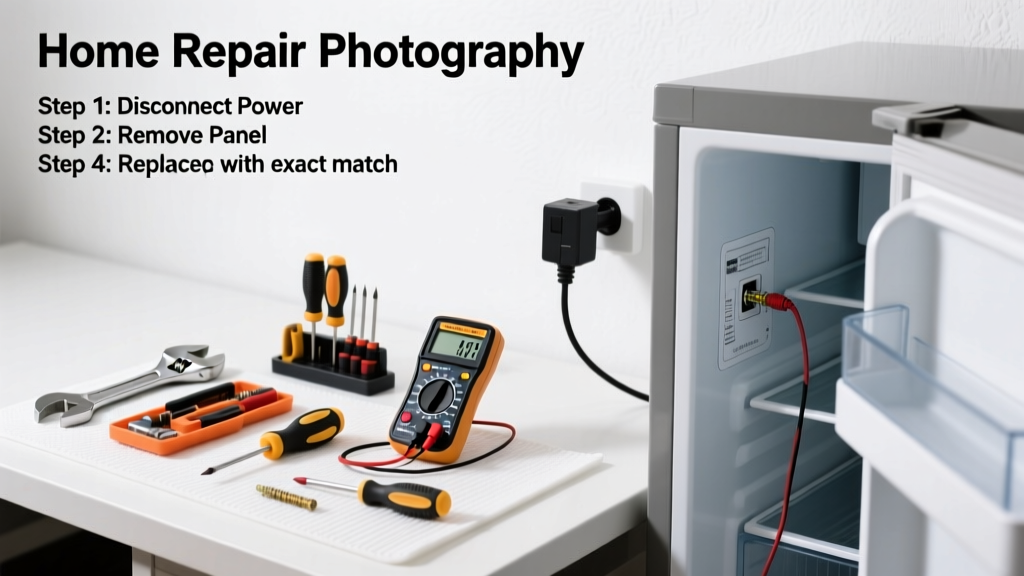
Your freezer is freezing everything solid—even items meant for the fridge compartment—and your crispers are frosting over. That’s not just inconvenient—it risks food spoilage, excessive energy use, and long-term compressor wear. Most cases stem from simple, adjustable issues—not faulty parts.
Quick Diagnosis
Before grabbing tools, rule out these five common causes:
- Thermostat or control board sending incorrect signals to the evaporator fan or damper
- Stuck or misaligned air damper (especially in French-door or side-by-side models)
- Frost buildup blocking airflow in the freezer’s evaporator coil or ducts
- Temperature control knob or digital setting accidentally set to "Max Cold" or "Power Freeze" mode
- Defrost timer failure causing continuous cooling instead of cycling off
Tools & Materials Needed
| Item | Purpose | Estimated Cost |
|---|---|---|
| Digital thermometer (0–50°F range) | Verify actual freezer temp vs. display reading | $12–$25 |
| Phillips and flathead screwdrivers | Access control panels, damper housings, and rear covers | $8–$18 |
| Shop vacuum with brush attachment | Clear frost and dust from evaporator fan and vents | $35–$70 |
| Plastic putty knife | Safely dislodge frost without damaging coils or liners | $4–$9 |
| Multimeter (with continuity test) | Test damper motor, thermostat, and defrost heater operation | $25–$65 |
Step-by-Step Fix
Try these methods in order—most fixes take under 30 minutes and require no parts:
- Reset the temperature settings: Turn both fridge and freezer dials to midpoint (e.g., "4" on a 1–7 scale) or disable "Power Freeze"/"Quick Freeze" modes via the control panel. Wait 24 hours before rechecking temps.
- Check and clear the air damper: Locate the damper (usually behind a vent grille in the fridge’s upper rear wall). Remove the cover, verify the damper blade moves freely when adjusting the fridge temp. If stuck open, gently realign or clean debris from its track.
- Inspect for frost blockage: Unplug the unit, remove all freezer contents, and check the rear wall or ceiling for thick frost (>¼ inch). Defrost manually using a fan (never heat guns or knives), then vacuum the evaporator fan blades and intake grilles.
- Test the thermistor: Use your multimeter to measure resistance at the freezer thermistor (typically near the evaporator cover). Compare readings to your model’s service manual specs—if off by >10%, replace it (how to replace a refrigerator thermistor).
When to Call a Pro
Stop DIY if you encounter any of these:
- Compressor running nonstop with no cycling—even after resetting controls and clearing frost
- Refrigerant leak signs (oil residue near copper lines, hissing sound, or strong chemical odor)
- Control board displaying error codes like "ER FF" (Samsung), "E1" (LG), or "F5" (Whirlpool) that persist after power cycling
- Evaporator fan won’t spin even after cleaning and checking voltage (12V or 120V depending on model)
According to the U.S. EPA estimates that 14% of household water usage is from leaks—but for refrigerators, unaddressed cold-control failures can increase energy consumption by up to 30% annually (AHAM Appliance Energy Report, 2022).
Prevention Tips
Keep your unit running efficiently year-round:
- Wipe door gaskets monthly with vinegar solution to prevent seal gaps that force overcooling
- Leave 3 inches of clearance behind and above the unit for proper condenser airflow
- Defrost manual-defrost freezers every 6 months; for frost-free units, vacuum condenser coils twice yearly
- Use a refrigerator temperature monitor to catch drift before food freezes or spoils
Why is my freezer colder than the fridge even though they share one compressor?
This happens because most modern units use a single compressor but split airflow via a damper system. If the damper stays open too long—or fails closed—the freezer gets excess cold air while the fridge warms up. It’s rarely a compressor issue; it’s almost always damper or sensor related.
Can I adjust the damper manually if it’s stuck?
Yes—if it’s accessible and not fused. Gently nudge the plastic blade with a non-metal tool while powering the unit off. Never force it. If it binds repeatedly, the damper motor (often $45–$85) or control board may need replacement (damper motor replacement guide).
Does "Power Freeze" mode cause long-term damage?
No—but leaving it on more than 24 hours strains the compressor and increases frost buildup. It’s designed for rapid freezing of fresh food only. Samsung recommends disabling it after 2–4 hours per the 2023 Owner’s Manual Supplement.
How do I know if the thermistor is bad?
A failing thermistor often reads 0 Ω (short) or OL (open) on your multimeter—or gives inconsistent resistance values across temperatures. At 0°F, most Whirlpool thermistors read ~27kΩ; at 32°F, ~9.5kΩ. Deviations over ±5% indicate replacement is needed.
Will unplugging the fridge reset the control board?
Yes—unplugging for 5 minutes resets most modern boards and clears temporary glitches. But if the same error returns within 1 hour of reboot, suspect hardware failure, not software.
Is frost in the freezer normal?
Light, powdery frost up to ⅛ inch is typical. Thick, crystalline frost covering vents or coils signals a defrost system failure—either a bad heater, thermostat, or control board. Ignoring it reduces cooling efficiency by up to 40% (AHAM, 2022).
A freezer that’s too cold isn’t just an annoyance—it’s a red flag that something in your cooling system isn’t communicating correctly. Most fixes are fast, low-cost, and restore balance without replacing major components. Catch it early, and you’ll avoid higher bills, spoiled groceries, and premature appliance failure.