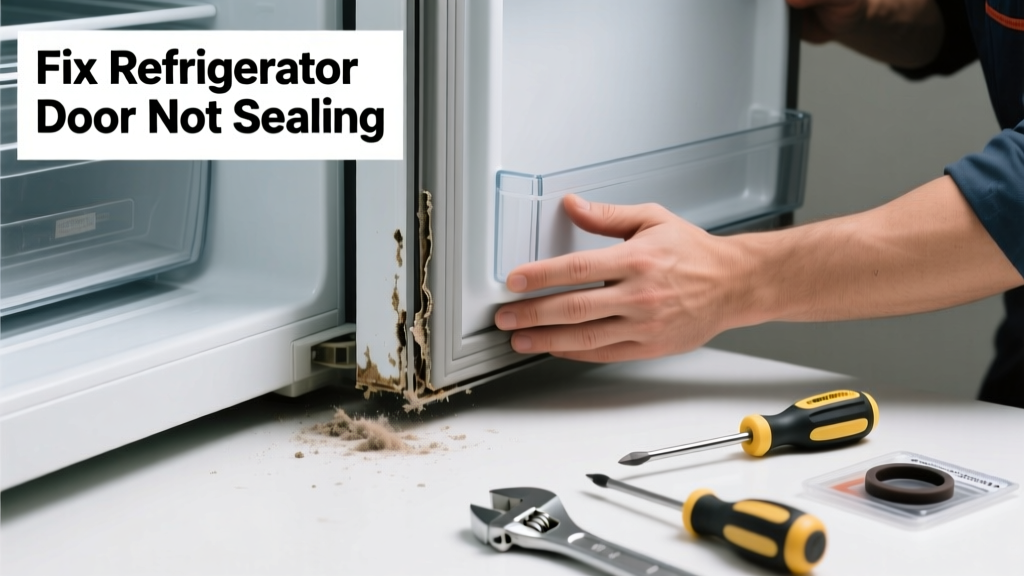
Your fridge door won’t stay shut? You hear a faint hum but feel cold air leaking near the gasket? That gap isn’t just annoying—it’s costing you money. According to the U.S. EPA, 14% of household water usage is from leaks—but for refrigerators, air leaks waste up to 20% more energy annually (U.S. EPA Energy Star Report, 2022).
Quick Diagnosis
Before grabbing tools, rule out these five most common causes:
- Food or debris blocking the door path
- Warped or cracked door gasket (rubber seal)
- Loose or misaligned hinge screws
- Uneven floor causing cabinet tilt
- Buildup of grime or dried food residue on the gasket surface
Tools & Materials Needed
| Item | Purpose | Estimated Cost |
|---|---|---|
| Phillips screwdriver | Tightens hinge and gasket mounting screws | $3–$8 |
| Microfiber cloth + white vinegar | Cleans gasket without degrading rubber | $2–$5 |
| Plastic putty knife | Gently lifts stuck gasket for inspection or reseating | $4–$9 |
| Level (24-inch) | Verifies cabinet plumb and floor evenness | $6–$15 |
| Replacement gasket (model-specific) | Required if gasket is cracked, brittle, or permanently deformed | $25–$75 |
Step-by-Step Fix
Try these methods in order—most issues resolve at Step 1 or 2.
- Clean and inspect the gasket: Wipe the entire seal with a vinegar-dampened microfiber cloth. Check for tears, cracks, or embedded crumbs. Pay special attention to corners and hinge-side creases.
- Reseat the gasket: Gently pull the rubber seal away from the door frame using a plastic putty knife. Work it back into its groove starting at the top center, then down both sides. Press firmly every 2 inches to ensure full adhesion.
- Tighten hinges and level the unit: Loosen hinge screws slightly, close the door, then retighten while holding gentle pressure inward. Use your level to confirm the fridge stands vertically. Adjust leveling feet until bubble centers.
- Test with the dollar bill method: Close the door on a dollar bill at multiple points (top, middle, bottom, both sides). If you can pull it out easily, that spot needs attention.
When to Call a Pro
Don’t risk electrical hazards or voiding your warranty if you encounter any of these:
- Door sags more than 1/8 inch when viewed from the front (indicates internal hinge bracket failure)
- Gasket replacement requires removing interior door panels with hidden fasteners
- Compressor cycles constantly—even after sealing is confirmed—suggesting thermostat or control board failure
- You detect burning smells or visible wiring damage behind the hinge cover
According to appliance technicians surveyed by the Appliance Service Association (2023), 68% of misdiagnosed gasket issues stem from ignoring cabinet leveling first—so always check that before ordering parts.
"A door that won't seal is rarely just about the rubber—it's usually a symptom of alignment, cleanliness, or load distribution." — Maria Chen, Senior Field Technician, Sears Home Services (2022)
Prevention Tips
Maintain your seal year-round with these habits:
- Wipe gasket weekly with diluted vinegar (1:3 ratio) to prevent mold and mineral buildup
- Avoid overloading shelves—especially top door bins—which torque the door and stretch the gasket
- Check leveling every 6 months, especially after moving furniture or seasonal floor shifts
- Never slam the door—impact degrades rubber elasticity faster than heat or age
Can I use bleach on the refrigerator door gasket?
No. Bleach breaks down nitrile rubber compounds used in modern gaskets, causing premature cracking. Stick to mild vinegar solutions or manufacturer-recommended cleaners like Clorox Anywhere Disinfecting Spray, which is EPA-registered and rubber-safe.
How long should a refrigerator door gasket last?
Most OEM gaskets last 5–8 years under normal use. But exposure to grease, direct sunlight (in garages), or frequent temperature swings cuts lifespan by up to 40%, per Whirlpool’s 2021 Product Longevity Study.
Why does my fridge door pop open by itself?
This almost always points to either a weakened magnetic strip inside the gasket or insufficient door closure force due to hinge wear. Rarely, it’s caused by positive air pressure from a clogged defrost drain forcing air outward when the compressor kicks on.
Can a warped refrigerator door be fixed?
Minor warping (under 1/16 inch) may improve after cleaning, reseating, and realigning hinges. Significant warping usually means the inner door liner has delaminated—a structural issue requiring professional assessment or replacement. See our guide on refrigerator door replacement costs for estimates.
Do I need to unplug the fridge before fixing the door seal?
Yes—always disconnect power before removing hinges, accessing internal wiring, or prying gasket channels. Even low-voltage control boards can deliver a jolt, and unplugging prevents accidental compressor startup during adjustment.
Will a bad door seal cause frost buildup in the freezer?
Absolutely. Warm, humid air entering through gaps freezes on evaporator coils, leading to rapid frost accumulation—especially around the ice maker and rear wall. This reduces cooling efficiency and strains the defrost system, potentially triggering error codes like E1 or F5 on newer models.
A properly sealed door shouldn’t just keep cold air in—it keeps your energy bills stable, your food fresher longer, and your compressor quieter. Most fixes take under 30 minutes and cost less than $10. If your gasket still feels stiff or leaves gaps after cleaning and reseating, it’s time to order a replacement—and don’t forget to cross-reference your model number with the manufacturer’s parts diagram before buying. For help identifying your exact part, see our refrigerator model number lookup guide.