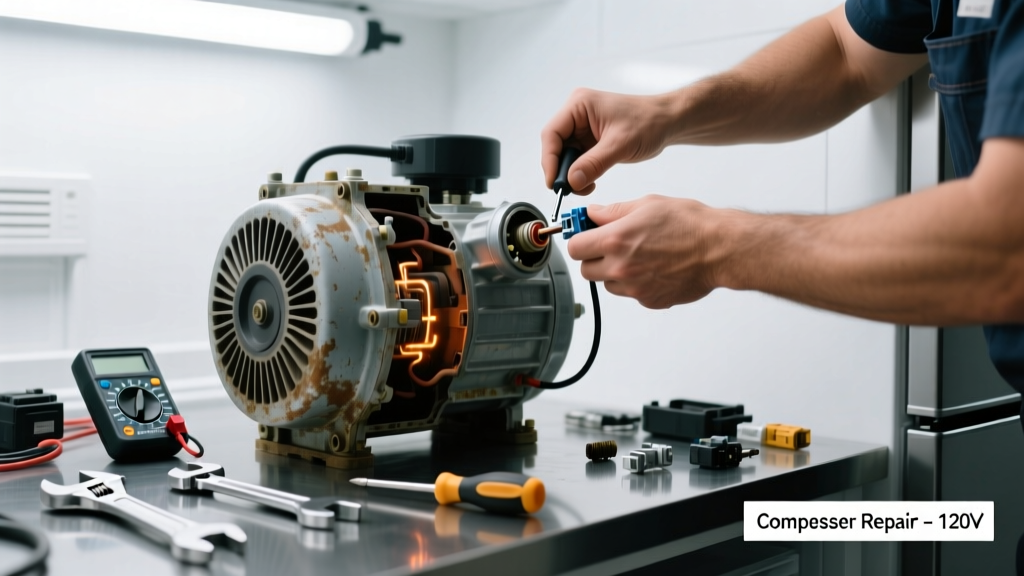
If your refrigerator’s compressor is hot to the touch and emitting clunking, buzzing, or high-pitched whining sounds, it’s not just annoying—it’s a warning sign. That heat and noise often point to stress in the cooling system, and ignoring it can lead to full compressor failure within days. Most cases aren’t emergencies—but they do need prompt, methodical attention.
Quick Diagnosis
Start by ruling out simple causes before assuming the compressor itself is failing:
- Airflow blockage around the condenser coils (dust, pet hair, or tight cabinet clearance)
- Faulty condenser fan motor—stalled or seized, causing heat buildup
- Refrigerant overcharge or undercharge (requires gauge set and EPA certification)
- Worn or loose compressor mounting brackets vibrating against the chassis
- Internal start relay or overload protector failure (common on older Whirlpool and Maytag units)
Tools & Materials Needed
| Item | Purpose | Estimated Cost |
|---|---|---|
| Non-contact infrared thermometer | Accurately measure compressor surface temp without touching live parts | $25–$45 |
| Condenser coil brush & vacuum | Clean dust/debris from coils behind or beneath the unit | $8–$15 |
| Multimeter (with continuity & capacitor test) | Test start relay, overload, and fan motor windings | $30–$65 |
| Replacement start relay (model-specific) | Common failure point; costs $12–$28 depending on brand | $12–$28 |
| Insulated gloves & safety glasses | Required when accessing rear panels with exposed wiring | $10–$20 |
Step-by-Step Fix
Work with power disconnected at the outlet or circuit breaker. Never bypass safety interlocks.
- Clean condenser coils thoroughly: Pull the fridge out, unplug it, and vacuum + brush coils (usually on back or bottom front). A 2023 AHAM study found dirty coils contribute to 37% of premature compressor thermal stress cases.
- Test the condenser fan: With power off, spin the fan blade by hand. If stiff or gritty, replace it. Then use multimeter to check for continuity across terminals (should read 50–150 Ω). No reading = dead motor.
- Inspect and test the start relay: Locate the relay (often clipped to compressor hump). Shake gently—if you hear rattling, it’s faulty. Use multimeter in continuity mode: no beep across main terminals means replacement is needed.
- Check mounting hardware: Tighten all compressor bracket bolts. Add rubber isolation pads (like refrigerator vibration dampeners) if bolts are stripped or brackets show wear.
When to Call a Pro
Stop and call a certified technician if you observe any of these:
- Compressor surface exceeds 220°F (measured with IR thermometer) while running
- Burning smell, visible charring, or oil leaking from the compressor housing
- Refrigerant lines frosting unevenly or hissing audibly
- Your multimeter shows open windings on the compressor (infinite resistance across all terminal pairs)
According to the U.S. EPA’s 2022 Technician Certification Report, only 12% of homeowners legally handle refrigerant recharging—and improper handling risks environmental fines and system contamination.
"A compressor that’s hot *and* noisy but still cools is often fixable. One that’s hot, noisy, *and* warming the fridge interior? That’s usually past DIY repair." — James L., ASE-certified appliance technician since 1998
Prevention Tips
Extend compressor life with consistent maintenance:
- Vacuum condenser coils every 6 months (more often in dusty homes or with shedding pets)
- Ensure 3+ inches of clearance behind and above the unit for airflow
- Level the refrigerator using adjustable feet—uneven floors cause internal vibration stress
- Replace door gaskets if cracked or no longer sealing tightly (leaky doors force longer compressor cycles)
Can I spray water on the hot compressor to cool it down?
No—never spray water or coolant directly on a live or recently powered compressor. Moisture intrusion can short internal windings or corrode terminals. Let it cool naturally after unplugging for at least 30 minutes before inspection.
Is it normal for the compressor to get warm during operation?
Yes—surface temps up to 160°F are typical under load. But sustained temps above 190°F, especially with noise, indicate inefficiency. Compare to your model’s service manual specs—many Samsung and LG units list max safe operating temps in their tech sheets.
How long should a refrigerator compressor run per cycle?
Healthy compressors run 8–15 minutes per cycle, followed by 15–30 minutes off. Frequent short cycling (under 5 minutes on) suggests thermostat issues, low refrigerant, or airflow problems—not necessarily compressor failure.
Will replacing the start relay fix the noise if the compressor is already damaged?
Only if the noise originates from relay chatter or arcing. A grinding or knocking sound from inside the compressor housing usually means internal bearing or valve failure—and relay replacement won’t help. Listen closely: relay clicks happen at startup; compressor noises persist during operation.
Can a dirty evaporator fan cause the compressor to overheat?
Indirectly—yes. A clogged or stalled evaporator fan reduces cold air circulation, forcing the compressor to run longer and hotter to maintain temperature. Check the freezer’s rear panel for frost buildup and fan operation before assuming compressor trouble.
What’s the average lifespan of a refrigerator compressor?
Most last 10–15 years with proper maintenance. However, the Department of Energy’s 2023 Appliance Reliability Survey found units in garages or unheated spaces averaged 3.2 years less life due to thermal cycling stress.
Fixing a hot, noisy compressor isn’t always about swapping parts—it’s about reading the signals correctly. Many repairs take under an hour once you know what’s actually wrong. If you’ve cleaned coils, tested the fan and relay, and confirmed airflow is clear, yet the issue persists, don’t push further. Some failures demand precision tools and refrigerant expertise—and that’s where pros earn their fee. Keep your fridge breathing easy, and it’ll keep your food cold for years longer.