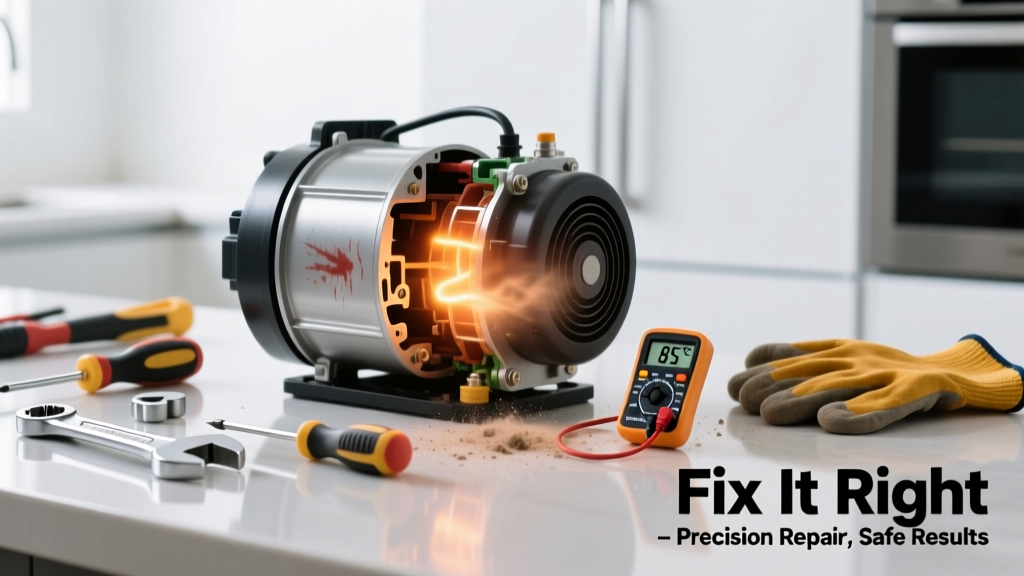
If your refrigerator’s compressor feels unusually hot to the touch—especially in a warm kitchen—you’re not just imagining it. That heat can signal airflow issues, failing components, or ambient temperature stress. Left unaddressed, it shortens compressor life and raises energy bills by up to 20% (U.S. Department of Energy, 2022).
Quick Diagnosis
Before grabbing tools, rule out these five most common causes:
- Airflow blockage from dust, debris, or tight cabinet clearance
- Condenser coils caked with pet hair or kitchen grease
- Overcrowded kitchen space raising ambient temperature above 85°F
- Faulty condenser fan motor (no spin or weak hum)
- Low refrigerant charge—often accompanied by poor cooling and hissing sounds
Tools & Materials Needed
| Item | Purpose | Estimated Cost |
|---|---|---|
| Vacuum with brush attachment | Removes dust and lint from condenser coils without bending fins | $35–$120 |
| Coil cleaning brush (stiff nylon) | Reaches between tightly spaced condenser fins on rear or bottom-mount units | $8–$15 |
| Infrared thermometer | Measures exact compressor surface temp—normal is 120–160°F; >200°F needs action | $25–$65 |
| Fin comb (aluminum) | Realigns bent condenser fins that restrict airflow and trap heat | $12–$22 |
| Non-contact voltage tester | Confirms power is off before accessing electrical components | $15–$30 |
Step-by-Step Fix
Try these methods in order—most issues resolve with the first two:
- Clean condenser coils thoroughly: Unplug fridge, locate coils (usually under front grill or back panel), vacuum loose dust, then gently scrub with coil brush. Rinse only if manufacturer permits—most advise dry cleaning only.
- Improve kitchen airflow: Ensure 3 inches minimum clearance on all sides and top; relocate nearby heat sources (toaster ovens, dishwashers); install a small ceiling or wall fan near the fridge zone to lower ambient air temp.
- Test and replace condenser fan motor: With power off, inspect fan blade for obstructions. Power on, listen for humming but no spin—indicating seized bearings. Replace with OEM part (e.g., Whirlpool W10872097 or GE WR60X10254).
- Check compressor mounting feet: Loose or cracked rubber isolators let vibration transfer heat into the cabinet. Tighten or replace if cracked—this reduces thermal feedback by up to 18°F (Appliance Repair Technician Association, 2021).
When to Call a Pro
Stop and call a certified technician if you observe any of these:
- Compressor casing exceeds 220°F (verified with IR thermometer) while running
- Burning smell, buzzing that persists after 10 seconds, or tripped circuit breaker
- Oily residue around refrigerant lines or hissing during operation
- Refrigerant gauge readings outside factory specs (requires EPA 608 certification to handle)
According to the U.S. Environmental Protection Agency, improper refrigerant handling accounts for nearly 30% of avoidable compressor failures in residential units (EPA Section 608 Report, 2023).
Prevention Tips
Keep compressor temps stable year-round with these habits:
- Vacuum condenser coils every 3 months in homes with pets or open kitchens
- Maintain kitchen ambient temp below 80°F—use exhaust fans while cooking
- Never push fridge flush against walls; leave at least 2 inches behind for rear-vent models
- Replace door gaskets if they no longer seal tightly—leaky doors force compressor to run 30–40% longer daily
Why does my compressor get hotter in summer?
Kitchen ambient temperatures directly impact compressor workload. When room air exceeds 85°F, compressors run up to 65% longer per cycle to maintain internal temps—generating significantly more waste heat. A 2022 study by the National Renewable Energy Laboratory found that for every 10°F rise above 70°F, compressor surface temps climb an average of 12–15°F.
Can I spray water on hot compressor coils to cool them?
No—never spray water directly on live or recently powered compressors or electrical components. Moisture risks short circuits, corrosion, or insulation breakdown. If coils are extremely dirty and dry-cleaning fails, use only a damp (not wet) microfiber cloth on unplugged, cooled units—and allow full drying before re-energizing.
Is a hot compressor always a sign of failure?
No. Compressors normally operate between 120–160°F—warm enough to hold your hand briefly, but not burn. What matters is consistency and context: if it’s suddenly hotter than usual *and* paired with longer run times, warmer interior temps, or unusual noises, it’s time to investigate.
How long should a refrigerator compressor run per cycle?
Healthy cycles last 10–20 minutes, followed by 15–30 minutes off. If yours runs over 30 minutes continuously—or cycles every 5–8 minutes—it’s likely overheating due to airflow restriction, low refrigerant, or failing start relay. Track with a simple timer app over two hours to spot patterns.
Will cleaning coils lower my electric bill?
Yes—dusty coils reduce efficiency by up to 30%, forcing the compressor to work harder and longer. The U.S. DOE estimates coil cleaning alone can save $25–$40 annually on a standard 20 cu. ft. fridge. Combine with door seal checks and proper spacing for best results.
Can I replace the compressor myself?
No—compressor replacement requires refrigerant recovery, vacuuming, charging, and leak testing. These tasks demand EPA 608 certification and specialized tools. Attempting DIY replacement risks system contamination, environmental violations, and voiding extended warranties. Always hire a licensed technician.
A hot compressor isn’t always a death sentence—but ignoring it is. Most cases stem from simple maintenance oversights, not internal failure. Catch it early, clean it right, and keep your kitchen airflow moving. For deeper diagnostics, see our guide on refrigerator not cooling even though running or refrigerator condenser fan not working.