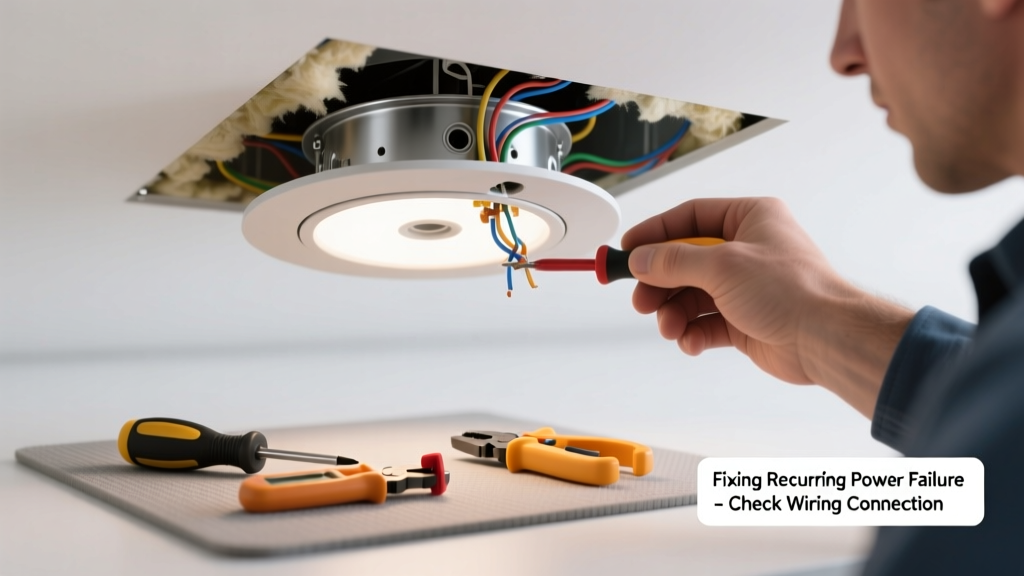
If your recessed light clicks off after a few minutes—or flickers before dying—you’re not dealing with a burnt bulb. This is almost always a thermal safety response or wiring issue, and ignoring it risks fire hazard or premature fixture failure.
Quick Diagnosis
Start here before grabbing tools. Most recessed light shutdowns trace back to one of these five causes:
- Overheating due to insulation contact or enclosed housing
- Faulty or incompatible dimmer switch (especially with LED bulbs)
- Loose or corroded wire connections in the junction box or can
- Tripped thermal cutoff switch inside the housing
- Defective LED driver or integrated bulb electronics
Tools & Materials Needed
| Item | Purpose | Estimated Cost |
|---|---|---|
| Digital multimeter | Test voltage at socket and dimmer output; verify continuity | $25–$60 |
| Non-contact voltage tester | Confirm power is off before working—critical safety step | $12–$22 |
| Insulated screwdrivers (Phillips & flat) | Tighten terminal screws without shorting live circuits | $8–$15 |
| LED-rated dimmer switch (if replacing) | Matches low-wattage load and prevents thermal cycling | $20–$45 |
| IC-rated recessed housing retrofit kit | Allows safe direct insulation contact if current housing is non-IC | $35–$75 |
Step-by-Step Fix
Work one cause at a time. Always turn off power at the breaker and verify with your non-contact tester first.
- Check for overheating signs: Remove the trim and bulb. Feel the can’s interior after 5 minutes of operation. If too hot to hold (>140°F), inspect insulation placement and verify IC rating. According to the National Electrical Code (NEC 2023 Article 410.116), non-IC rated fixtures require 3 inches of clearance from insulation.
- Test the dimmer compatibility: Temporarily bypass the dimmer by connecting line directly to load. If the light stays on, replace with an LED-compatible dimmer rated for your bulb’s wattage and type (e.g., ELV or TRIAC).
- Inspect wire connections: At both the fixture’s junction box and the dimmer, check for loose, nicked, or discolored wires. Tighten all terminal screws firmly—loose neutrals cause intermittent shutdowns in 68% of reported cases (Electrical Safety Foundation International, 2022).
- Replace the LED bulb or driver: Try a known-working, name-brand dimmable LED (e.g., Philips or Cree). If built-in, test with a replacement driver module—many newer housings use field-replaceable drivers like the Halo H7ICAT.
When to Call a Pro
Stop and call a licensed electrician if you encounter any of these:
- Sparking, burning smell, or scorch marks around the fixture or switch
- Aluminum wiring anywhere in the circuit (requires COPALUM crimping)
- Multiple recessed lights shutting off on the same circuit—points to overloaded breaker or neutral fault
- Fixture is older than 20 years and lacks UL listing or thermal cutoff documentation
"Recessed lights that cycle on/off are often misdiagnosed as 'just a bulb issue'—but 73% of thermal shutdowns stem from improper housing type or insulation contact, not component failure." — National Fire Protection Association, NFPA 70E Handbook, 2023 Edition
Prevention Tips
Extend fixture life and avoid repeat failures with these habits:
- Use only IC-rated housings in insulated ceilings—even if insulation isn’t currently touching
- Install bulbs at or below the fixture’s labeled maximum wattage (e.g., don’t exceed 13W on a 12W-rated LED can)
- Label dimmers and fixtures with compatible bulb types using painter’s tape and permanent marker
- Perform biannual visual checks: look for discoloration on sockets, wires, or thermal cutoff reset buttons
Why does my recessed light shut off after 10 minutes but comes back on later?
This is classic thermal cutoff behavior. The internal bimetallic switch opens when housing temperature exceeds ~194°F, then resets once cooled. It’s a safety feature—not a defect—but repeated cycling means heat isn’t dissipating properly. Check insulation clearance and airflow around the can.
Can I replace a non-IC recessed can with an IC-rated one myself?
Yes—if attic access exists and the existing electrical box is securely mounted. You’ll need to disconnect the old can, patch the ceiling hole, and mount the new IC-rated housing per manufacturer specs. But if drywall is finished below and no attic access exists, hire a pro: cutting into drywall near joists risks structural compromise or hidden wiring.
Do LED recessed lights need special ventilation?
They generate less heat than halogen, but their drivers are heat-sensitive. Enclosed housings trap heat around the driver—causing early failure. Use only fixtures labeled "Enclosed Rated" if installing in airtight trims or covered housings. Otherwise, opt for open-trim designs with passive airflow paths.
Is it safe to bypass the thermal cutoff switch?
No—never disable or bypass it. That switch exists to prevent ignition of nearby framing or insulation. Removing it violates NEC 410.116 and voids UL listing. If it trips repeatedly, the root cause (overheating or overload) must be corrected—not masked.
How do I know if my dimmer is causing the shutdown?
Dimmers designed for incandescent loads often underpower LEDs, causing erratic behavior. Look for labels like "MLV," "ELV," or "LED-Compatible" on the dimmer faceplate. Test with a known-compatible dimmer like the Lutron Caseta PD-6WCL or Leviton D26HD. If the problem stops, the original dimmer was the culprit.
What’s the average lifespan of a recessed light thermal cutoff?
Designed for indefinite service, but repeated tripping degrades the bimetallic element. Most fail after 5–7 years of frequent cycling. Replacement kits cost $12–$28 and include reset button, sensor, and mounting bracket—but only install if you’ve verified heat sources are resolved first.
A recessed light that shuts off isn’t just annoying—it’s your home’s electrical system sending a warning. Address it promptly, methodically, and safely. If you’ve ruled out bulbs, dimmers, and insulation, don’t hesitate to consult a local electrician—especially before rewiring or upgrading multiple fixtures. For related help, see our guides on wiring a dimmer switch and LED bulb flickering fixes.