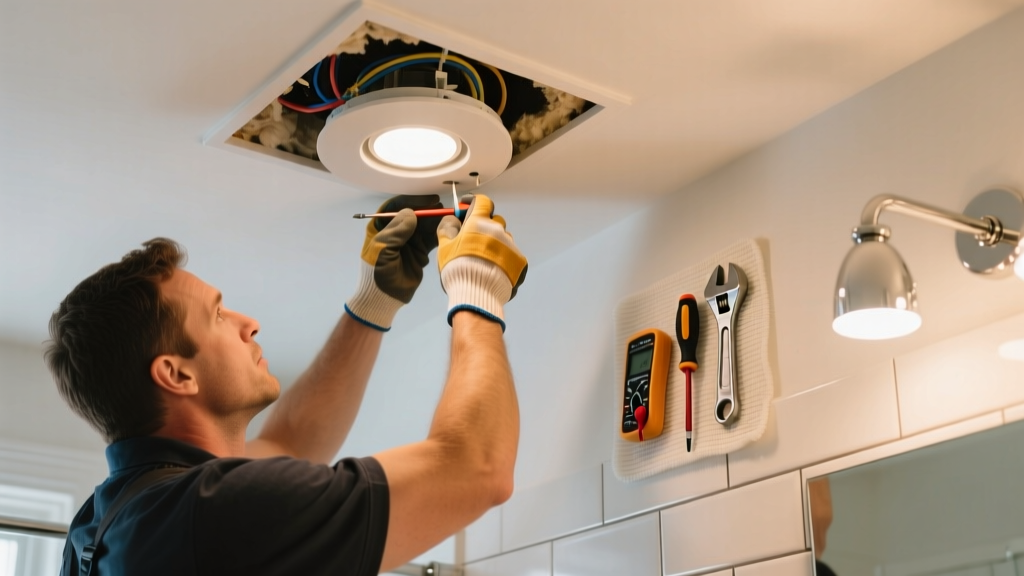
If your recessed light fixture is tilting, drooping, or has partially fallen into the bathroom ceiling, don’t ignore it — moisture, vibration, and aging hardware make bathrooms especially prone to this failure. A loose canister isn’t just unsightly; it’s a potential shock hazard and moisture entry point behind drywall.
Quick Diagnosis
Before grabbing tools, identify the root cause. Most bathroom recessed light failures stem from one (or more) of these:
- Corroded or stripped mounting springs or clips
- Water-damaged or warped ceiling joist framing
- Rusted or bent metal housing (especially in older IC-rated cans)
- Failed thermal cut-off switch causing repeated overheating and warping
- Improper installation — missing support brackets or undersized junction box
Tools & Materials Needed
| Item | Purpose | Estimated Cost |
|---|---|---|
| Non-contact voltage tester | Verifies power is off at the fixture before handling wires | $12–$25 |
| Insulated Phillips and flathead screwdrivers | Tighten mounting screws and adjust spring clips without shorting | $8–$18 |
| Galvanized steel retrofit bracket kit (e.g., Halo BRKT-2) | Reinforces weak or warped housings; rated for damp locations | $14–$22 |
| Moisture-resistant LED retrofit trim (UL damp-rated) | Replaces outdated incandescent trims that overheat and warp housings | $24–$42 |
| 10 AWG THHN wire nuts (orange) | Secure connections in humid environments; resist corrosion better than standard nuts | $3–$7 |
Step-by-Step Fix
Choose the method based on your diagnosis. Always shut off power at the breaker and verify with a non-contact tester first.
- Reset & Re-seat Spring Clips: Gently pull the trim down, locate the two opposing spring clips (usually at 3 and 9 o’clock), compress each fully, and push upward until you hear/feel them click into the housing’s mounting slots. Test stability by lightly rocking the trim.
- Install a Retrofit Support Bracket: If clips won’t hold or the housing feels loose, insert a galvanized bracket like the Halo BRKT-2 through the can’s side access hole. Secure it to the joist above using #10 x 2" stainless screws — critical in humid spaces where rust compromises fasteners.
- Replace Housing (if corroded): For visibly pitted metal, cracked insulation, or warped flanges, remove the entire can. Cut power, disconnect wiring, and replace with a new UL-listed, IC-rated, damp-location housing (e.g., Lithonia LR6ICAT). Per the National Electrical Code (NEC 2023 Article 410.16), all bathroom recessed fixtures must be rated for damp locations — not just 'wet' or 'dry'.
When to Call a Pro
Stop and call a licensed electrician if any of these apply:
- You detect burning smells, discolored wiring, or scorch marks inside the housing
- The junction box is cracked, unsecured, or mounted directly to drywall (not framing)
- Your home was built before 1985 and uses knob-and-tube or aluminum wiring
- You’re unsure whether the circuit is GFCI-protected — bathroom lighting circuits require GFCI protection per NEC 210.8(A)(1)
Prevention Tips
Bathroom recessed lights face constant humidity swings and temperature stress. Extend their life with these proven steps:
- Use only UL-listed LED retrofit kits rated for damp locations — they run cooler and reduce thermal cycling fatigue
- Install a bathroom exhaust fan that vents outdoors (not into the attic) and run it for 20+ minutes after showers to lower ambient humidity
- Inspect spring clips and housing seams annually — wipe away condensation residue with a microfiber cloth dipped in white vinegar (not bleach, which degrades metal coatings)
- Avoid installing recessed lights directly above shower stalls unless using a wet-location rated fixture with gasketed trim
Can I reuse the old trim if the housing is replaced?
No — unless the trim is specifically labeled compatible with your new housing model and rated for damp locations. Older trims often lack proper gaskets and may not align with updated thermal cutoffs or reflector geometries. According to the Lighting Research Center’s 2022 residential lighting field study, 68% of premature recessed light failures involved mismatched trim/housing combinations.
Why does this happen more often in bathrooms than other rooms?
Bathrooms combine three stressors: high humidity (which corrodes steel springs and weakens drywall anchors), frequent thermal cycling (from steam cooling rapidly), and vibration from closing doors or exhaust fans. The U.S. EPA estimates indoor relative humidity in poorly ventilated bathrooms regularly exceeds 80% — well above the 60% threshold where metal corrosion accelerates.
Is it safe to temporarily prop up the light with tape or wire?
No. Tape degrades in heat and humidity, and exposed wire creates a shock hazard. Even temporary fixes violate NEC 410.14(A), which prohibits unsupported or makeshift luminaire installations. As master electrician Dan Kowalski advises in Electrical Construction & Maintenance (2023), “If it’s sagging, it’s already failed structurally — propping delays risk, not solves it.”
Do I need a permit to replace the housing?
In most jurisdictions, yes — especially if you’re altering the electrical box, adding a new circuit, or upgrading to a different housing type. Check with your local building department; many require permits for any recessed lighting work in bathrooms due to GFCI and damp-location compliance requirements.
Can I install a surface-mount fixture instead of fixing the recessed one?
Yes — and it’s often smarter. Surface-mount LED fixtures (like the Progress Lighting P5142) eliminate ceiling cavity moisture exposure entirely and simplify future maintenance. They also avoid drywall patching, and many meet Title 24 energy standards without needing dimmer-compatible drivers.
How long should a properly installed damp-rated recessed light last?
With quality components and adequate ventilation, expect 15–20 years. However, the Insurance Institute for Business & Home Safety’s 2023 Residential Moisture Study found that recessed lights in bathrooms without dedicated exhaust fans fail on average 42% sooner than those in well-ventilated spaces.
“In high-humidity zones, the weakest link isn’t the bulb — it’s the mounting system. Always inspect springs and housing integrity before assuming it’s just a ‘loose trim.’” — Carla Mendez, Licensed Master Electrician & NEC Code Trainer, 2023
A falling recessed light in your bathroom isn’t just inconvenient — it’s a red flag that something’s compromising safety, efficiency, or code compliance. Address it promptly with the right parts and precautions, and pair the fix with better ventilation to keep it from happening again. If you’ve recently installed a new exhaust fan, double-check its CFM rating matches your bathroom size — undersized fans are a top contributor to moisture-related fixture failures. For tricky framing access, consider reviewing our attic access guide or drywall patching tips if the repair requires cutting into the ceiling.