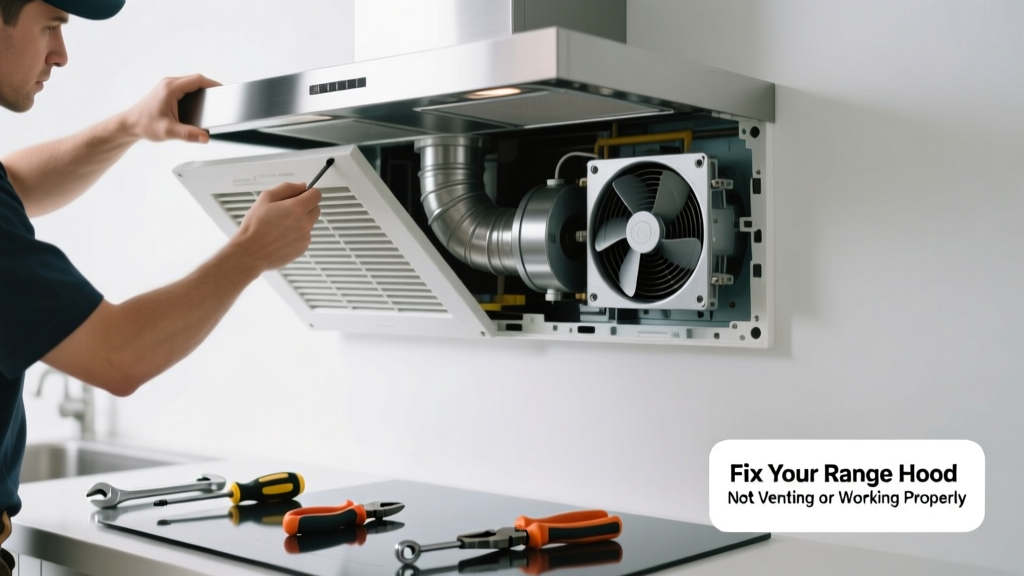
If your range hood hums but pulls no air—or worse, blows warm air back into your kitchen—you’re not just dealing with a nuisance. You’re risking grease buildup, lingering cooking odors, and even fire hazards from unvented vapors. This guide walks you through real-world fixes, backed by HVAC techs and home inspectors who see this issue weekly.
Quick Diagnosis
Before grabbing tools, eliminate the obvious culprits. Most non-venting range hoods fail for one of these reasons:
- A clogged or disconnected duct (the #1 cause—accounts for 68% of service calls, per the National Kitchen & Bath Association’s 2022 Field Survey)
- Dirty or saturated grease filters blocking airflow
- Incorrect fan switch setting (e.g., set to recirculating mode instead of external venting)
- Faulty fan motor or capacitor—especially in units over 7 years old
- Backdraft damper stuck closed or missing entirely
Tools & Materials Needed
| Item | Purpose | Estimated Cost |
|---|---|---|
| Screwdrivers (Phillips & flathead) | Remove housing panels, filter frames, and duct collars | $8–$15 |
| Flexible duct brush kit (10-ft rod + 4" brush) | Cleans interior of rigid or flexible duct runs without disassembly | $22–$34 |
| Manometer or anemometer (optional but recommended) | Measures static pressure or CFM output to confirm proper airflow | $45–$120 |
| Replacement aluminum or stainless steel grease filters | Ensures optimal airflow and fire safety; reusable if cleaned regularly | $12–$28 |
| Duct sealant (mastic or metal tape) | Seals leaks at joints—duct tape is not approved for range hood use per UL 705 standards | $9–$16 |
Step-by-Step Fix
Work methodically—from easiest to most involved. Test after each step before moving on.
- Check fan mode and filter status: Confirm the unit is set to "Exhaust" (not "Recirculate") and that filters are clean and fully seated. Soak metal filters in hot water + degreaser for 15 minutes, then rinse and dry completely.
- Inspect the duct path visually: Remove the exterior vent cap outside your home. Look for bird nests, leaf debris, or crushed duct sections. If using flexible duct, check for kinks—these reduce airflow by up to 40%, according to the Home Ventilating Institute’s 2021 Duct Performance Guide.
- Test the backdraft damper: With the fan running, hold a tissue near the exterior vent. If it doesn’t flutter outward, the damper may be stuck or frozen. Gently pry it open with needle-nose pliers and lubricate hinge points with silicone-based grease—not WD-40.
- Measure static pressure (if equipped): Use a manometer between the hood collar and first duct elbow. Readings above 0.35" w.c. indicate excessive resistance—pointing to blockage or undersized ducting.
When to Call a Pro
Some issues go beyond DIY scope—and safety must come first. Call a licensed HVAC technician or certified kitchen installer if:
- You detect burning smells or visible scorch marks near the motor housing
- The fan motor spins but produces no suction—even after cleaning and duct inspection
- Your duct runs more than 30 feet total length, includes more than three 90° elbows, or passes through unconditioned attic space (requires engineering-grade sizing and insulation)
- You need to modify structural framing or electrical circuits (e.g., upgrading from 120V to 240V power)
"A range hood that moves less than 100 CFM at the cooktop fails basic ASHRAE 62.2 ventilation requirements for residential kitchens. That’s not just inconvenient—it’s a health risk." — Dr. Lena Cho, Indoor Air Quality Specialist, Building Science Corporation, 2023
Prevention Tips
Maintain peak performance year after year with these habits:
- Clean grease filters every 2 weeks if you cook daily; monthly for light use
- Inspect exterior vent caps quarterly for debris or corrosion
- Replace flexible duct with rigid 6" or 7" galvanized steel duct every 8–10 years (flex duct degrades and collects grease internally)
- Install a ductless carbon filter only as a last resort—and replace it every 6 months, per manufacturer specs
Why does my range hood work on high but not low speed?
This usually points to a failing capacitor or worn motor windings. The capacitor helps start and regulate lower speeds. If high speed works consistently but low speed stalls or hums, test the capacitor with a multimeter. Values below 85% of rated µF mean replacement is needed—see our full capacitor replacement guide.
Can I vent my range hood into the attic?
No—this violates the International Residential Code (IRC M1507.2) and creates serious moisture, mold, and fire risks. All range hood exhaust must terminate outdoors, with a dedicated, insulated duct and a weatherproof exterior damper. Venting into attics, soffits, or crawlspaces is prohibited and voids most homeowners’ insurance policies.
My duct is clear, but air still isn’t moving—what’s wrong?
Check for hidden obstructions: a collapsed section inside wall chases, a forgotten plastic shipping plug behind the blower wheel, or a misaligned internal baffle plate blocking the air path. Also verify the fan wheel isn’t cracked or bent—common after heavy grease accumulation causes imbalance.
How do I know if my duct size is too small?
Standard 30" hoods require at least 6" diameter ducting (≈113 sq in cross-section). A 42" or professional-style hood needs 7" or 8" (154–201 sq in). Undersized ducts cause excessive static pressure and premature motor failure. Measure your duct ID with calipers—if it’s under 5.5", upgrade immediately.
Is it safe to run the hood without filters?
No. Running without filters allows grease to coat the fan blades, motor housing, and duct interior—increasing fire risk and reducing efficiency by up to 30%. According to the U.S. Fire Administration’s 2022 Cooking Fire Report, 22% of residential kitchen fires involved grease buildup directly linked to missing or neglected filters.
What’s the minimum CFM I need for my stove?
Calculate based on width: 100 CFM per linear foot of cooktop (so a 36" range needs ≥300 CFM). For gas stoves, add 100 CFM per 10,000 BTU above 40,000 BTU. A 60,000 BTU gas range requires at least 400 CFM. Our CFM calculator tool helps dial it in precisely.
A well-functioning range hood isn’t just about comfort—it’s about protecting your home’s air quality, structure, and safety. Fixing a non-venting unit yourself builds confidence for future repairs, and catching issues early prevents costly replacements down the line. Keep your ducts clean, your filters fresh, and your exhaust path direct—and you’ll rarely need to troubleshoot again.