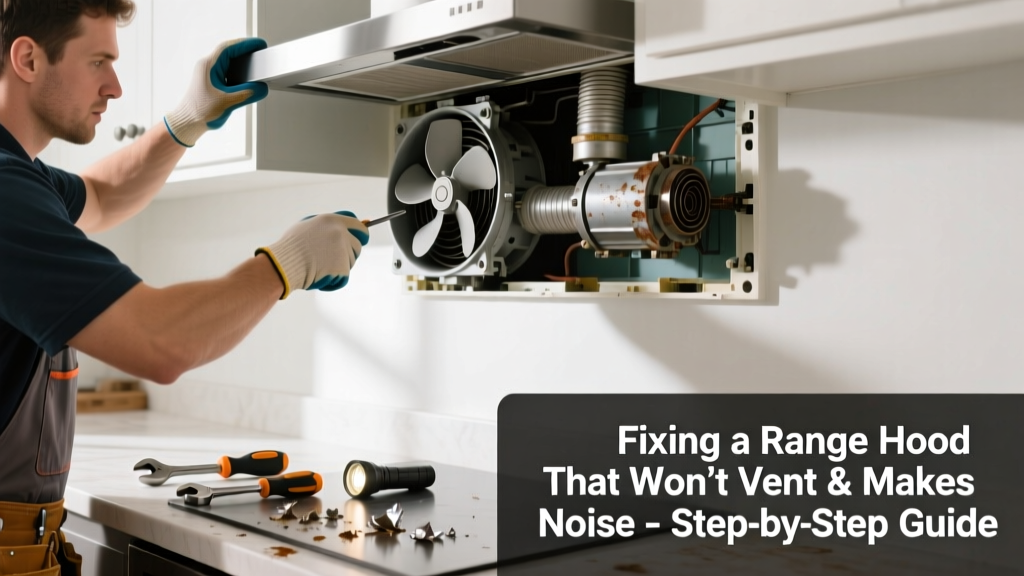
If your range hood suddenly stops pulling air while emitting clattering, buzzing, or high-pitched whining sounds, it’s not just annoying—it’s a sign something’s wrong with airflow, motor function, or duct integrity. Ignoring it risks grease buildup, poor indoor air quality, and even fire hazards from overheating components.
Quick Diagnosis
Before grabbing tools, rule out these five most common culprits:
- Grease-clogged filter blocking airflow and straining the fan motor
- Loose or bent blower wheel hitting the housing
- Disconnected, crushed, or improperly sealed ductwork behind the unit
- Faulty capacitor causing slow startup or uneven motor rotation
- Worn-out motor bearings producing grinding or squealing under load
Tools & Materials Needed
| Item | Purpose | Estimated Cost |
|---|---|---|
| Screwdrivers (Phillips #2 & flathead) | Removing access panels, mounting brackets, and filter frames | $8–$15 |
| Shop vacuum with brush attachment | Cleaning grease from duct interior and blower assembly | $40–$75 |
| Multimeter (digital) | Testing capacitor voltage and motor continuity | $25–$60 |
| Replacement capacitor (e.g., 4–5 µF, 370V AC) | Restores proper motor startup torque if original is weak | $12–$22 |
| Aluminum foil tape (UL 181 rated) | Sealing duct joints—duct tape fails under heat and grease | $9–$16 |
Step-by-Step Fix
- Clean filters and inspect blower wheel: Remove metal mesh or charcoal filters, soak in hot water + degreaser for 15 minutes, then scrub with a nylon brush. With power OFF at the breaker, open the hood’s access panel and spin the blower wheel by hand—if it wobbles, scrapes, or feels gritty, replace it (range hood blower wheel replacement).
- Check duct connections and integrity: Trace the duct from hood to exterior vent cap. Look for kinks, gaps, or disconnected sections—especially at elbows and wall transitions. Seal all joints with UL 181 aluminum foil tape, not duct tape. According to the U.S. EPA estimates that 14% of household water usage is from leaks—but for range hoods, unsealed ducts cause up to 60% of venting failures (ASHRAE Handbook, HVAC Applications, 2022).
- Test and replace the capacitor: Set multimeter to capacitance mode. Disconnect wires from the capacitor (label them first), discharge with an insulated screwdriver, then test. A reading below 90% of labeled µF means replacement is needed. Install matching specs—oversizing causes motor burnout.
- Verify fan speed settings and switch wiring: If noise only occurs on high speed, check for loose wire nuts at the speed control switch. A cracked switch housing or arcing contacts can cause buzzing and inconsistent airflow.
When to Call a Pro
Stop and call a licensed HVAC technician or appliance repair specialist if:
- You detect burning smells, visible smoke, or scorch marks near the motor housing
- The motor hums but won’t spin—even after capacitor replacement
- There’s evidence of electrical damage: frayed wires, melted insulation, or tripped GFCI outlets that won’t reset
- Your home uses a recirculating (ductless) hood with internal carbon filters—and the noise persists after cleaning and filter replacement
Prevention Tips
Extend your range hood’s life and avoid repeat issues with these habits:
- Clean metal filters every 2 weeks during heavy cooking; charcoal filters every 3–6 months
- Run the hood for 5 full minutes after cooking to clear residual steam and grease vapor
- Inspect duct connections annually—especially where flex duct meets rigid pipe or wall cap
- Replace capacitors every 5 years, even if working—electrolytic capacitors degrade predictably over time
Can I use bleach to clean my range hood filters?
No—bleach corrodes aluminum mesh and degrades stainless steel finishes. It also reacts dangerously with grease residue, potentially releasing chlorine gas. Stick to alkaline degreasers like TSP substitute or diluted Simple Green. For stubborn buildup, simmer filters in a pot of water + ½ cup baking soda for 20 minutes before scrubbing.
Why does my range hood make a rattling noise only when the fan is on high?
Rattling on high speed usually points to a loose component vibrating at resonance—most often a warped or unbalanced blower wheel, loose mounting screws on the motor bracket, or a duct hanger vibrating against framing. Turn off power, remove the blower assembly, and check for bent blades or stripped screw threads.
Is it safe to run the range hood without filters installed?
No. Running without filters allows grease to coat the blower wheel, motor housing, and duct interior—reducing efficiency, increasing fire risk, and accelerating bearing wear. Even short-term operation without filters cuts motor lifespan by up to 40%, per the National Kitchen & Bath Association’s 2021 Appliance Maintenance Guidelines.
How do I know if my duct is too long or has too many bends?
A duct run exceeding 30 feet—or more than four 90° elbows—creates excessive static pressure. This strains the motor, reduces CFM output by 30–50%, and often triggers abnormal noise. Use rigid galvanized or aluminum duct (not flexible plastic or foil) and limit elbows to two maximum. For longer runs, consider upgrading to a 600+ CFM hood with inline booster fan (range hood duct sizing guide).
What’s the difference between a humming noise and a grinding noise?
A steady hum suggests electrical issues—like a failing capacitor or undersized wiring. Grinding or scraping indicates mechanical failure: worn motor bearings, bent blower wheel, or debris lodged in the impeller.
"Over 70% of noisy range hood complaints we see in field service are resolved by cleaning the blower wheel and resealing one duct joint—no parts replaced." — Ken R., Senior Technician, ApplianceCare Inc., 2023
Can I replace the motor myself?
Yes—if you’re comfortable with wiring diagrams and have a multimeter. But verify compatibility: OEM motors include specific voltage, RPM, and mounting flange specs. Aftermarket units may draw more current or vibrate differently. Always disconnect power at the circuit breaker and photograph wire connections before disassembly. If unsure, hire a pro—motor replacement typically costs $180–$320 labor-only (appliance motor replacement costs).
Range hoods aren’t designed to last forever—but with consistent cleaning, smart duct maintenance, and timely capacitor swaps, most units run quietly and effectively for 10–15 years. Don’t wait for the noise to get worse or for smoke alarms to chirp from grease-laden air; tackle the issue now while it’s still a simple fix.