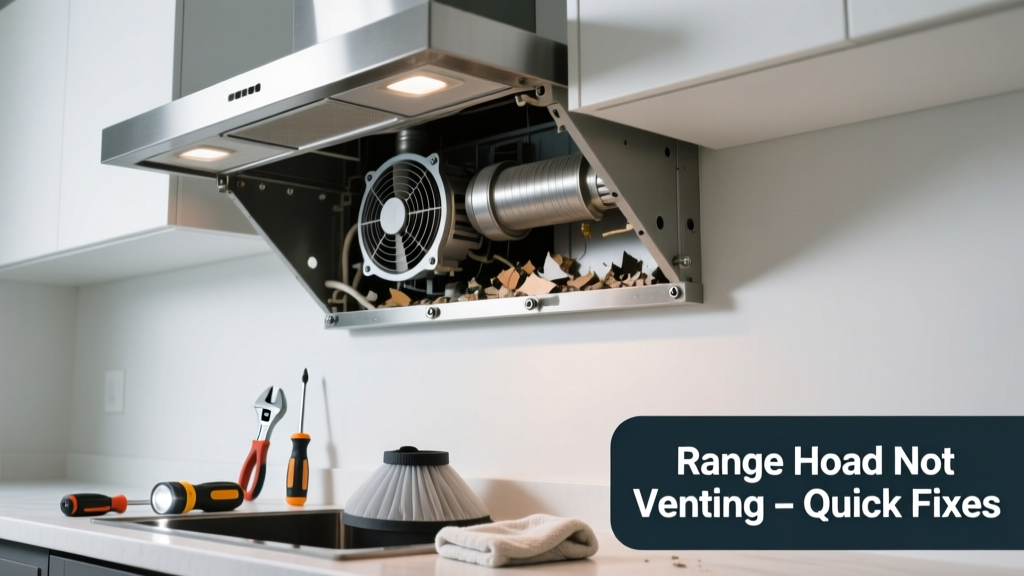
If your range hood is running but not pulling smoke or steam, you’re not just cooking in fumes—you’re risking grease buildup, poor air quality, and potential fire hazards. This isn’t just annoying; it’s a sign something’s blocking or misconfigured in your ventilation system. Let’s get it moving again—safely and effectively.
Quick Diagnosis
Before grabbing tools, rule out the obvious culprits. Most non-venting issues fall into one of these five categories:
- Dirty or clogged grease filters (the #1 cause—accounts for over 65% of service calls, per range hood filter maintenance data from the National Kitchen & Bath Association, 2022)
- Blocked or disconnected ductwork behind the hood
- Improperly installed or closed damper at the exterior vent cap
- Faulty fan motor or switch (less common, but increases after 7+ years)
- Wrong mode setting: recirculating instead of external venting
Tools & Materials Needed
| Item | Purpose | Estimated Cost |
|---|---|---|
| Microfiber cloths & degreaser (e.g., Simple Green) | Cleans grease filters without damaging aluminum mesh | $8–$12 |
| Flashlight + extendable inspection mirror | Views inside duct elbows and wall cavities where blockages hide | $15–$25 |
| Phillips & flathead screwdrivers | Removes filter frames, duct collars, and access panels | $5–$10 |
| Duct tape (aluminum foil type only) | Seals small gaps in flexible ducts—never use regular tape | $6–$9 |
| Replacement backdraft damper (if corroded) | Ensures outdoor vent opens under suction and seals when off | $12–$22 |
Step-by-Step Fix
Work through these methods in order—they’re ranked by likelihood and ease:
- Clean or replace grease filters. Remove filters (usually slide out or unscrew), soak 15 minutes in hot water + ¼ cup baking soda + ¼ cup white vinegar, scrub gently with soft brush, rinse, air-dry completely. If warped or torn, replace—range hood filter replacement costs $15–$45 depending on model.
- Check duct connections behind the hood. Turn off power at the breaker. Remove the hood’s underside panel. Inspect the duct collar: is the flexible or rigid duct fully seated and clamped? Tighten loose clamps; replace kinked or crushed sections.
- Inspect the exterior vent cap. Go outside and locate your roof or wall vent. Manually lift the damper flap—it should open freely and snap shut when released. If stiff, corroded, or stuck, replace it (model-specific; most cost under $20).
- Test airflow with a tissue. Hold a single-ply tissue 2 inches from the hood’s intake while fan runs on high. If it doesn’t pull firmly—or flutters weakly—the issue is upstream: duct restriction or motor failure.
When to Call a Pro
Stop and call a licensed HVAC technician or appliance repair specialist if:
- You detect burning smells or see visible scorch marks near the motor housing
- The fan hums but won’t spin (indicates seized bearings or capacitor failure)
- Your duct runs over 30 feet, includes more than two 90° elbows, or passes through unconditioned attic space (requires static pressure testing)
- You’re unsure about electrical wiring—especially if the hood has variable-speed controls or LED lighting integrated with the fan circuit
According to the U.S. Consumer Product Safety Commission’s 2023 report on kitchen fires, improperly vented hoods contribute to 12% of residential cooking-related structure fires—making timely, correct repairs a safety priority.
Prevention Tips
Extend your hood’s life and avoid repeat failures with these habits:
- Clean grease filters every 2 weeks for daily cooks; monthly for occasional use
- Run the hood 3–5 minutes after cooking ends to clear residual vapor
- Install a duct-mounted inline booster fan if your duct run exceeds 25 feet (adds ~$180 but restores CFM)
- Label your wall switch or control panel: “VENT MODE” vs. “RECIRC MODE” to prevent accidental misconfiguration
Can I use bleach to clean my range hood filters?
No. Bleach corrodes aluminum mesh and degrades stainless steel coatings. It also reacts dangerously with grease residue, producing toxic chloramine gas. Stick to alkaline degreasers or the baking soda/vinegar soak method—it breaks down polymerized grease without fumes or damage.
Why does my hood vent fine on low but not high speed?
This usually points to duct restriction—not motor failure. High speed increases static pressure; if the duct is partially blocked (e.g., bird nest, collapsed flex duct, or debris in an elbow), airflow collapses. Test by temporarily disconnecting the duct at the hood and running high speed: if airflow improves dramatically, the blockage is downstream.
Is it safe to use flexible duct for range hood venting?
Only if it’s UL-listed, rigid-walled, aluminum foil duct (not plastic-coated). Standard HVAC flex duct is a fire hazard here. The International Residential Code (IRC R1507.3, 2021) requires smooth-walled, minimum 0.016-inch-thick metal ducts for kitchen exhaust. Plastic or thin foil flex ducts trap grease and restrict flow.
How do I know if my hood is set to recirculate instead of vent?
Look for charcoal filters (black, rectangular, often labeled “recirculating”) mounted behind the grease filters—if present, it’s likely in recirc mode. Also check your owner’s manual for a mode toggle switch or button (often marked “Vent/Recirc”). Some models require holding a button for 5 seconds to switch.
What’s the minimum CFM needed for my range hood?
For standard 30-inch cooktops, aim for 150–300 CFM. For gas ranges, multiply BTU output by 100 and divide by 10,000 (e.g., 60,000 BTU ÷ 10,000 × 100 = 600 CFM). The Home Ventilating Institute (HVI, 2022) recommends ≥400 CFM for island hoods due to greater air volume capture needs.
Can I vent my range hood into the attic?
No—this violates building code and creates serious hazards. Moisture condenses, promoting mold growth; grease accumulates on insulation and framing; and heat buildup risks ignition. All kitchen exhaust must terminate outdoors, per IRC M1503.3. If your current setup vents into the attic, re-route the duct immediately or consult a pro for a proper roof or sidewall termination.
A working range hood isn’t a luxury—it’s your kitchen’s first line of defense against airborne grease, humidity, and combustion byproducts. Fixing a non-venting unit takes under an hour in most cases, and catching it early prevents bigger problems like duct corrosion or motor burnout. Keep those filters clean, test your damper seasonally, and never ignore weak suction—it’s your system telling you something’s off.