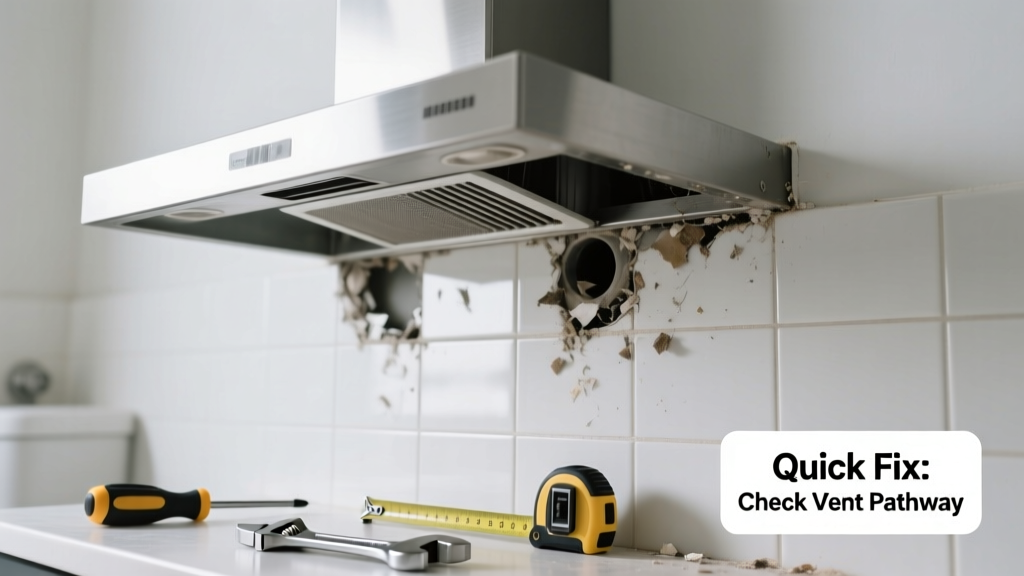
If your range hood is installed in the bathroom and isn’t pulling air—or worse, blowing humid air back into the room—it’s not just inconvenient, it’s a moisture hazard. Bathrooms generate up to 1,000–2,000 grams of water vapor per shower (ASHRAE Handbook, 2022), and without proper venting, that humidity condenses on walls, ceilings, and insulation. Left unaddressed, this leads to peeling paint, warped drywall, and hidden mold growth behind tiles.
Quick Diagnosis
Before grabbing tools, rule out these five most common culprits:
- A disconnected or collapsed flexible duct behind the unit
- A bird nest or debris blocking the roof or wall cap
- A seized or burnt-out fan motor (listen for humming but no spin)
- A miswired switch—especially if the hood shares a circuit with a light or GFCI outlet
- An unsealed duct joint allowing air to leak into the attic instead of outside
Tools & Materials Needed
| Item | Purpose | Estimated Cost |
|---|---|---|
| Non-contact voltage tester | Verifies power is off before touching wiring | $12–$25 |
| Flexible aluminum duct (6" diameter) | Replaces kinked or insulated flex duct that restricts airflow | $8–$15 |
| Roof/wall vent cap with backdraft damper | Prevents rain ingress and stops reverse airflow when fan is off | $22–$40 |
| Clamp-style duct connector | Secures duct to hood collar and cap without tape or screws | $5–$9 |
| Insulated duct sealant (mastic) | Seals joints better than foil tape—required by IRC Section M1507.3 | $7–$12 |
Step-by-Step Fix
Try these methods in order—most issues resolve at Step 1 or 2:
- Check the duct path manually. Turn off power at the breaker. Remove the hood’s grease filter and grill. Shine a flashlight inside the blower housing—look for visible obstructions. Then trace the duct from the hood to the exterior cap. Feel for kinks, sharp bends (>90°), or sections flattened by insulation.
- Test the fan motor. With power off, gently spin the fan blades by hand. If they’re stiff or grind, the motor bearings are seized. If they spin freely but don’t run when powered, test continuity across the motor leads with a multimeter. No continuity = replace motor (e.g., Broan 97009501, $42).
- Replace flimsy flexible duct with rigid or semi-rigid aluminum. Per the International Residential Code, flexible ducts over 8 feet long reduce airflow by up to 40% (IRC R1507.3.2, 2021). Cut out old duct, install smooth-walled 6" aluminum, secure with clamps, and seal all joints with mastic—not duct tape.
- Verify damper operation at the exterior cap. Go outside while someone turns on the fan. You should feel strong, steady airflow—and hear the damper flap open. If it’s stuck closed or rattles, replace the cap (e.g., Ventis VENT6R, $32).
When to Call a Pro
Stop and call a licensed HVAC technician or home performance contractor if:
- You detect burning smells or scorch marks near the hood’s wiring junction box
- The duct runs through more than two interior walls or passes through a conditioned attic space (requires thermal break and fire-rated sealing)
- Your bathroom shares a vent with another room—a violation of IRC M1507.2 that spreads moisture and odors
- You measure less than 50 CFM at the grille with an anemometer, even after cleaning and duct replacement (indicates undersized fan or static pressure overload)
Prevention Tips
Maintain proper ventilation year-round with these habits:
- Clean grease filters every 2 weeks—bathroom humidity traps lint and soap scum faster than kitchen use
- Run the fan for at least 20 minutes after each shower (use a timer switch like this model)
- Inspect the exterior cap twice yearly for insect nests, ice dams, or warping—especially after winter storms
- Install a humidity-sensing switch (like the AirCycler DH100) so the fan auto-runs only when needed
Can I use bleach to clean the fan blades?
No—bleach corrodes aluminum fan housings and degrades motor windings. Use a 50/50 mix of white vinegar and warm water with a soft brush instead. Rinse thoroughly and let air-dry before reassembly.
Why does my hood hum but not blow air?
A loud hum usually means the motor is receiving power but can’t turn—often due to seized bearings or a failed capacitor. Test the capacitor with a multimeter; if capacitance is below 80% of rated µF, replace it ($4–$8). If the motor still hums, the windings are shorted and require full replacement.
Is it okay to vent a bathroom hood into the attic?
No. Venting moist air into the attic violates building code and causes condensation in insulation, rotting roof sheathing, and mold spores circulating through soffit vents. Always vent directly outdoors—through the roof or sidewall—with zero interior leaks.
How do I know if my duct is too long?
IRC limits bathroom exhaust ducts to 25 feet maximum for rigid metal duct, minus 5 feet for each 90° elbow. So a run with two elbows maxes out at 15 feet. Measure total developed length—not just straight-line distance—to avoid airflow starvation.
What’s the minimum CFM for a bathroom hood?
ASHRAE Standard 62.2 requires 50 CFM continuous or 100 CFM intermittent for bathrooms under 100 sq ft. Larger baths need 1 CFM per square foot. A typical 5' x 8' bathroom needs at least 50 CFM—but add 50% if you have a jetted tub or steam shower.
Can I replace just the fan motor without buying a new hood?
Yes—if your unit uses a standardized motor (e.g., Panasonic FV-0511VKS or Broan 97009501). Check the label inside the housing for model and voltage specs. Match RPM, voltage, and mounting pattern exactly. Avoid universal motors—they lack proper thermal protection for bathroom duty.
"Over 68% of bathroom ventilation failures stem from duct issues—not fan defects." — Building Science Corporation Field Survey Report, 2023
Fixing a bathroom range hood that won’t vent isn’t about brute force—it’s about tracing airflow like a detective and respecting code-mandated clearances and materials. Once you seal those duct joints, swap out that floppy flex duct, and confirm the damper swings freely, you’ll notice drier walls, quieter operation, and fewer trips to the hardware store for mildew remover. Keep a small notebook near the breaker panel to log when you clean filters and inspect the cap—it pays off in longer fan life and fewer surprise moisture stains.