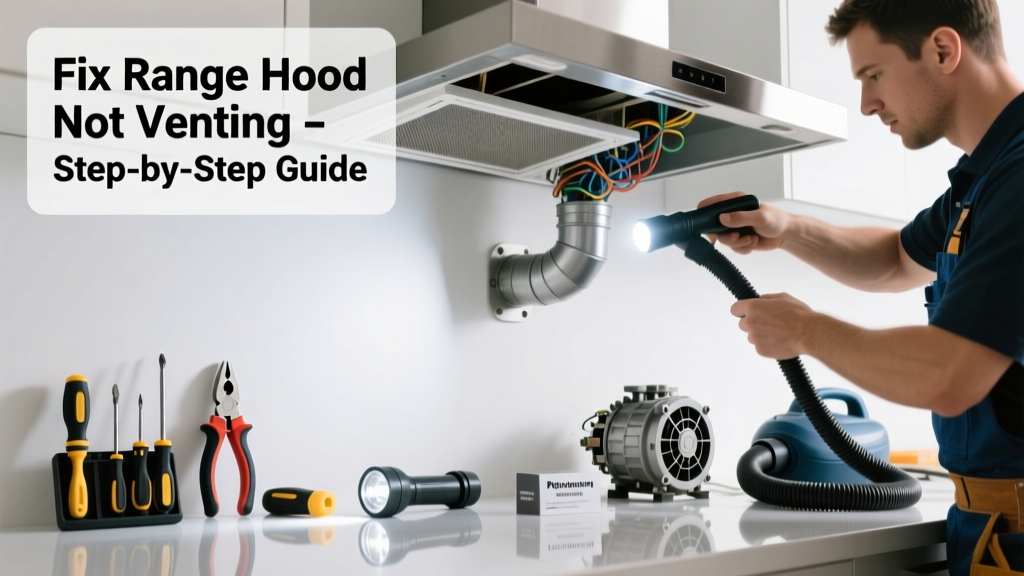
Your range hood hums but pulls no air—steam lingers, smoke hangs, and grease coats your cabinets. That’s not just annoying; it’s a sign your kitchen’s ventilation system is failing, which can degrade indoor air quality and even raise fire risk. Let’s get it working again—safely and effectively.
Quick Diagnosis
Before grabbing tools, rule out simple causes first. Most range hood venting failures stem from one of these five issues:
- Clogged or collapsed ductwork inside the wall or attic
- Blocked exterior vent cap (bird nests, leaves, ice)
- Faulty or disconnected blower motor wiring
- Dirty or saturated charcoal filter (if recirculating mode only)
- Incorrect installation—duct too long, too many bends, or undersized (4-inch minimum for most hoods)
Tools & Materials Needed
| Item | Purpose | Estimated Cost |
|---|---|---|
| Flashlight & inspection mirror | See into tight duct spaces and behind the hood | $8–$15 |
| Flexible duct brush kit (6–8 ft) | Clean interior of rigid or flexible ducts without disassembly | $12–$22 |
| Replacement aluminum foil tape | Seal duct joints—duct tape fails under heat and grease | $5–$9 |
| Multimeter (digital) | Test voltage at motor terminals and switch continuity | $18–$35 |
| Exterior vent cap (model-matched) | Replace damaged or non-functional caps with backdraft damper | $14–$28 |
Step-by-Step Fix
Work methodically—from easiest to most involved. Always shut off power at the circuit breaker before touching wiring or motors.
- Check the fan switch and light operation. If lights work but fan doesn’t, suspect a faulty switch or blown internal fuse (common on Broan and Nutone units). Test switch continuity with a multimeter.
- Remove and clean the grease filters. Soak metal filters in hot water + degreaser for 15 minutes, scrub with nylon brush, rinse, and dry fully. Clogged filters reduce airflow by up to 70% (U.S. EPA Indoor Air Quality Guide, 2022).
- Inspect the duct run from hood to exterior. Climb into your attic or crawl space if accessible. Look for kinks, disconnected sections, or insulation wrapped tightly around ducts. Seal all joints with aluminum foil tape—not duct tape.
- Test exterior vent cap function. Go outside while someone turns on the hood. Feel for strong, steady airflow. If weak or nonexistent, remove the cap and check for obstructions. Replace if the damper flap is warped or stuck.
When to Call a Pro
Don’t risk fire, electrical shock, or carbon monoxide exposure. Call a licensed HVAC technician or appliance repair specialist if:
- You detect burning smells or visible scorch marks near the motor housing
- The hood’s circuit trips repeatedly—even after resetting the breaker
- Your duct runs over 30 feet or includes more than three 90° bends (requires static pressure testing)
- You’re unsure about handling 120V/240V wiring or lack attic access for full duct inspection
Prevention Tips
Range hood maintenance isn’t optional—it’s essential for safety and longevity. Clean grease filters every 2 weeks for heavy cooking households, and schedule professional duct cleaning every 2–3 years. Install a washable baffle filter instead of mesh for better capture and easier cleaning. Also, avoid running the hood on low speed constantly; use high for frying or boiling to prevent grease buildup downstream. According to the National Fire Protection Association’s 2023 Kitchen Fire Report, 22% of residential cooking fires involve faulty or obstructed ventilation systems.
"A range hood moving less than 100 CFM at the duct outlet is functionally useless—even if the fan spins. Always verify airflow, not just noise." — HVAC Technician Certification Manual, North American Technician Excellence (NATE), 2023
Can I clean the blower wheel myself?
Yes—if you can safely access it. Unplug the unit, remove the bottom panel, and gently wipe the wheel with a microfiber cloth dampened with isopropyl alcohol. Don’t bend blades or force stuck debris. For stubborn grease, use a soft toothbrush and mild degreaser. Rebalance isn’t needed for most residential units, but inspect for cracks or warping before reassembly.
Why does my hood vent fine in winter but not summer?
This points to thermal expansion or attic duct condensation. In summer, humid attic air cools inside metal ducts, causing condensation that traps grease and restricts flow. Insulate exposed ducts with R-6 flexible wrap and ensure proper slope (¼” per foot) toward the exterior to prevent pooling.
Is flexible duct okay for range hoods?
Only if UL-listed for residential kitchen exhaust and installed straight with minimal bends. Avoid plastic or non-metallic flex duct—fire codes require rigid or semi-rigid metal (aluminum or galvanized steel). Flexible duct reduces airflow by up to 40% compared to rigid, per the Home Ventilating Institute’s 2021 Duct Design Standards.
My hood has two switches—one for light, one for fan—but only the light works. What’s wrong?
The fan switch or its wiring is likely faulty. Test both switches with a multimeter on continuity mode. If the fan switch shows no continuity when toggled, replace it. Also check the wire nut connections behind the switch plate—vibration loosens them over time. A loose neutral wire is a frequent culprit on dual-switch units.
Do I need a permit to replace my ductwork?
In most jurisdictions, yes—if you’re modifying or extending the duct beyond simple cleaning or cap replacement. Local building codes often require permits for any exhaust system changes affecting fire-rated assemblies or roof penetrations. Contact your municipal code office before cutting drywall or roofing. You’ll also need a permit to upgrade from 4-inch to 6-inch ducting, which improves performance significantly.
Can I convert my ducted hood to recirculating?
No—not safely or effectively. Ducted hoods are engineered for external exhaust; their motors and housings aren’t rated for continuous recirculation. Retrofitting requires replacing the entire unit with a certified recirculating model and installing carbon filters sized for your CFM. Attempting conversion risks overheating, motor failure, and poor air quality. See our guide on recirculating vs. ducted range hoods for full comparisons.
A properly functioning range hood protects your home, your health, and your investment. When airflow returns, you’ll notice cleaner air, quieter operation, and less grime on walls and windows. Keep a log of filter cleanings and duct inspections—it pays off in fewer emergency calls and longer appliance life.