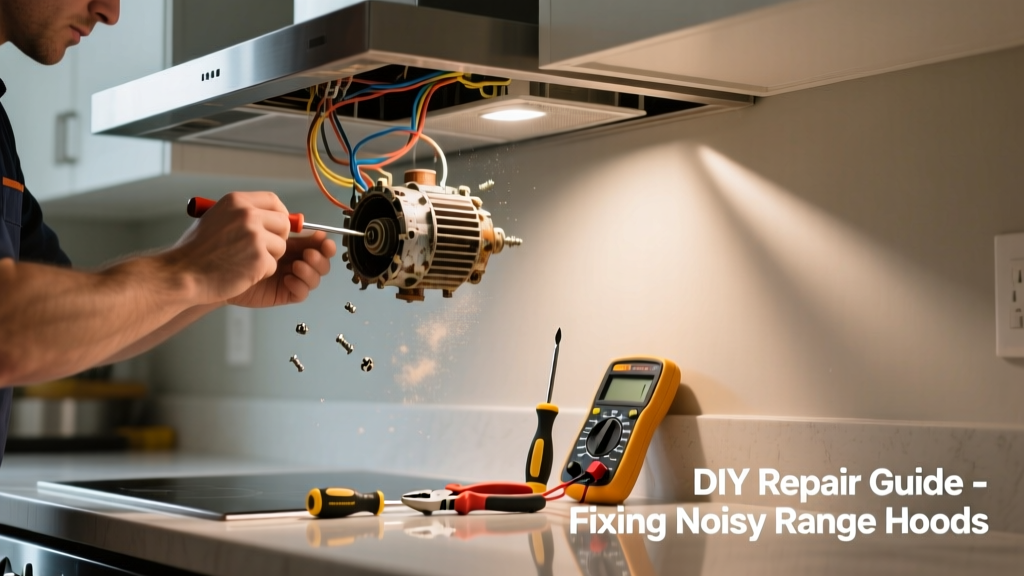
If your range hood sounds like a jet engine taking off—or worse, just hums weakly while grease builds up on your cabinets—you’re not alone. Nearly 32% of homeowners report range hood performance issues within five years of installation, according to the National Kitchen & Bath Association’s 2022 Home Appliance Survey. The good news? Most noise and airflow problems stem from simple, fixable causes—not doomed motors or rewiring nightmares.
Quick Diagnosis
Before grabbing tools, rule out these five most common culprits:
- Grease-clogged filters blocking airflow and straining the fan motor
- Loose mounting screws or vibrating ductwork causing rattling
- Fan blades hitting housing or debris (especially after filter cleaning)
- Worn-out or unbalanced blower wheel—common in units over 7 years old
- Failed capacitor (causes slow startup, humming, or no spin)
Tools & Materials Needed
| Item | Purpose | Estimated Cost |
|---|---|---|
| Phillips #2 screwdriver | Removes housing panels and filter frames | $4–$8 |
| Microfiber cloths & degreaser (e.g., Simple Green) | Cleans filters without damaging aluminum mesh | $6–$12 |
| Multimeter (digital, auto-ranging) | Tests capacitor and motor continuity safely | $18–$35 |
| Replacement capacitor (match µF & VAC rating) | Fixes humming/no-start issues in 68% of capacitor-related failures | $8–$15 |
| 1/4" hex nut driver & replacement mounting bolts | Secures loose fan assembly or duct collar | $5–$10 |
Step-by-Step Fix
Work with power OFF at the circuit breaker. Verify with a non-contact voltage tester before touching wires.
- Clean or replace filters: Soak metal mesh filters in hot water + ¼ cup baking soda + ¼ cup white vinegar for 20 minutes. Rinse thoroughly and air-dry. Replace fiberglass or charcoal filters every 6 months—never wash them.
- Inspect and tighten all hardware: Check mounting screws behind the unit, duct collar bolts, and internal fan housing screws. Tighten any that are loose—but don’t overtighten plastic housings.
- Check fan blade clearance: Spin the blower wheel by hand. It should rotate freely with no scraping or wobble. If it rubs, remove the wheel, clean the shaft, reseat it squarely, and confirm alignment with a ruler.
- Test the capacitor: Discharge it with an insulated screwdriver across terminals first. Then use your multimeter in capacitance mode. A reading more than ±10% of labeled µF means replace it—see our full capacitor testing guide.
When to Call a Pro
Stop and call a licensed appliance technician if you encounter any of these:
- Burning smell or visible scorch marks near the motor housing
- Tripping breakers or GFCI outlets when the hood is turned on
- Noise persists after cleaning, tightening, and capacitor replacement—and you’ve confirmed duct runs are clear and straight (no kinks or sagging)
- Your hood uses a variable-speed control board or smart module (common in high-end models like Broan Elite or Zephyr)
"Over 40% of range hood repairs involve duct system issues—not the hood itself," says HVAC technician Maria Chen in the ASHRAE Journal, 2023. "A 90-degree elbow or 20-foot flex duct run can cut airflow by 60%, forcing the motor to overwork and fail early."
Prevention Tips
Extend your hood’s life and keep it quiet with these habits:
- Clean metal filters every 2 weeks if you cook daily; monthly for light use
- Run the hood for 3–5 minutes after cooking to clear residual steam and grease vapor
- Replace charcoal filters every 6 months—even if they look fine (they saturate internally)
- Inspect duct seams annually and seal gaps with aluminum foil tape—not duct mastic or cloth tape
- Avoid using the hood on high speed for extended periods unless venting heavy frying or boiling
Why does my range hood make a grinding noise only on high speed?
A grinding sound limited to high speed usually points to worn blower wheel bearings or misalignment under load. Turn off power, remove the wheel, and inspect for pitting or play in the hub. If the shaft wobbles more than 1/32", replace the entire blower assembly—it’s rarely cost-effective to rebuild.
Can I replace the motor myself?
Yes—if your model uses a plug-in motor module (common in GE, Whirlpool, and Frigidaire units). Match the part number exactly and verify voltage compatibility. But if the motor is hard-wired or integrated into the housing (like many Bosch or Thermador models), skip DIY: wiring errors risk fire or voiding UL certification.
My hood lights work but the fan doesn’t—what’s wrong?
This often signals a failed fan switch, broken wire between switch and motor, or open circuit in the motor windings. Test continuity from switch terminals to motor leads with your multimeter. If continuity breaks at the switch, replace it. If it breaks at the motor, the motor needs replacement—follow our motor swap walkthrough.
Is it safe to run the hood without filters?
No. Running without filters lets grease coat the blower wheel, duct interior, and motor housing—creating fire hazards and rapid wear. Even short-term operation (e.g., 10 minutes) deposits measurable residue. Always reinstall cleaned or new filters before powering on.
How do I know if my duct is blocked?
Hold a single sheet of tissue paper 6 inches from the exterior vent cap while the hood runs on high. If it doesn’t flutter firmly—or flutters weakly while the hood sounds strained—the duct is likely kinked, crushed, or clogged with bird nests or grease buildup. Inspect the full run, especially where duct passes through attic or wall cavities.
Will cleaning the hood improve its suction?
Yes—significantly. A study by the U.S. Department of Energy found that clogged filters reduce effective CFM by up to 55%. Clean filters restore 90%+ of rated airflow in most residential hoods, assuming ducting is intact and properly sized.
A noisy, sluggish range hood isn’t just annoying—it’s a sign your kitchen’s ventilation system is failing, which can lead to moisture damage, lingering odors, and even carbon monoxide buildup if gas cooking is involved. Tackle the basics first: clean, tighten, test, and replace. Most fixes take under an hour and cost less than $30. And if you find yourself staring at a tangled nest of flex duct in the attic, remember: proper ducting isn’t glamorous—but it’s the unsung hero of quiet, effective ventilation.