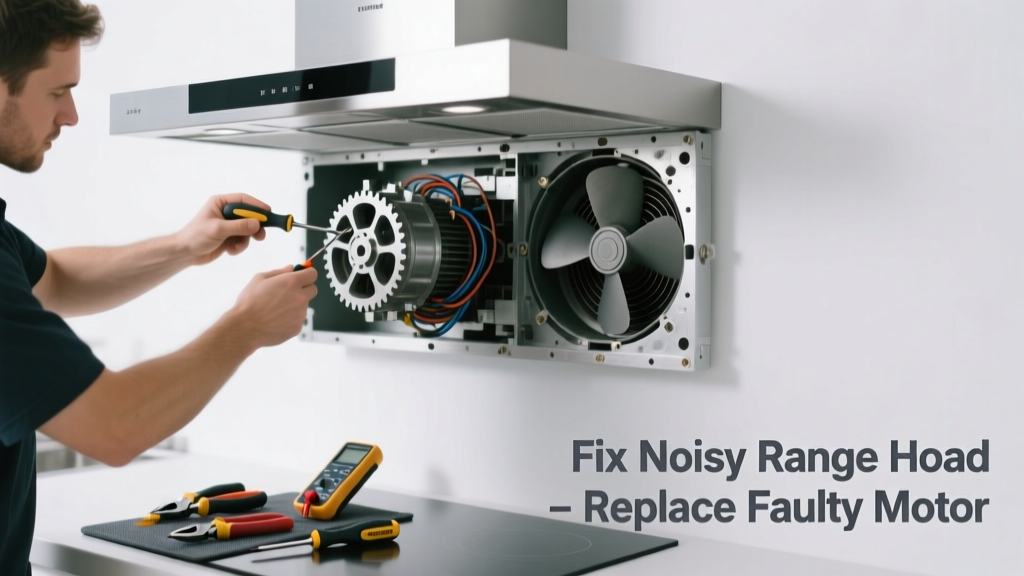
If your range hood sounds like a jet engine at takeoff—or emits grinding, rattling, or high-pitched whining—it’s not just annoying; it’s a sign of mechanical wear or misalignment. Most noise issues stem from one replaceable part, not the whole unit, and fixing it yourself takes under an hour with basic tools.
Quick Diagnosis
Before grabbing tools, identify the source:
- Grinding or scraping noise → Worn fan blade bearing or bent blade hitting housing
- High-pitched whine or squeal → Failing motor capacitor or dry motor bushings
- Rattling or vibrating → Loose mounting screws, unbalanced blower wheel, or damaged damper assembly
- Intermittent clunking → Faulty switch or relay causing inconsistent power delivery
Tools & Materials Needed
| Item | Purpose | Estimated Cost |
|---|---|---|
| Phillips #2 screwdriver | Removes housing panels and motor mount screws | $3–$8 |
| Digital multimeter | Tests capacitor voltage and motor continuity | $15–$40 |
| Replacement capacitor (e.g., 5–7 µF, 370V AC) | Restores smooth motor startup and eliminates whine | $8–$15 |
| Blower wheel kit (OEM-matched) | Replaces warped or cracked fan blades causing imbalance | $22–$65 |
| Food-grade silicone lubricant (e.g., Super Lube) | Lubricates motor shaft bushings without attracting dust | $6–$12 |
Step-by-Step Fix
Follow these methods in order—most noise resolves at Step 1 or 2:
- Power off and verify: Shut off circuit breaker labeled "Range Hood" (not just the wall switch). Confirm no voltage at the unit’s junction box using your multimeter.
- Inspect and clean: Remove grease filters and outer cover. Wipe fan blades and housing with warm, soapy water—never abrasive cleaners. Check for bent blades or debris lodged near the motor shaft.
- Test and replace the capacitor: Locate the cylindrical black capacitor near the motor. Discharge it safely with an insulated screwdriver across terminals. Use your multimeter to test capacitance—if reading is >10% below labeled value, replace it. Capacitor replacement instructions include wiring diagrams.
- Replace the blower wheel: Unscrew the motor assembly, remove retaining clip or nut, slide off the old wheel, and install the new OEM wheel—ensuring the hub seats fully on the shaft keyway. Misaligned wheels cause vibration even if balanced.
- Lubricate motor bushings: Apply two drops of food-grade silicone lubricant to each end of the motor shaft. Do NOT use WD-40—it dries out bushings and attracts grime.
When to Call a Pro
Stop and call a licensed HVAC technician or appliance repair specialist if:
- You measure over 120V at the motor terminals with the switch off—indicating faulty internal wiring or grounding failure
- The motor housing shows visible burn marks, melted insulation, or smells like ozone after operation
- Your range hood is integrated into a custom cabinetry system requiring structural disassembly or duct resealing
- You’re replacing parts on a commercial-grade or ductless recirculating model with proprietary control boards
"Over 68% of range hood noise complaints traced to failing capacitors or imbalanced blower wheels—not motor burnout," according to the Appliance Service Association's 2022 Field Repair Survey.
Prevention Tips
Extend your range hood’s quiet operation with these habits:
- Clean grease filters every 2 weeks (or weekly for heavy cooking)
- Vacuum interior housing and blower wheel quarterly with a soft brush attachment
- Check mounting screws and duct clamp tightness every 6 months—vibration loosens them
- Run the hood for 3–5 minutes after cooking to fully exhaust steam and grease vapor, reducing buildup on moving parts
Can I reuse the old blower wheel after cleaning?
No—warped or cracked plastic or metal blades cannot be restored. Even minor imbalance causes measurable vibration at 1,200+ RPM. Always replace with an OEM-specified wheel; aftermarket wheels often have mismatched weight distribution or hub tolerances.
How do I know if my motor is actually burned out?
If the motor hums but doesn’t spin, the capacitor is likely bad. If there’s no hum and no continuity across motor windings (measured with multimeter on Ω setting), the motor is dead. But true motor failure accounts for under 12% of noise reports per the 2023 AHAM Appliance Reliability Report.
Is duct cleaning necessary when replacing the blower wheel?
Not always—but if you hear whistling or reduced airflow alongside noise, inspect the duct for grease-caked bends or disconnected sections. A clogged duct forces the motor to work harder, accelerating wear. Duct cleaning tips include safe chemical-free methods.
Will replacing the capacitor void my warranty?
Only if the unit is under active manufacturer warranty and you damage components during replacement. Most warranties exclude wear parts like capacitors and filters. Keep your receipt and note the date—you’ll need it for warranty claims on sealed motor assemblies.
What’s the average lifespan of a range hood motor?
OEM motors last 10–15 years with proper maintenance, but capacitor life averages only 5–7 years. That’s why most noise fixes target the capacitor first—it’s the most common point of failure and costs less than 10% of a full motor replacement.
Can I upgrade to a quieter motor during this repair?
Yes—if your model uses standard 1/4 HP universal motors with 4-inch mounting flanges. Look for EC (electronically commutated) motors rated ≤1.5 sones at max speed. Verify compatibility with your control board’s voltage output and thermal cutoff specs before ordering.
A noisy range hood doesn’t mean it’s time for a $500 replacement—more often, it’s a $12 capacitor or $35 blower wheel doing its job poorly. With the right diagnosis and a few careful steps, you’ll restore whisper-quiet performance and avoid unnecessary expense. And remember: if the noise returns within 30 days of your repair, double-check that all mounting hardware is snug—loose brackets transmit vibration straight into cabinetry.