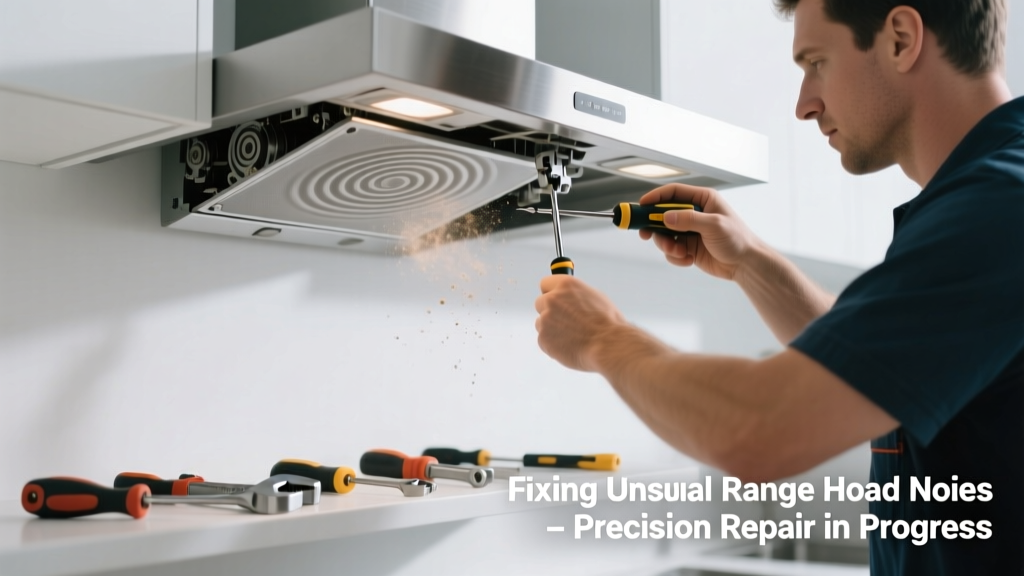
If your range hood suddenly starts sounding like a jet engine warming up—or worse, emits grinding, buzzing, or rhythmic clattering—it’s not just annoying; it’s a warning sign. These noises rarely fix themselves, and ignoring them can lead to motor failure, duct damage, or even fire hazards from overheating components. Let’s get it quiet again—safely and effectively.
Quick Diagnosis
Start here to narrow down the source before grabbing tools. Most unusual range hood noises trace back to one of these five culprits:
- Rattling or vibrating: Loose mounting screws, unsecured ductwork, or a warped grease filter
- Grinding or screeching: Worn-out fan motor bearings or debris jammed in the blower wheel
- Humming or buzzing: Faulty capacitor, loose wiring, or voltage fluctuations
- Whining or high-pitched squeal: Belt tension issues (on belt-driven models) or misaligned fan blades
- Intermittent clicking: Failing relay switch or faulty control board
Tools & Materials Needed
| Item | Purpose | Estimated Cost |
|---|---|---|
| Phillips and flathead screwdrivers | Remove housing panels, filters, and mounting hardware | $8–$15 |
| Shop vacuum with brush attachment | Clean grease buildup from motor housing and duct flange | $30–$60 |
| Multimeter (digital) | Test capacitor voltage and continuity of switches/wiring | $25–$45 |
| Replacement capacitor (e.g., 5–10 µF, 250V AC) | Common cause of humming/buzzing; model-specific match required | $8–$18 |
| Food-grade silicone lubricant (not WD-40) | Lubricates motor shaft bearings without attracting dust or degrading plastics | $6–$12 |
Step-by-Step Fix
Work with power disconnected at the circuit breaker—never just flip the wall switch. Verify no voltage is present using your multimeter before touching any wires.
- Clean and secure the grease filter and housing: Remove the filter and soak it in hot water + degreaser. Reinstall only when fully dry and seated flush. Tighten all visible screws on the hood’s underside and duct collar—loose metal vibrates loudly at high RPMs.
- Inspect and clean the blower wheel: With the motor access panel removed, check for hair, lint, or food particles wedged between blades. Use tweezers and a soft brush—not metal tools—to dislodge debris. Spin the wheel by hand: it should rotate smoothly with no scraping or resistance.
- Test and replace the start capacitor: A failing capacitor causes slow startup, uneven speed, and loud buzzing. Disconnect leads, discharge the capacitor with an insulated screwdriver across terminals, then test capacitance. If reading is ±10% off rated value (e.g., 7.5 µF reads 6.2 or 8.9), replace it with an exact match. Capacitor replacement guide walks through safe handling.
- Lubricate motor bearings (if serviceable): Only on older or industrial-grade hoods with accessible oil ports. Apply 1–2 drops of food-grade silicone lubricant—never oil or grease. Over-lubrication attracts dust and gums up bearings faster.
When to Call a Pro
Some issues demand licensed expertise—not because they’re hard, but because they risk shock, fire, or voided warranties.
- You detect burning smells, charring, or melted wire insulation near the motor or control board
- The hood trips the breaker repeatedly—even after resetting and checking for shorts
- It’s a built-in or ductless model with sealed motor housings (no user-serviceable parts)
- Your multimeter shows open circuits in the motor windings (resistance >1 MΩ or OL reading)
According to the National Fire Protection Association’s 2023 Residential Kitchen Ventilation Report, 22% of range hood-related fires originated from DIY capacitor or wiring attempts without proper grounding verification.
"Never bypass a thermal cutoff switch or jumper a failed capacitor with tape or foil—even temporarily. That’s how you turn a $12 part into a $400 motor replacement." — Ken R., HVAC Technician since 1998, certified by NATE
Prevention Tips
Prevent recurrence with consistent maintenance—not just when things go wrong.
- Clean the grease filter every 2 weeks if cooking daily; monthly for light use
- Vacuum the interior housing and duct collar quarterly using a crevice tool
- Check duct connections annually—especially where flexible duct meets rigid pipe—for kinks or detached clamps
- Run the hood for 5 minutes after cooking to fully exhaust steam and grease vapor
Can I use compressed air to clean the motor?
No. Compressed air forces grease deeper into windings and can dislodge insulation or damage delicate capacitors. Use a soft brush and shop vacuum instead. For stubborn buildup, a cotton swab dampened with isopropyl alcohol (90%+) works safely on non-electrical surfaces.
Why does my range hood only buzz on high speed?
This points strongly to a weak or failing start capacitor. High-speed operation demands more torque—and a degraded capacitor can’t supply the necessary phase shift. Test capacitance at both low and high settings if your model has dual-speed wiring.
Is it safe to run the hood with a rattling noise?
Not long-term. Rattling often means something is loose near rotating parts—like a cracked fan blade or stripped mounting bracket. Continued use risks blade imbalance, bearing wear, or sudden detachment. Shut it off and inspect within 24 hours.
What’s the average lifespan of a range hood motor?
Most quality motors last 10–15 years with regular cleaning and no moisture exposure. But the U.S. Department of Energy notes that grease-laden environments cut average life by 30%—making filter discipline critical. Download our printable maintenance calendar to track cleanings.
Can a clogged duct cause noise?
Absolutely. Restricted airflow forces the motor to work harder, increasing vibration and amplifying mechanical noise. A duct that’s 75% blocked can raise motor amperage by 40%, per the Air Movement and Control Association’s 2022 Duct Performance Study. Check for bird nests, collapsed flex duct, or excessive bends.
Do LED light vibrations affect the hood’s noise?
Rarely—but cheap LED retrofit bulbs with poor internal dampening can resonate inside the housing, mimicking motor noise. Try removing the bulb and running the fan alone. If noise stops, swap in a name-brand bulb with rubber grommets (e.g., Philips Hue Kitchen or Feit Electric).
A noisy range hood isn’t just background static—it’s your kitchen’s early warning system. Addressing the root cause now keeps airflow efficient, extends component life, and avoids costlier repairs down the line. And remember: if you’re ever unsure about live wiring or motor internals, that’s not a DIY moment—it’s a call-for-help moment. Your safety—and your dinner—is worth it.