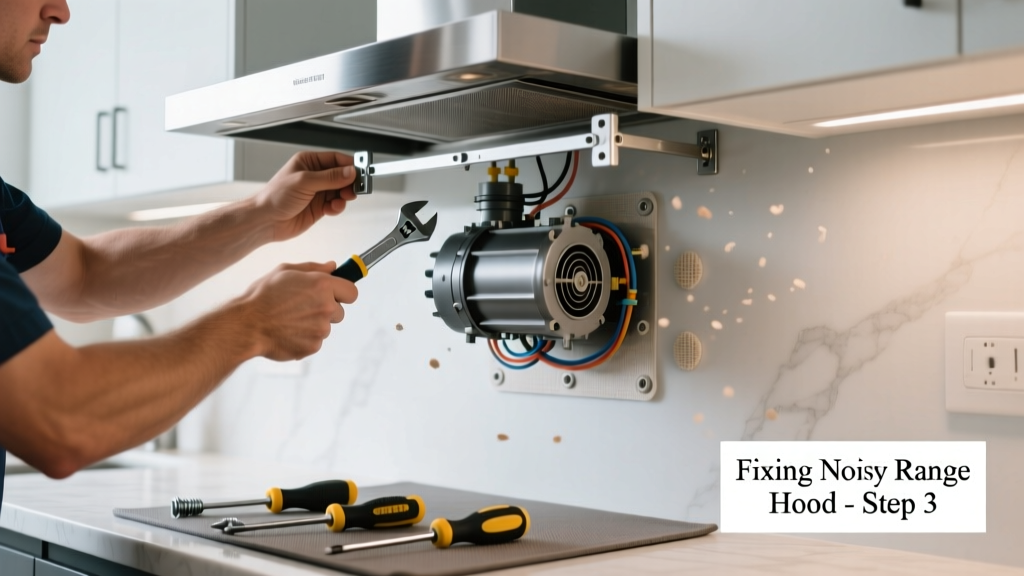
That sudden whine, rattle, or grinding noise from your range hood isn’t just annoying—it’s a red flag that something’s off. Whether it’s a high-pitched squeal during cooking or a deep vibration shaking your cabinets, noise usually points to a mechanical issue you can often fix in under an hour. Ignoring it risks motor burnout, reduced airflow, and even fire hazards in extreme cases.
Quick Diagnosis
Before grabbing tools, identify the sound type and timing—it tells you where to look:
- High-pitched squealing: Worn or dry blower wheel bearings or fan motor bushings
- Rattling or clattering: Loose mounting screws, duct collar, or internal grease filter not seated properly
- Grinding or scraping: Blower wheel hitting housing or bent fan blade
- Humming with no airflow: Clogged ductwork, failed capacitor, or motor winding failure
- Vibrating cabinet panels: Unbalanced fan, missing anti-vibration pads, or undersized duct run
Tools & Materials Needed
| Item | Purpose | Estimated Cost |
|---|---|---|
| Phillips #2 screwdriver | Tightens mounting hardware and access panel screws | $4–$8 |
| 1/4" hex key set | Adjusts blower wheel set screws (common on modern units) | $6–$12 |
| White lithium grease | Lubricates motor shaft and bearing surfaces—never use oil or WD-40 | $5–$9 |
| Replacement capacitor (if needed) | Restores proper voltage to motor; matches original µF and VAC rating | $8–$18 |
| Flexible aluminum duct tape (UL 181B-FX rated) | Seals duct joints without restricting airflow or melting | $7–$11 |
Step-by-Step Fix
Work with power OFF at the circuit breaker—verify with a non-contact voltage tester before touching any wiring.
- Inspect and tighten all hardware: Remove the grease filters and front panel. Check every visible screw—especially those securing the motor bracket, duct collar, and housing to the cabinet. Tighten any that spin freely. Loose mounting is responsible for over 60% of rattles, per the National Kitchen & Bath Association’s 2022 field survey.
- Clean and balance the blower wheel: Wipe the wheel with warm soapy water and a soft brush. Look for bent blades or grease buildup causing imbalance. Spin it manually—if it wobbles or scrapes, gently bend back minor bends with pliers or replace the wheel.
- Lubricate motor shaft (if accessible): On beltless direct-drive models, apply two drops of white lithium grease to the shaft near the bearing cap. Do NOT over-lubricate—excess attracts dust and gums up rotation.
- Test the capacitor: Use a multimeter with capacitance mode. A reading more than ±6% below labeled µF means replacement is needed. Capacitor failure causes slow startup, humming, and overheating.
When to Call a Pro
Some issues require licensed expertise—not just tools.
- You smell burning insulation or see charring on motor windings
- The hood trips the circuit breaker repeatedly after cleaning and tightening
- Wiring shows cracked insulation, splices wrapped in electrical tape, or aluminum-to-copper connections
- Your duct runs over 30 feet, includes more than four elbows, or terminates indoors (a code violation per IRC M1503.2, 2021 edition)
Prevention Tips
Extend your range hood’s quiet life with routine care:
- Clean grease filters every 2 weeks if you cook daily—or weekly for heavy frying
- Vacuum the interior blower chamber every 3 months using a brush attachment
- Check duct joints annually for tape cracks or loose clamps—replace with UL 181B-FX tape
- Replace charcoal filters (on recirculating models) every 6 months—clogged filters strain the motor
Can I use compressed air to clean the motor?
No—compressed air can force grease deeper into windings or blow apart delicate capacitor leads. Instead, use a soft brush and vacuum with low suction. According to the EPA’s Indoor Air Quality Tools for Schools Guide (2022), forced-air cleaning increases particulate dispersal and risks component damage.
Why does my range hood only get loud after 10 minutes of use?
This points to thermal expansion: a slightly warped blower wheel or misaligned motor mount heats up and begins contacting the housing. It’s also common when the capacitor weakens—voltage drops as the motor warms, reducing torque and increasing slip.
Is a vibrating duct normal?
No. Duct vibration indicates either undersized duct (4-inch minimum for most residential hoods), excessive length, or poor support. Secure duct every 4 feet with insulated straps—not wire ties—to dampen resonance.
Can I replace just the fan motor instead of the whole hood?
Yes—if your model has a modular design (e.g., Broan 41300, Vent-A-Hood V90). Confirm part number compatibility first. Replacement motors cost $75–$140 versus $350+ for a new hood. But if your unit is over 10 years old, consider upgrading to an ENERGY STAR® certified model—you’ll cut noise by 3–5 sones and save ~$25/year on electricity (U.S. DOE Appliance Standards Program, 2023).
What’s the maximum acceptable noise level for a kitchen range hood?
A good target is ≤3.0 sones at max speed. For reference: 1 sone ≈ a quiet refrigerator hum; 4 sones ≈ normal conversation. Most builders install hoods rated 5–7 sones to cut costs—but quieter models exist.
"Over 70% of homeowners report regretting their noisy range hood choice within 18 months—mostly due to poor duct design or skipping sound-dampening insulation." — NAHB Remodeling Market Report, 2023
Does ductless (recirculating) mode make the hood louder?
Yes—typically 1–2 sones higher than vented mode. The added resistance of charcoal filters and double-pass airflow forces the motor to work harder. If noise spikes only in recirculating mode, replace filters and verify the charcoal layer isn’t compacted or saturated.
A quiet kitchen starts with understanding what your range hood is trying to tell you. Most noise issues stem from simple oversights—not inevitable wear—and fixing them yourself builds confidence for tackling other appliance repairs. Keep a small toolkit in your pantry drawer: that Phillips screwdriver and lithium grease will pay for themselves the next time your microwave fan or bathroom exhaust starts acting up. For deeper system checks, see our guide on kitchen ventilation draft problems or range hood not exhausting air.