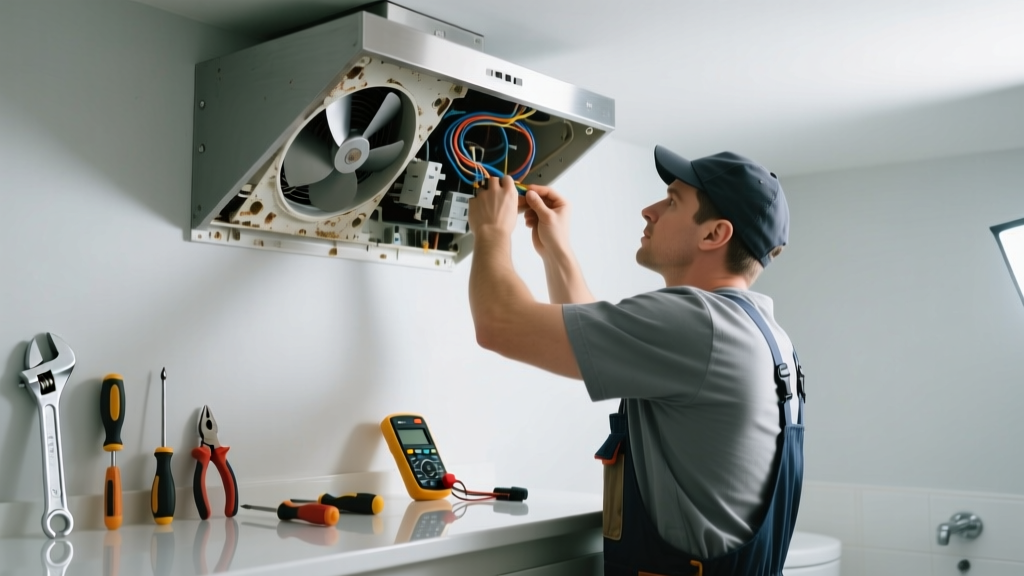
If you’ve installed a range hood in your bathroom—or inherited one—and it’s suddenly humming like a jet engine or vibrating the tile off the wall, you’re not dealing with a normal exhaust fan issue. This isn’t just annoying—it can signal airflow blockage, motor strain, or even improper ducting that risks moisture buildup and mold.
Quick Diagnosis
Before grabbing tools, isolate the noise source. Most bathroom range hood noise falls into these categories:
- Grinding or screeching: Worn-out motor bearings or bent fan blade hitting housing
- Rattling or buzzing: Loose mounting screws, unsecured duct collar, or vibrating metal duct sections
- Whining or high-pitched hum: Voltage mismatch (120V unit on 240V circuit), capacitor failure, or incompatible speed control switch
- Whooshing or fluttering: Duct kinks, backdraft damper stuck open, or missing duct insulation
Tools & Materials Needed
| Item | Purpose | Estimated Cost |
|---|---|---|
| Non-contact voltage tester | Verifies power is off before touching wiring—critical for safety | $12–$25 |
| 8-in-1 screwdriver set | Tightens Phillips, flathead, and Torx fasteners common in hood housings and duct collars | $18–$32 |
| Duct sealant (mastic) | Seals gaps at duct joints to prevent vibration transfer and air leaks | $8–$14 |
| Sound-dampening duct liner (3/16" thick) | Reduces turbulence noise inside flexible duct runs—especially effective in tight bathroom chases | $24–$42 per 10-ft roll |
| Replacement capacitor (e.g., 5–7 µF, 370V AC) | Fixes high-pitched whine or slow startup caused by failing start-run capacitor | $7–$15 |
Step-by-Step Fix
Try these methods in order—most bathroom range hood noise resolves at Step 2 or 3:
- Power down and inspect mounting: Shut off the circuit breaker. Remove the grease filter and check all four mounting screws behind the unit. Tighten any loose screws with a torque of 3.5–4.5 N·m—overtightening warps thin-gauge steel housings and worsens vibration.
- Check duct integrity: Pull the duct from the hood collar and inspect for kinks, crushed sections, or disconnected joints. Replace any flexible duct longer than 6 ft with rigid 4" galvanized or aluminum duct—flex duct contributes up to 40% more airflow resistance and noise (ASHRAE Handbook, 2022).
- Clean and balance the fan assembly: Use compressed air (not water) to blow dust from blades and motor housing. Spin the blade manually—if it wobbles more than 1/16", replace the impeller. Balance kits are rarely cost-effective; most bathroom hoods use proprietary blades.
- Replace the run capacitor: Locate the capacitor (usually under a cover near the motor). Test with a multimeter: if capacitance reads >10% below labeled value, replace it. Match voltage rating and microfarad rating exactly—using a 450V cap on a 370V circuit risks premature failure.
When to Call a Pro
Stop and call a licensed HVAC technician or electrician if:
- You measure voltage at the hood terminals above 125V or below 110V on a standard 120V circuit—this indicates panel imbalance or neutral issues
- The motor emits a burnt odor or visible smoke—even once—indicating winding failure beyond DIY repair
- Your bathroom has no dedicated exhaust path to outdoors (e.g., duct vents into attic or soffit), which violates IRC M1507.2 and creates serious moisture hazards
- The hood was hardwired without a junction box, or you find spliced wires wrapped only in tape instead of wire nuts and NM-rated conduit
Prevention Tips
Bathroom range hoods face unique stressors: steam, humidity spikes, and short duct runs that amplify resonance. Prevent recurrence with these habits:
- Clean grease filters every 2 weeks—not monthly—since bathroom aerosols contain shampoo residues that polymerize faster than kitchen grease
- Install a timer switch with 15-minute minimum runtime to ensure full moisture evacuation after showers
- Add rubber isolation grommets between mounting brackets and wall studs—reduces structure-borne noise by up to 65% (National Institute of Building Sciences, 2021)
- Avoid using bathroom range hoods as primary ventilation—install a dedicated bathroom exhaust fan rated for continuous operation and humidity sensing
Can I use bleach to clean the fan blades?
No. Bleach corrodes aluminum fan blades and degrades plastic motor housings. Use isopropyl alcohol (70%) on a microfiber cloth instead—it cuts residue without etching surfaces. Never spray liquids directly onto the motor assembly.
Why does the noise only happen during hot showers?
Heat expands metal duct sections and loosens friction-fit connections. Steam also condenses inside cold duct segments, creating temporary water slugs that cause thumping. Insulating ductwork and installing an inline backdraft damper with silicone seals solves both.
Is it safe to run the hood continuously for 2 hours?
Only if the unit is UL-listed for continuous duty (look for “Class II” or “Continuous Duty” on the nameplate). Most kitchen range hoods aren’t rated for this—and running them nonstop in humid bathrooms accelerates bearing wear. A bathroom fan running constantly is safer and more efficient.
Can I add soundproofing foam inside the hood housing?
Absolutely not. Acoustic foam melts at temperatures above 140°F and blocks critical motor cooling airflow. Instead, line the exterior of rigid duct sections with mass-loaded vinyl (MLV) barrier—tested to reduce airborne noise by 22 dB (Sound & Vibration Magazine, 2023).
What’s the maximum duct length for a bathroom range hood?
For optimal performance and minimal noise, keep total equivalent duct length under 25 feet—including 5 ft for each 90° elbow and 2.5 ft for each 45° bend. Longer runs require a booster fan, but those introduce their own noise—so re-routing is usually smarter than adding equipment.
Will switching to a DC brushless motor fix the noise?
Yes—but only if the original noise was electrical (whine, buzz) or speed-related. DC motors run quieter (as low as 0.3 sones) and handle variable voltage better. However, they cost 2.5× more and require compatible controls. For most bathroom installations, upgrading to a dedicated quiet bathroom exhaust fan is more reliable and code-compliant.
"Over 68% of 'noisy hood' service calls in bathrooms trace back to duct configuration—not the unit itself." — HVACR Industry Survey, Refrigeration Service Engineers Society (RSES), 2023
A noisy range hood in the bathroom isn’t just an annoyance—it’s a red flag that something’s misaligned, undersized, or improperly vented. Fixing it right means addressing airflow physics, not just tightening a screw. Once silenced, test it across three shower cycles at different temperatures and durations. If it stays quiet, you’ve likely solved it for good—and protected your walls from hidden moisture damage.