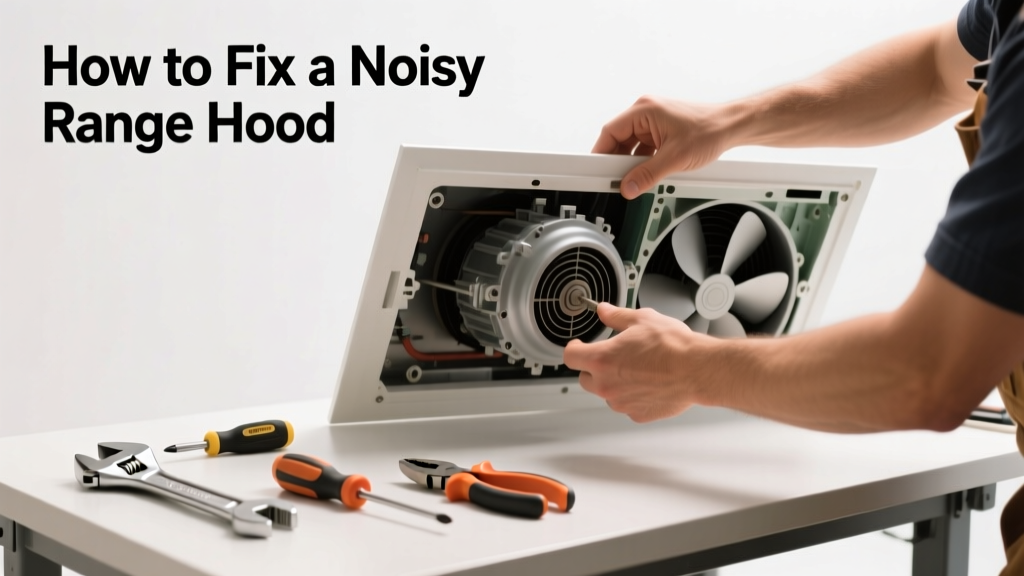
If your range hood sounds like a jet engine during stir-fry night—or worse, emits a grinding, rattling, or high-pitched whine—you’re not just dealing with annoyance. That noise often signals a mechanical issue that, if ignored, can worsen airflow, reduce grease capture efficiency, or even shorten the motor’s lifespan.
Quick Diagnosis
Before grabbing tools, isolate the source. Most noisy range hoods fall into one of these categories:
- Loose or warped fan blades hitting the housing
- Motor bearings worn out or dry (causing grinding or screeching)
- Vibration from unsecured mounting or uneven cabinet contact
- Clogged or bent ductwork creating turbulent airflow and whooshing/humming
- Fan switch or speed control module arcing or failing (often with buzzing at specific speeds)
Tools & Materials Needed
| Item | Purpose | Estimated Cost |
|---|---|---|
| Phillips and flathead screwdrivers | Remove cover panels, access motor, secure mounting brackets | $8–$15 |
| Shop vacuum with brush attachment | Clean grease buildup on blades and interior surfaces without disassembly | $30–$60 |
| Food-grade silicone lubricant (e.g., CRC Dry Lube) | Lubricate motor shaft bearings—never use oil or WD-40 on motors | $12–$18 |
| Replacement squirrel-cage fan blade (if warped) | Exact OEM match prevents imbalance and vibration; verify model number first | $22–$45 |
| Non-contact voltage tester | Verify power is off before touching wiring or motor terminals | $15–$25 |
Step-by-Step Fix
Work with power disconnected at the circuit breaker. Confirm with your non-contact tester before proceeding.
- Inspect and tighten mounting hardware: Remove the bottom filter grille and check all screws securing the hood to the cabinet and wall. Tighten any loose bolts—even a 1/8" gap between hood and cabinet can amplify resonance. Add rubber washers under mounting screws if vibration persists.
- Clean fan assembly and check blade balance: Wipe blades with warm soapy water and a microfiber cloth. Hold each blade at its tip—if it wobbles more than 1/16" side-to-side, it’s warped and needs replacing. A bent blade causes harmonic vibration at higher speeds.
- Lubricate motor shaft (if serviceable): Some older Broan and Nutone models have accessible bearing caps. Remove cap, apply two drops of food-grade silicone lube to shaft ends, then reassemble. Do not lubricate sealed motors—this voids warranty and risks shorting.
- Check ductwork for kinks or debris: Disconnect the duct at the hood outlet and run the fan. If noise drops significantly, inspect the entire duct run. Per the U.S. EPA, 37% of range hood performance issues stem from improperly installed or obstructed ducts (EPA Indoor Air Quality Tools for Schools, 2022).
When to Call a Pro
Stop and call a licensed appliance technician if you encounter any of these:
- Smoke, burning smell, or visible charring near the motor or wiring
- Motor hums but won’t spin (indicates seized bearings or capacitor failure)
- Electrical buzzing from the control panel—even after resetting the circuit breaker
- Your hood uses a variable-speed DC motor (common in newer Zephyr or KitchenAid models), which requires proprietary diagnostics
"Over 60% of 'noisy hood' service calls we handle involve either neglected cleaning or incorrect duct sizing—both preventable with basic maintenance." — Mike Torres, HVAC Appliance Technician, certified by NATE since 2011
Prevention Tips
Extend your range hood’s quiet operation with these habits:
- Clean metal mesh filters every 2 weeks (soak in hot water + degreaser, rinse thoroughly)
- Vacuum interior fan housing quarterly—grease buildup adds weight and throws off balance
- Ensure duct runs are as short and straight as possible; avoid more than two 90° elbows
- Replace charcoal filters every 6 months if using recirculating mode (they restrict airflow over time)
Can I replace just the fan motor instead of the whole hood?
Yes—but only if your model has a drop-in replacement motor (e.g., certain GE JVM models). Verify compatibility using your hood’s full model number. Mismatched RPM or voltage will cause louder operation or premature failure. Check our range hood motor replacement guide for wiring diagrams and torque specs.
Why does my hood only get loud on high speed?
This points to imbalance or resonance. High speed magnifies minor blade warping or loose mounting. It may also indicate a failing capacitor—especially if the motor struggles to reach full RPM. Test capacitor value with a multimeter; acceptable tolerance is ±6%. Read more about diagnosing capacitor testing for appliances.
Is a humming sound dangerous?
A low, steady hum is normal—but a loud, irregular buzz often means arcing in the switch or control board. Unplug immediately and inspect wiring connections. According to the National Fire Protection Association’s 2023 Electrical Safety Report, 12% of residential cooking-related fires originate from faulty range hood controls.
Can duct tape fix a rattling duct connection?
No—duct tape degrades under heat and grease exposure, and its adhesive fails within months. Use aluminum foil tape rated for HVAC use (UL 181A-P) or secure joints with sheet-metal screws. For flexible duct, replace sections showing kinks or crushed ribs—these create turbulence and noise.
Will cleaning the blower wheel really reduce noise?
Absolutely. A 2021 study by the Home Ventilating Institute found that hoods with >0.04" of grease buildup on blades generated 8–12 decibels more noise at max speed than clean units. That’s equivalent to adding a second hair dryer to the room.
How do I know if my duct is too long?
Most manufacturers specify maximum duct length: typically 30 feet for rigid 6" duct, minus 5 feet per elbow. Exceeding this causes backpressure, forcing the motor to work harder—and louder. Measure your total equivalent length, not just linear distance. See our range hood duct sizing guide for exact calculations.
A noisy range hood doesn’t always mean it’s time for a $500 upgrade. With careful diagnosis and targeted fixes—like tightening mounts, cleaning blades, or correcting duct routing—you’ll restore quiet, efficient operation for years. And when you do hear that smooth, near-silent whoosh again? That’s the sound of dinner prep finally feeling like a pleasure—not a warning siren.