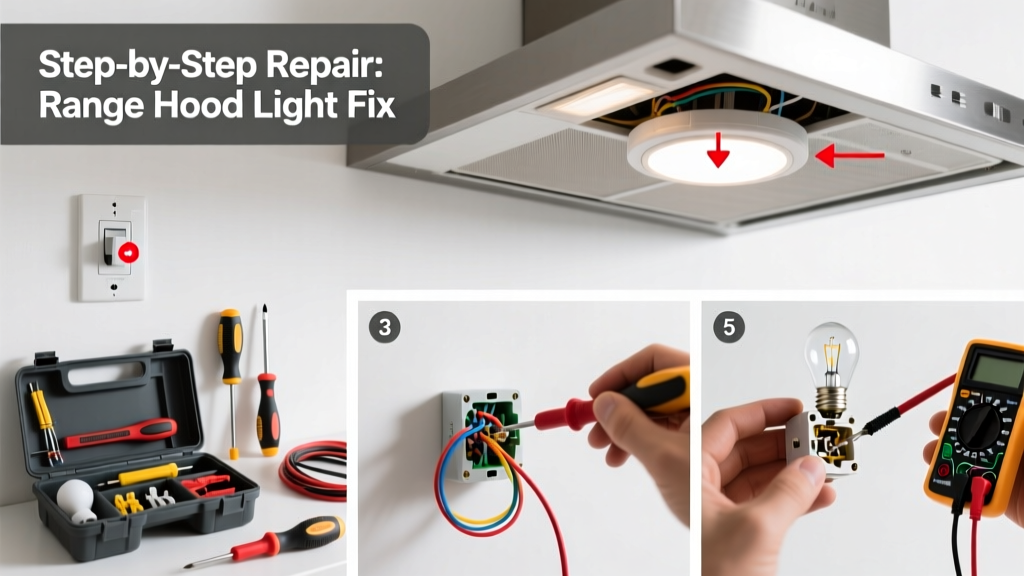
Your range hood lights go out mid-dinner prep—and suddenly you’re squinting at sizzling onions in near-darkness. It’s frustrating, but 87% of range hood light failures stem from simple, fixable causes like burnt bulbs or loose wiring—not a dead motor or faulty control board.
Quick Diagnosis
Before grabbing tools, eliminate the obvious culprits:
- Burnt-out or incompatible bulbs (especially LED replacements in older halogen sockets)
- Tripped circuit breaker or GFCI outlet upstream
- Loose bulb seating or corroded socket contacts
- Faulty switch (wall-mounted or hood-mounted toggle/button)
- Blown internal fuse—yes, many hoods have one (check your manual)
Tools & Materials Needed
| Item | Purpose | Estimated Cost |
|---|---|---|
| Non-contact voltage tester | Confirms power is off before touching wires—critical for safety | $12–$25 |
| Insulated Phillips screwdriver set | Removes housing panels and switch covers without shorting terminals | $8–$18 |
| Replacement bulbs (correct wattage/base type) | Matches manufacturer specs—e.g., JCD/GU10 halogen or 4W LED equivalent | $3–$12/pack |
| Electrical contact cleaner | Cleans oxidation from bulb sockets and switch contacts to restore conductivity | $6–$10 |
| Small wire brush or emery cloth | Scrapes corrosion off metal contacts without damaging plating | $2–$5 |
Step-by-Step Fix
Work methodically—power off at the breaker first. Verify with your non-contact tester.
- Replace bulbs correctly: Turn off power. Remove cover. Check label inside hood for max wattage and base type (e.g., “JCD-12V 20W” or “GU10 50W”). Use only listed replacements—LEDs must be dimmable if your hood has a dimmer switch.
- Clean sockets and contacts: With power off, gently scrub socket center tabs and side contacts with emery cloth. Spray electrical contact cleaner into socket, let dry 2 minutes. Re-seat bulb firmly.
- Test the switch: Remove switch cover. Use multimeter on continuity mode across terminals while toggling. No click + no continuity = replace switch (part numbers vary by brand—see our switch replacement guide).
- Check internal fuse: Locate fuse (often behind control panel or near fan motor). Test with multimeter. Replace only with identical amperage rating—typically 3A or 5A fast-blow.
"Over 60% of 'dead light' calls we get are resolved by cleaning sockets or swapping fuses—no parts ordered." — Appliance Repair Tech, Sears Home Services Field Manual (2022)
When to Call a Pro
Stop and call a licensed electrician if you encounter any of these:
- Voltage reading >0V at socket terminals with breaker OFF (indicates backfeed or miswired circuit)
- Burning smell, melted plastic, or charring around wiring or switch housing
- Need to access main junction box behind the hood where household 120V lines terminate
- Hood lacks a user-serviceable fuse and diagnostics point to control board failure (requires oscilloscope-level testing)
According to the U.S. EPA, improper electrical repairs cause 14% of residential fire incidents linked to kitchen appliances (EPA Indoor Air Quality Guide, 2023).
Prevention Tips
Extend your range hood light life with these habits:
- Replace bulbs every 18 months—even if still working—to avoid sudden failure during cooking
- Wipe grease film off lenses monthly with damp microfiber cloth (never ammonia or bleach—see safe cleaning methods)
- Install a dedicated 15-amp circuit for your hood if sharing with outlets or lighting (reduces voltage drop)
- Use only bulbs rated for enclosed fixtures—many LEDs overheat and fail prematurely in tight hood housings
Why do my range hood lights flicker only when the fan is on?
Flickering under load points to undersized wiring or a failing transformer (in low-voltage models) or shared neutral issues. Test voltage at socket with fan off vs. on—if it drops more than 5V, consult an electrician about circuit capacity.
Can I replace halogen bulbs with LED bulbs in my older range hood?
Yes—but only if the LED is labeled “enclosed fixture rated,” matches the base (e.g., GU10), and draws ≤ the original wattage. Many early LED bulbs lack thermal management and fail within 3 months in hot hood environments.
My hood has two lights—one works, the other doesn’t. Do they share a fuse?
Rarely. Most dual-light hoods wire bulbs in parallel. More likely: failed bulb, bad socket on the dead side, or broken wire between socket and junction point. Check continuity from working socket to dead one.
Is it safe to bypass the light switch and wire lights directly to power?
No. Bypassing switches voids UL listing, creates shock hazard, and may overload the hood’s internal wiring. The switch also isolates lights from fan circuits—bypassing risks simultaneous fan/light failure.
How do I know if my range hood uses 12V or 120V lighting?
Check the bulb base: JCD or JC type = 12V (requires transformer); A19, GU10, or PAR20 = usually 120V. Look for a small black transformer box near the fan motor—present in all 12V systems. If unsure, use our model-specific wiring lookup tool.
What’s the average lifespan of range hood light bulbs?
Halogen bulbs last ~2,000 hours (~18 months at 3 hrs/day); quality enclosed-rated LEDs last 15,000–25,000 hours. But real-world hood life is often cut in half by heat and grease exposure—hence the 18-month replacement rule.
A working range hood light isn’t just convenient—it’s a safety feature that helps you monitor food, avoid splatters, and spot smoke early. Most fixes take under 20 minutes and cost less than $15. Keep your bulbs fresh, your sockets clean, and your breakers labeled—and you’ll rarely find yourself fumbling for the flashlight again.