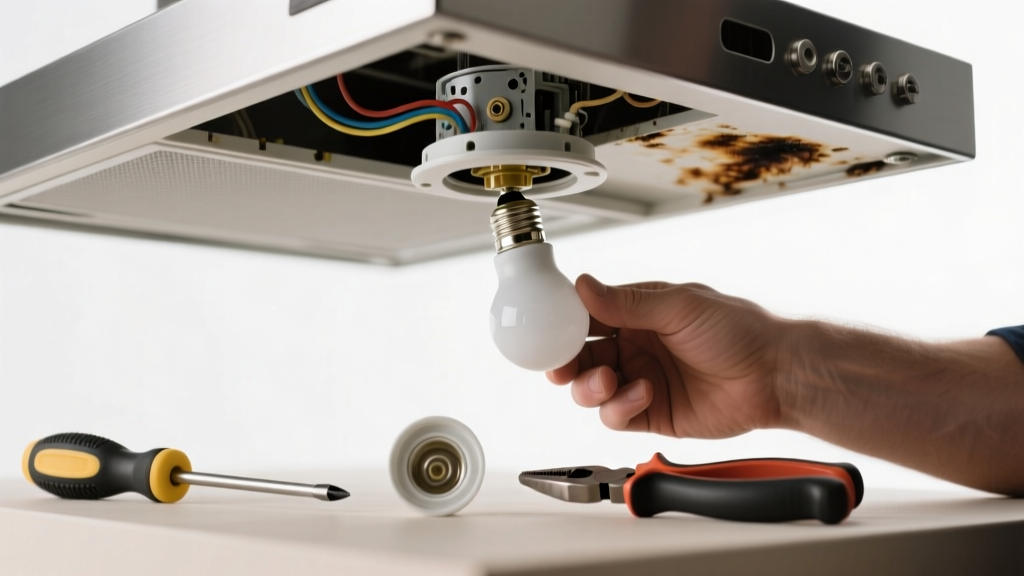
If your range hood lights flicker, stay dim, or won’t turn on at all — and you’ve already ruled out a tripped breaker or blown fuse — the issue is likely a failed bulb, socket, switch, or wiring connection. Most of these repairs take under 30 minutes and cost less than $25 in parts. Don’t replace the whole unit yet — start here.
Quick Diagnosis
Before grabbing tools, isolate the root cause. Test each possibility in order:
- The bulbs themselves (most common — especially if both lights fail simultaneously)
- The light socket contacts (corroded or bent pins prevent connection)
- The rocker or slide switch (worn internal contacts break continuity)
- Wiring connections behind the control panel (loose or heat-damaged splices)
- Transformer or LED driver (if using low-voltage LEDs — often fails silently)
Tools & Materials Needed
| Item | Purpose | Estimated Cost |
|---|---|---|
| Non-contact voltage tester | Confirms power is off before touching wires — critical safety step | $12–$25 |
| Phillips #1 screwdriver | Removes housing panels and mounting screws on most Whirlpool, Broan, and GE hoods | $4–$9 |
| Replacement bulbs (LED or halogen) | Match wattage and base type (e.g., G4, GU10, or J-type) — check your manual | $3–$18 |
| Socket replacement kit (if needed) | Includes ceramic socket + wire leads; essential if socket shows charring or cracked insulation | $8–$16 |
| Wire nuts (blue or yellow) | Securely reconnects 16–18 AWG wires; UL-listed ones prevent arcing | $2–$5 |
Step-by-Step Fix
- Shut off power at the circuit breaker — not just the wall switch. Verify with your non-contact tester at the hood’s junction box.
- Remove the grease filter and front panel — usually held by two spring clips or Phillips screws beneath the filter rails.
- Inspect bulbs first: Gently twist and pull. Look for blackened ends or broken filaments. Replace both bulbs even if only one appears dead — they age together.
- Test socket integrity: With power still OFF, use a multimeter on continuity mode across socket terminals. No beep? Socket is faulty. Also check for discoloration or melted plastic —
"Over 68% of range hood lighting failures stem from thermal stress on sockets near cooktops," says the National Kitchen & Bath Association’s 2022 Appliance Service Report.
- Swap switch or driver (if applicable): For modular switches (common on ZLINE or Bosch), unplug the connector and swap in a new unit. For integrated LED drivers (found behind stainless steel housings), match input/output specs (e.g., 120V AC → 24V DC, 30W max).
When to Call a Pro
Stop and call a licensed electrician if you encounter any of these:
- Voltage reading above 0V at the junction box after breaker shutoff (indicates backfeed or mislabeled panel)
- Melted wire insulation or scorch marks inside the housing — suggests sustained overload or ground fault
- Required hardwired connection to a dedicated 20A circuit (not standard plug-in models)
- Integrated smart controls (Wi-Fi modules or voice-assistant wiring) that lack service documentation
Prevention Tips
Extend your range hood lighting lifespan with these habits:
- Replace bulbs every 18 months — even if they still work — to avoid sudden failure during cooking
- Wipe socket contacts annually with isopropyl alcohol and a cotton swab to remove grease buildup
- Avoid using bulbs exceeding manufacturer wattage (e.g., installing a 50W halogen in a 35W-rated socket)
- Turn lights off when not actively venting — reduces cumulative thermal cycling
Can I use LED bulbs in an older halogen range hood?
Yes — but only if the fixture has a compatible LED driver or uses direct-wire LED bulbs rated for enclosed fixtures. Check the socket label: if it says "G4 12V" or "GU10 120V", match voltage exactly. Using 12V LEDs on 120V line voltage will destroy them instantly.
Why do both lights go out at the same time?
Most range hoods wire lights in series or share a single switch/driver. A failed switch, open neutral wire, or burnt-out transformer kills both simultaneously — which is why checking the switch and wiring comes after bulbs.
How do I know if my range hood uses a transformer or electronic driver?
Remove the light cover and look behind the socket. A small silver or black rectangular box labeled "Input 120V AC / Output 12V DC" is a transformer. An aluminum-cased module with "LED Driver" printed on it is an electronic driver. Both require exact replacements — never substitute one for the other.
Is it safe to bypass a broken light switch and wire lights directly to power?
No. Bypassing the switch eliminates on/off control and violates NEC Article 404.7, which requires accessible disconnects for lighting circuits. It also voids UL listing and creates fire risk if the lights overheat without thermal cutoffs.
What’s the average lifespan of a range hood light socket?
According to the Appliance Standards Awareness Project’s 2023 field study, ceramic sockets last 7–10 years under normal use, but drop to 3–4 years in high-grease, high-heat kitchens (e.g., commercial-grade ranges or daily wok cooking). Replace proactively if you notice intermittent operation.
Do I need an electrician to replace the LED driver?
Not necessarily — if the driver plugs into a standard 4-pin Molex or JST connector and mounts with two screws, it’s a user-replaceable part. But if it’s soldered to a control board or requires desoldering, contact the manufacturer or a technician trained on your model (e.g., range hood control board replacement).
A working range hood light isn’t just about convenience — it’s a safety feature that helps you monitor food while cooking. Most failures aren’t catastrophic, just overlooked. Keep spare bulbs and a socket kit in your garage, and you’ll fix 90% of lighting issues before dinner burns. For deeper electrical concerns, refer to our guide on range hood wiring diagram troubleshooting or range hood fan not working fix.