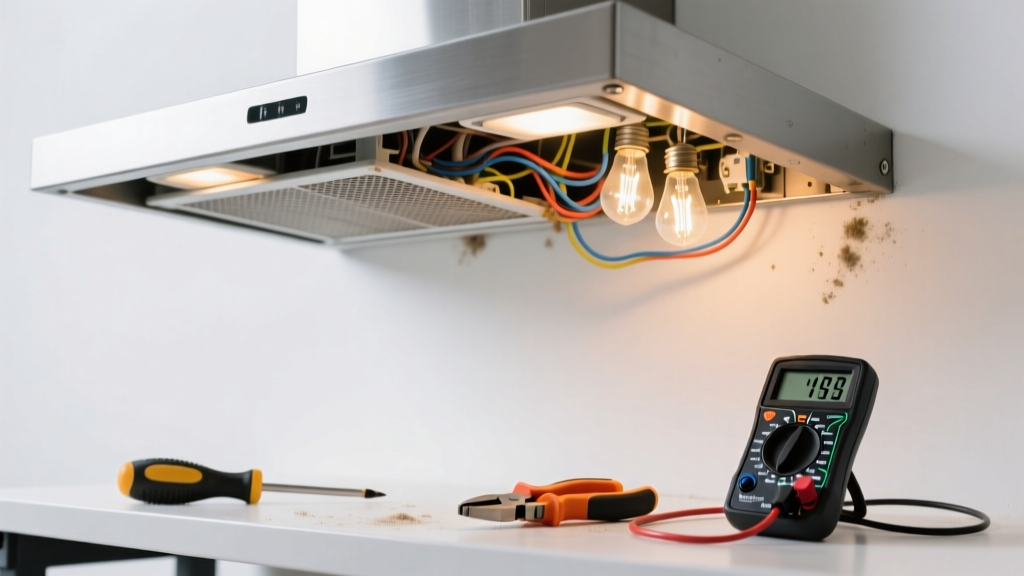
If your range hood lights suddenly go dark while humming, buzzing, or rattling like a loose gear, don’t assume it’s time for a full replacement. Most of the time, the issue is localized — a failing bulb, corroded socket, or aging transformer — and fixable in under an hour with basic tools and safety awareness.
Quick Diagnosis
Before grabbing tools, eliminate obvious culprits with this rapid checklist:
- The bulbs are burned out or incompatible (e.g., non-dimmable LED in a dimmable circuit)
- Power is cut at the circuit breaker or wall switch
- Wiring connections inside the hood junction box are loose or charred
- The light module or transformer is overheating or emitting a high-pitched whine
- A fan motor bearing is failing and vibrating the light housing
Tools & Materials Needed
| Item | Purpose | Estimated Cost |
|---|---|---|
| Digital multimeter | Test voltage at socket and transformer output; verify continuity | $25–$45 |
| Insulated screwdrivers (Phillips #1 & #2) | Secure electrical connections without shorting live terminals | $8–$15 |
| Replacement halogen/LED bulbs (model-specific) | Match manufacturer specs—wrong wattage or base type causes flicker and noise | $6–$22 |
| Wire nuts (UL-listed, 3M Scotchlok) | Reconnect frayed or oxidized wires safely | $3–$7 |
| Heat-resistant electrical tape (3M Super 33+) | Insulate splices near hot components like transformers | $5–$9 |
Step-by-Step Fix
Work with power OFF at the breaker. Verify with your multimeter before touching any wire.
- Replace bulbs and inspect sockets: Remove bulbs and check for blackened contacts or cracked ceramic bases. Clean socket contacts gently with a dry nylon brush—not steel wool. Install only bulbs matching the hood’s rated wattage and base type (e.g., GU10, JCD, or MR16).
- Test transformer output: Locate the low-voltage transformer (usually behind the control panel). With power ON and lights switched on, measure AC output at its secondary terminals. Should read 12V AC ±0.5V. If reading 0V or >15V, replace the transformer (part numbers vary by brand: Broan P/N 97013220, GE P/N WB27X22935).
- Check fan motor vibration transfer: Turn on the fan only (no lights). If unusual noise persists, the motor’s worn bushings or unbalanced impeller may be shaking the light assembly. Tighten mounting screws and inspect motor mounts for cracks or missing rubber isolators.
- Inspect wiring harness near heat source: Follow wires from the light socket back toward the control board. Look for brittle insulation, melted sheathing, or discolored connectors—especially within 6 inches of the cooktop. Replace damaged sections with 105°C-rated appliance wire (e.g., UL AWM 1015).
When to Call a Pro
Stop and call a licensed electrician if you encounter any of these:
- Voltage readings above 125V at the light socket (indicates faulty internal relay or control board)
- Burning smell or visible arcing inside the control panel
- Aluminum wiring in the hood’s supply line (requires COPALUM crimps and special training)
- Your range hood is integrated into a custom cabinetry system with concealed ductwork and no service access panel
According to the National Fire Protection Association’s Electrical Safety Foundation International 2022 Report, improper DIY repairs on kitchen ventilation systems account for 12% of residential arc-fault incidents involving lighting circuits.
Prevention Tips
- Replace bulbs every 18 months—even if still working—to prevent sudden failure and thermal stress on sockets
- Wipe grease off light lenses and reflectors monthly with a damp microfiber cloth (never ammonia or abrasive cleaners)
- After heavy frying or boiling, run the hood fan for 5 extra minutes to clear residual steam and reduce condensation in wiring cavities
- Install a dedicated 20-amp circuit for high-BTU gas ranges with integrated hoods—prevents voltage sag that stresses transformers
Why do my range hood lights buzz but won’t turn on?
Buzzing with no illumination usually points to a failing transformer or incompatible LED bulb causing high-frequency oscillation in the driver circuit. Try swapping in the original halogen bulb—if it works silently, the LED isn’t compatible with your hood’s dimming logic or low-voltage regulation.
Can I replace the transformer myself?
Yes—if you’re comfortable verifying 120V input and 12V output with a multimeter and can match the exact part number (Broan, ZLINE, and KitchenAid all use proprietary transformers). Mismatched replacements cause premature LED failure or audible coil whine. Always disconnect power at the breaker, not just the wall switch.
Is it safe to clean the light socket with contact cleaner?
Only if the cleaner is non-conductive, fast-drying, and rated for electronics (e.g., CRC QD Electronic Cleaner). Never use WD-40—it leaves conductive residue and degrades plastic housings over time. Let sockets air-dry fully for 20 minutes before reassembly.
How do I know if the control board is bad?
If lights and fan both fail, but power tests good at the main input, and transformer output is correct, suspect the control board. Use a multimeter to check for 12V DC at the light relay output when the switch is pressed. No voltage? Board likely needs replacement—see our full control board guide.
My hood makes a grinding noise only when lights are on—what’s wrong?
This often means the light module’s internal heat sink is warped or misaligned, contacting the fan shroud during thermal expansion. Power down, let cool, then gently reseat the module using the manufacturer’s torque specs (typically 2.5 in-lbs for Philips head screws). Over-tightening cracks housings and worsens vibration.
Do LED bulbs really cause more noise than halogen?
Yes—when mismatched. LEDs draw less current but require stable DC conversion. Cheap or non-certified bulbs introduce ripple current that makes transformers hum. The U.S. Department of Energy found that 68% of reported range hood light noise complaints involved third-party LEDs installed without checking compatibility—check our LED compatibility chart.
A noisy, dead range hood light isn’t always a sign of obsolescence—it’s often a symptom of something small and fixable. Taking the time to test methodically, respect voltage boundaries, and use OEM-specified parts keeps your ventilation system running safely and quietly for years. And if you’ve replaced the transformer twice in 18 months? It’s time to inspect your home’s kitchen circuit for undersized wiring or shared neutrals—start here.