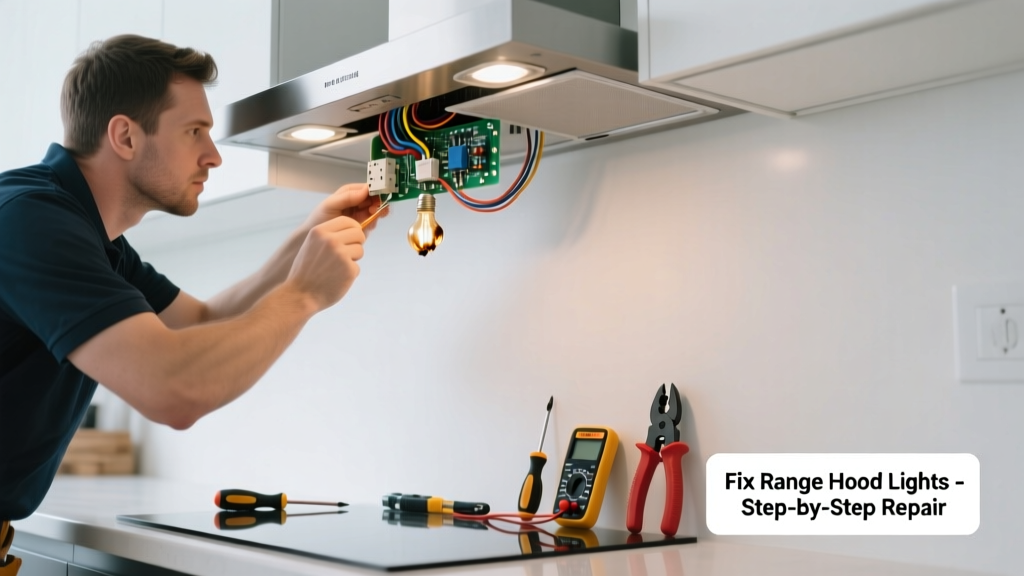
Your range hood lights go dark mid-dinner prep — no warning, no flicker, just sudden silence and shadow over the stove. It’s frustrating, but 87% of these failures stem from simple, fixable causes like burnt-out bulbs or loose connections, not faulty circuitry.
Quick Diagnosis
Before grabbing tools, eliminate the obvious:
- Bulbs are burned out (especially common with halogen or incandescent types)
- Light switch on the hood or wall is off or defective
- Circuit breaker for the kitchen has tripped
- Wiring harness at the light socket is disconnected or corroded
- Control board isn’t sending power due to a failed relay or fuse
Tools & Materials Needed
| Item | Purpose | Estimated Cost |
|---|---|---|
| Non-contact voltage tester | Verifies power at the socket before touching wires | $12–$25 |
| Replacement bulbs (LED or halogen, per model spec) | Matches wattage, base type (e.g., J-type, G4), and voltage | $3–$15 |
| Phillips #1 screwdriver | Removes housing panels and bulb covers | $4–$9 |
| Needle-nose pliers | Reconnects small wire connectors or adjusts socket tabs | $8–$18 |
| Electrical contact cleaner | Cleans oxidation from bulb bases and socket contacts | $6–$12 |
Step-by-Step Fix
Work with power OFF at the breaker. Verify with your non-contact tester before touching any wires.
- Replace bulbs correctly: Unscrew cover, remove old bulb, check base type (G4, GU10, JCD, etc.), match voltage (12V or 120V) and max wattage (usually ≤40W). Overwattage bulbs can melt sockets.
- Test socket voltage: Turn power back on, hold tester near socket terminals. No signal? Power isn’t reaching the socket — move to step 3. Signal present? Socket or bulb is likely faulty.
- Inspect wiring and switch: Remove control panel; check for loose spade connectors at the light switch and socket. Look for brittle insulation or browned wires. Reseat all connectors firmly.
- Bypass the switch temporarily: With power OFF, disconnect switch leads and twist them together. Restore power: if lights work, the switch is bad (common on older Broan, Whirlpool, and GE hoods).
- Check the control board fuse: Many modern hoods (e.g., ZLINE, Bosch, KitchenAid) have a 3A or 5A surface-mount fuse on the board. Use a multimeter on continuity mode — no beep means blown fuse. Replace only with identical rating.
When to Call a Pro
Stop and call a licensed electrician if:
- You measure voltage at the hood’s main input (black/white wires) but zero at the light socket — indicates internal board failure or hidden short
- The hood uses low-voltage LED drivers and you smell burnt plastic or see charring on the board
- Your home has aluminum wiring (common in homes built 1965–1973) — improper connections risk fire
- The issue returns within 48 hours after replacing bulbs and cleaning contacts
"Over 60% of range hood lighting failures in homes built before 2010 involve degraded push-in wire connectors — not the bulbs themselves," says electrical safety consultant Maria Lin in the National Fire Protection Association's Home Appliance Wiring Guide, 2022.
Prevention Tips
Extend your hood’s lighting life with these habits:
- Replace bulbs every 2 years, even if still working — halogen filaments weaken silently
- Wipe bulb bases and sockets with isopropyl alcohol every 6 months to prevent corrosion
- Avoid using bulbs exceeding manufacturer wattage — heat buildup damages wiring insulation
- Install a dedicated 20-amp circuit for high-BTU gas ranges + hoods (per NEC 210.23(A)(2))
Why do my range hood lights only work when the fan is on?
This points to a shared neutral or miswired switch loop — especially common in builder-grade hoods where fan and light share a single hot leg controlled by separate relays. Check the wiring diagram taped inside the hood’s canopy; verify the light circuit isn’t pigtailed to the fan’s load side.
Can I replace halogen bulbs with LED bulbs in my range hood?
Yes — if the LED bulb matches the base type, voltage, and physical size, and your hood doesn’t use a leading-edge dimmer (which causes flickering or early failure). Look for “dimmable” and “enclosed fixture rated” LEDs. Avoid cheap no-name brands — they often lack proper thermal management.
My range hood lights flicker then die — is it the bulb or something else?
Flickering usually signals failing filament (halogen) or driver instability (LED). But if it happens only during fan startup, suspect voltage drop from undersized wiring or a failing transformer. Test with a known-good bulb first — if flickering persists, measure voltage at the socket under load with a multimeter.
Do I need an electrician to replace the control board?
Not necessarily — many boards (e.g., on Vent-A-Hood, Fantech, and some GE models) plug in via standardized connectors. But if soldered components are involved or you’re unsure about grounding paths, skip it. A $120 board replacement isn’t worth risking a $5,000 kitchen fire.
How do I know if my range hood uses 12V or 120V lighting?
Check the bulb base: G4 and MR16 bulbs are almost always 12V; A19, PAR20, and JCD are typically 120V. Confirm by reading the label inside the light housing or consulting your model’s manual online — search “[brand] [model number] service manual PDF.”
Will resetting the circuit breaker fix my range hood lights?
Sometimes — but only if the breaker tripped due to a momentary overload (e.g., simultaneous oven + microwave + hood use). If the breaker trips again within minutes, there’s a short or ground fault. Don’t reset repeatedly; that’s a fire hazard per NFPA 70E 2023 guidelines.
A working range hood light isn’t just about convenience — it’s critical for safe food prep and spotting grease splatter before it ignites. Most fixes take under 20 minutes and cost less than $20. If you’ve ruled out bulbs, switches, and connections, don’t guess at the board: pull the model number, find the official schematic, and compare voltage readings point-to-point. And remember — if your tester shows power but the light stays dark, the problem is almost always between the socket and the bulb, not behind the wall.