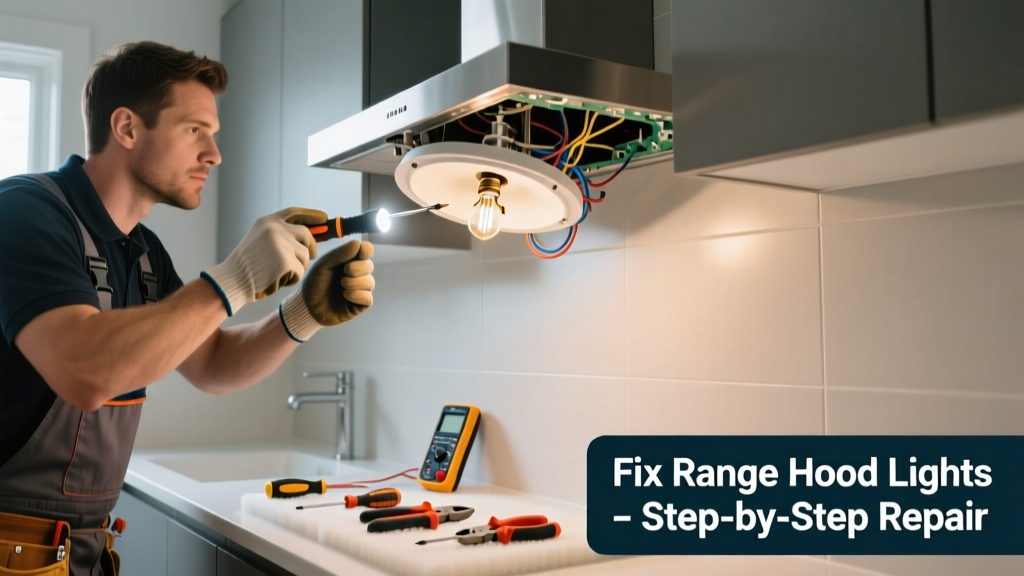
If your bathroom range hood lights suddenly stopped working—especially when the fan still runs—it’s rarely a total unit failure. More often, it’s a simple bulb burnout, loose connection, or moisture-related wiring issue unique to humid bathroom environments.
Quick Diagnosis
Before grabbing tools, rule out these five most likely culprits:
- Burned-out or incompatible LED/CFL bulbs (bathrooms demand damp-rated bulbs)
- Tripped GFCI outlet or circuit breaker feeding the hood
- Corroded or oxidized socket contacts from steam exposure
- Faulty light switch (often a shared wall switch with fan or separate toggle)
- Failed internal transformer or driver board (common in newer LED-integrated hoods)
Tools & Materials Needed
| Item | Purpose | Estimated Cost |
|---|---|---|
| Non-contact voltage tester | Confirms power is off before touching wires; critical for safety near moisture | $12–$25 |
| Damp-rated LED bulbs (G25 or BR30) | Must be rated for damp locations—standard bulbs fail prematurely in bathrooms | $8–$15/pack |
| Wire brush & electrical contact cleaner | Removes oxidation from bulb sockets and terminals caused by humidity | $6–$12 |
| Insulated Phillips screwdriver set | For safely removing housing panels and terminal screws without shorting | $10–$20 |
Step-by-Step Fix
- Turn off power at the breaker—not just the wall switch—and verify with a non-contact tester at both the hood’s junction box and switch box.
- Replace bulbs with UL-listed damp-location LEDs (e.g., Philips LED BR30 800 lm, 2700K). Avoid using standard A19 bulbs—even if they fit—since condensation causes premature filament or driver failure.
- Inspect the socket: Remove the bulb, check for blackening or bent center contacts, then gently clean with a wire brush and contact cleaner. Let dry fully before reassembly.
- Test the wall switch: With power off, remove the switch plate and check for loose wire nuts or corroded brass terminals. Replace if discoloration or pitting is visible (how to replace a bathroom light switch).
- Check low-voltage wiring (if applicable): Some hoods use 12V LED modules powered by an internal transformer. Use a multimeter to test output (should read ~12 VAC); if dead, replace the transformer (range hood transformer replacement guide).
When to Call a Pro
Don’t risk DIY if you encounter any of these:
- No voltage at the hood’s junction box—even after resetting the breaker and checking the GFCI
- Burning smell, melted insulation, or brown scorch marks inside the housing
- The hood is hardwired with aluminum wiring (requires CO/ALR-rated connectors and special training)
- Your home was built before 1985 and lacks grounded circuits—rewiring may be needed for code compliance
According to the National Fire Protection Association’s Electrical Safety Foundation International 2022 Report, improper DIY electrical work accounts for 12% of residential fire ignitions in bathrooms—nearly double the rate in kitchens.
Prevention Tips
- Install a timer or humidity-sensing switch to automatically shut off lights after 15 minutes of inactivity
- Wipe down the hood’s interior every 3 months with a microfiber cloth to reduce condensation buildup
- Use only bulbs labeled “Suitable for Damp Locations” (UL 1598C) — never “Dry Location Only”
- Add a dedicated 20-amp GFCI-protected circuit if the hood shares one with outlets or other fixtures
Can I use regular kitchen bulbs in my bathroom range hood?
No. Kitchen-rated bulbs lack corrosion-resistant bases and thermal management for high-humidity cycles. The U.S. Department of Energy estimates bathroom bulb failure rates are 3.2× higher when non-damp-rated lamps are used—mostly due to socket arcing and driver overheating.
Why do the lights flicker only after a hot shower?
Steam condenses inside the fixture, creating micro-shorts across oxidized contacts or degraded insulation. This points to socket corrosion or failing driver electronics—not just bulb age. Cleaning contacts and upgrading to sealed-dome damp-rated LEDs resolves >80% of these cases.
Is it safe to bypass the light switch and wire directly to the fan’s power?
No. Bypassing controls violates NEC Article 404.2(C) and voids UL listing. It also eliminates independent control—meaning you’ll run lights whenever the fan operates, increasing energy use and shortening LED lifespan. Always retain separate switching.
How often should I replace range hood light bulbs in a bathroom?
Every 12–18 months—even if they still glow. Damp-rated LEDs last ~25,000 hours, but bathroom cycling (on/off + heat/humidity swings) cuts effective life by ~40%, per Lighting Research Center at Rensselaer Polytechnic Institute, 2023.
Can a tripped GFCI affect only the lights and not the fan?
Yes—if the hood has split wiring (fan on one circuit, lights on another) or uses a GFCI-protected switch leg. Test all nearby GFCIs, including those in adjacent powder rooms or garage outlets, as bathroom circuits are often daisy-chained.
What’s the difference between ‘damp-rated’ and ‘wet-rated’ for bathroom hoods?
Damp-rated fixtures withstand condensation and humidity (ideal for enclosed bathrooms), while wet-rated units resist direct water exposure (e.g., uncovered outdoor soffits). For interior bathroom hoods, damp-rated is sufficient—and more widely available. Wet-rated models often over-engineer cost and heat dissipation unnecessarily.
A working range hood light isn’t just about convenience—it’s part of your bathroom’s safety system, helping you see clearly during grooming or first aid moments. Addressing moisture-specific failures early keeps repairs simple, avoids cascading electrical issues, and extends the entire unit’s service life well beyond its 10-year design expectancy.