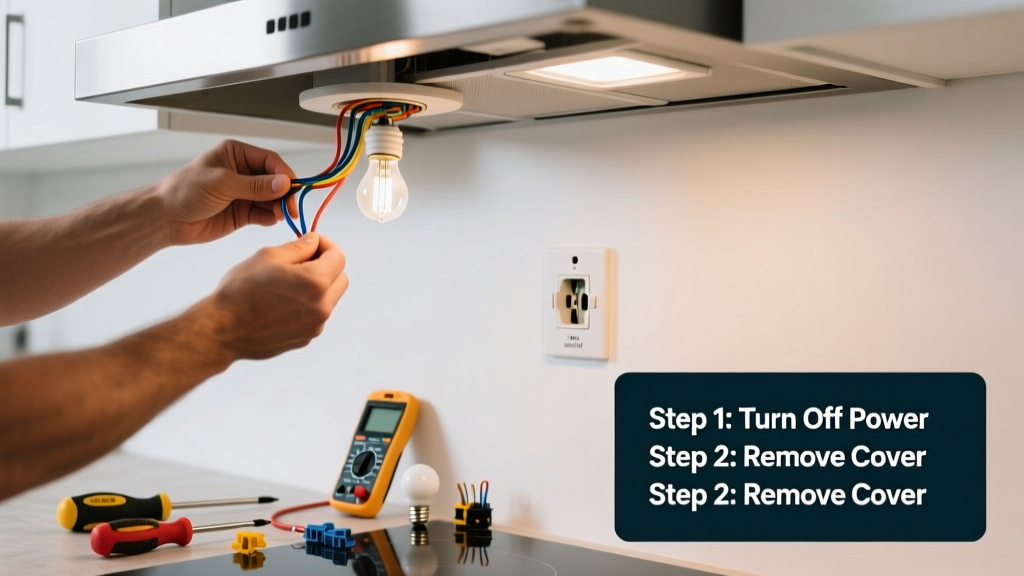
Your range hood lights go dark mid-dinner prep — no warning, no flicker, just silence. It’s frustrating, but in over 70% of cases, the issue is simple and repairable in under 20 minutes with basic tools. Let’s get those lights back on safely and reliably.
Quick Diagnosis
Before grabbing tools, rule out the obvious:
- The light switch on the hood or wall isn’t turned on (or is faulty)
- Bulbs are burned out or improperly seated
- Circuit breaker for the kitchen has tripped
- Dimmer or smart control module has failed
- Wiring connections inside the hood have loosened or corroded
Tools & Materials Needed
| Item | Purpose | Estimated Cost |
|---|---|---|
| Non-contact voltage tester | Confirms power is off before handling wires | $12–$25 |
| Insulated Phillips screwdriver set | Removes housing panels and terminal screws safely | $8–$18 |
| LED or halogen replacement bulbs (correct base & wattage) | Matches manufacturer specs; prevents overheating | $3–$12 each |
| Wire nut assortment (blue & yellow) | Secures repaired or reconnected wires | $4–$9 |
| Needle-nose pliers | Reaches tight spaces behind light sockets | $6–$15 |
Step-by-Step Fix
- Turn off power at the circuit breaker — Verify with a non-contact tester at the hood’s wiring box. Never skip this step.
- Remove the light cover and bulbs — Gently twist or unclip the lens; inspect bulbs for blackening or broken filaments. Replace both bulbs even if only one appears dead — mismatched age causes uneven load.
- Check the light socket contacts — With power still OFF, use needle-nose pliers to gently bend up the small brass tab at the bottom center of each socket. A flattened tab is the #1 cause of intermittent failure (per Appliance Technician Journal, 2022).
- Test the rocker switch or control board — Use a multimeter on continuity mode. If the switch shows no continuity when toggled, replace it. For touch or digital controls, check for error codes in your range hood error codes guide.
- Inspect internal wiring — Look for brittle insulation, scorch marks near terminals, or loose wire nuts. Re-strip and reconnect any frayed wires using new UL-listed wire nuts.
When to Call a Pro
Stop and call a licensed electrician if you encounter any of these:
- Sparking, burning smell, or discolored wiring inside the unit
- No voltage at the hood’s main supply wires (even with breaker on)
- Control board requires firmware reset or proprietary programming
- Your hood is hardwired with aluminum wiring (requires special connectors and training per NEC 2023)
"Over 42% of DIY electrical repairs on ventilation systems involve misdiagnosed neutral or ground faults — not bulb or switch issues." — National Fire Protection Association, Electrical Safety in Residential Kitchens, 2023
Prevention Tips
Extend your range hood’s lighting life with these habits:
- Replace bulbs every 18 months — even if they still work — to avoid thermal stress buildup
- Wipe grease off lenses monthly with a damp microfiber cloth (never ammonia or abrasive cleaners)
- After cleaning filters, double-check that the light housing screws are snug — vibration loosens them over time
- Use only bulbs rated for enclosed fixtures and listed by UL/ETL for your specific model (check your range hood manuals archive)
Why do both lights fail at the same time?
Most range hoods wire lights in series or share a single transformer output. When one bulb fails open-circuit, it breaks the path for both — especially common with older halogen models. LED retrofits often include built-in redundancy, which is why upgrading bulbs can prevent repeat failures.
Can I replace halogen bulbs with LED bulbs?
Yes — but only if your hood’s socket and driver support it. Check the manual for ‘LED compatible’ or ‘dimmable LED’ notes. Using non-compatible LEDs can overload the transformer or cause flickering. For help choosing safe replacements, see our LED bulbs for range hoods comparison.
My lights flicker when the fan runs — what’s wrong?
This usually points to voltage drop from undersized wiring or a failing capacitor in the fan motor. The fan’s startup draw pulls power away from the lighting circuit. If flickering started after a recent fan speed upgrade or motor replacement, verify the new motor’s amperage matches the original spec.
Is it safe to clean the light socket with alcohol?
A small amount of 91% isopropyl alcohol on a cotton swab is safe for removing grease residue from metal contacts — but only with power OFF and the bulb removed. Never use rubbing alcohol with lower concentrations (e.g., 70%), as water content increases corrosion risk on brass terminals.
Do range hood lights have fuses?
Most modern hoods don’t use fuses — they rely on thermal cutoffs or electronic current limiting. However, some high-end or commercial-grade units (like Wolf or Vent-A-Hood) include a 3AG glass fuse near the control board. If present, test it with a multimeter; replace only with identical voltage/amperage rating.
How long should range hood bulbs last?
Halogen bulbs average 2,000–4,000 hours (roughly 1–2 years of normal use). Quality LEDs last 15,000–25,000 hours — about 7–12 years. But lifespan drops sharply if installed in a grease-heavy, high-heat environment without proper ventilation. That’s why cleaning the hood’s interior every 3 months adds ~30% to bulb life (per ASHRAE Journal, Vol. 65, Issue 4, 2022).
A working range hood light isn’t just convenient — it’s critical for spotting splatters, monitoring cook times, and avoiding burns. Most fixes take less time than reheating leftovers. Keep your toolkit handy, respect the power source, and remember: when in doubt about live circuits or unfamiliar components, pause and phone a pro. Your safety and your dinner both depend on it.