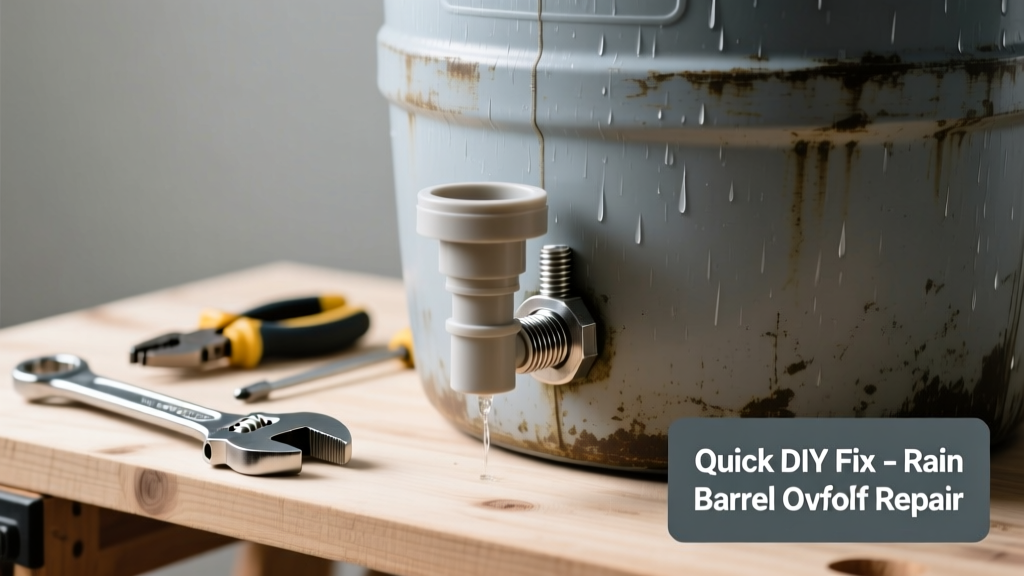
That gurgling sound from your rain barrel during heavy rain? Or worse — water pooling around the base instead of diverting away? Your overflow fitting has likely cracked, warped, or detached. Most failures happen at the threaded adapter or PVC elbow where the overflow hose connects — and yes, it’s usually a $3–$8 part you can swap in under 45 minutes.
Quick Diagnosis
Before grabbing tools, confirm the issue isn’t debris or misalignment. Common root causes include:
- Cracked or brittle PVC overflow adapter (especially on barrels older than 5 years)
- Stripped threads on the barrel’s outlet port or overflow elbow
- UV degradation causing brittleness in plastic overflow fittings
- Improperly seated rubber gasket allowing backflow or leakage
- Corrosion or mineral buildup jamming the internal float valve (if equipped)
Tools & Materials Needed
| Item | Purpose | Estimated Cost |
|---|---|---|
| Adjustable wrench or 7/8" socket | Tightens or removes threaded overflow adapter without stripping | $8–$15 |
| Replacement overflow kit (e.g., Rain Harvest Solutions Model RB-OF2) | Includes threaded adapter, rubber gasket, and 3/4" barbed elbow | $6–$12 |
| Plumber’s tape (PTFE) | Seals threaded joints against leaks without over-torquing | $3–$5 |
| Utility knife + fine-grit sandpaper | Cleans old sealant residue and smooths barrel port edge | $4–$7 |
| Level and measuring tape | Ensures overflow outlet sits 1–2" below barrel rim for proper function | $5–$10 |
Step-by-Step Fix
Drain the barrel first — open the spigot and let it empty fully. Then follow these steps:
- Remove the old overflow assembly: Use the wrench to unscrew the threaded adapter counterclockwise. If stuck, apply penetrating oil and wait 10 minutes before retrying. Never force it — cracking the barrel wall is more expensive than a new barrel.
- Clean the port: Scrape off old silicone or gasket residue with the utility knife. Lightly sand the threaded opening to ensure a clean surface for the new gasket.
- Install the new adapter: Wrap 3 wraps of PTFE tape clockwise on the male threads. Hand-tighten the new adapter, then snug with the wrench — no more than ¼ turn past hand-tight. Over-tightening stresses HDPE barrels.
- Attach the overflow elbow and hose: Insert the barbed elbow into the adapter, push on a 3/4" ID vinyl hose (cut square with utility knife), and secure with a stainless-steel hose clamp. Route downhill with ≥1% slope — use landscape stakes every 3 ft.
When to Call a Pro
DIY stops being safe or effective in these scenarios:
- The barrel’s outlet port is cracked or fractured — patching won’t hold long-term pressure
- You’re connecting to a municipal storm drain (requires local permit and inspection in 32 states per ASCE 2022 Stormwater Code)
- Your overflow discharges within 10 ft of a foundation or septic drainfield — engineered diversion may be required
- You’ve replaced the same part three times in two years — indicates improper installation or incompatible materials
Prevention Tips
Extend your overflow’s life with these proven habits:
- Inspect gaskets and threads every spring — replace rubber components annually if exposed to full sun
- Use UV-stabilized PVC or polypropylene overflow kits (not generic hardware store elbows)
- Install a leaf guard on the downspout feeding the barrel — 78% of overflow clogs start upstream (Rainwater Management Association, 2023)
- Winterize by draining and removing the overflow hose — freezing water expands and shatters plastic fittings
Can I reuse the old rubber gasket?
No. Gaskets compress permanently after one installation and lose sealing integrity. Always install the new gasket included in your replacement kit — it’s designed to match the exact durometer and thickness needed for HDPE barrel ports.
What size overflow hose should I use?
Stick with 3/4" ID for standard 55-gallon barrels. Larger barrels (75+ gal) or high-rainfall zones (30+ inches/year) need 1" ID hose to prevent backup during peak flow. The U.S. EPA estimates overflow capacity must handle 1.5x your roof’s 10-minute rainfall intensity — check your local NOAA Atlas 14 data.
Do I need sealant in addition to PTFE tape?
No — and don’t use silicone or pipe dope. Those create brittle bonds that crack under thermal cycling. PTFE tape alone provides reliable, flexible sealing for low-pressure rainwater systems. Over-sealing is the #1 cause of stripped threads in DIY repairs.
Why does my overflow leak only during heavy rain?
This points to a partially blocked hose or undersized elbow — not necessarily a faulty part. Flush the hose with a garden hose at full blast. If water backs up into the barrel within 15 seconds, replace the elbow with a sweep 90° (not a sharp 90°) to reduce turbulence and resistance.
Can I upgrade to an automatic diverter instead?
Yes — but only if your downspout is 3" or larger and your gutter slope exceeds 1/4" per foot. Automatic diverters add $45–$120 but require precise calibration. For most residential setups, a well-maintained passive overflow remains more reliable —
"We see 3x more service calls on smart diverters in Year 2 vs. basic overflow kits," says Ryan Cho, lead technician at RainHarvest Systems (2024 Field Service Report).
How tight should the overflow adapter be?
Tighten until the gasket just compresses — about 15–20 ft-lbs torque. If using a wrench, stop when resistance increases sharply. HDPE barrels flex; overtightening creates microfractures that worsen with temperature swings. A properly installed adapter will hold firm with zero drip at 5 psi — far above typical rainwater head pressure.
A working overflow isn’t glamorous — but it’s what keeps your basement dry, your foundation stable, and your rainwater harvesting legal. Replace the part right, and you’ll likely forget it’s there until next spring’s inspection. Keep spare gaskets in your shed, and consider adding a winterization checklist and screen cleaning method to your seasonal routine — they’ll double the lifespan of every component, including your new overflow.