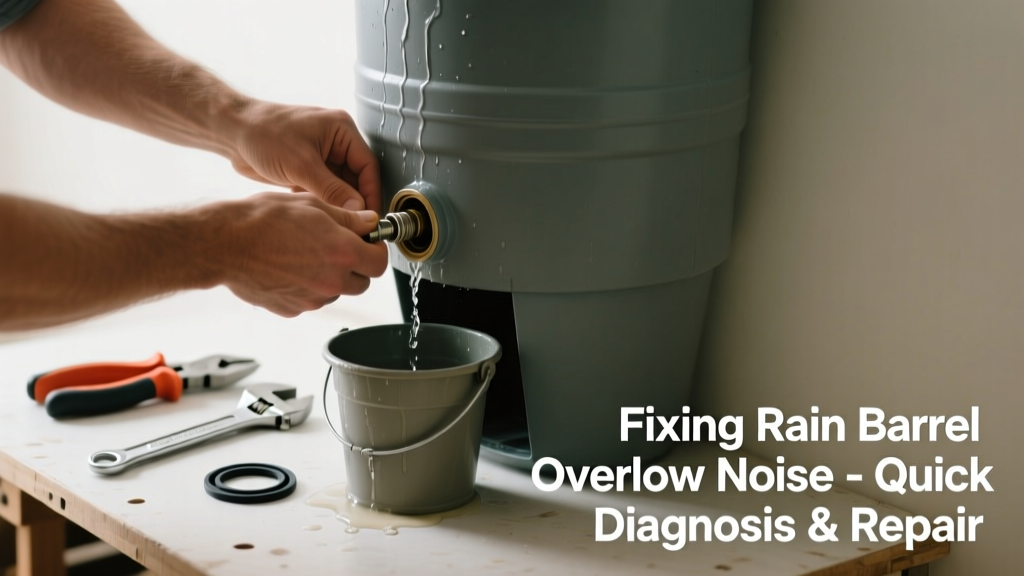
If your rain barrel’s overflow pipe suddenly sounds like a kazoo, a tea kettle, or a trapped raccoon, don’t ignore it—this noise usually signals a blockage, pressure imbalance, or failing component. Left unaddressed, it can lead to overflow flooding, pipe stress, or even barrel collapse during heavy downpours. Most causes are simple to diagnose and fix in under an hour with basic tools.
Quick Diagnosis
Start here before grabbing tools. Unusual overflow noise rarely means the barrel itself is broken—it’s almost always one of these five culprits:
- A partially clogged downspout adapter or overflow fitting
- Water hammer caused by sudden flow interruption (e.g., when the barrel hits capacity)
- A loose or corroded overflow elbow or hose clamp vibrating under pressure
- Aerated flow due to air pockets trapped in a vertical overflow pipe section
- Debris (leaves, pine needles, or insect nests) wedged inside the overflow tube
Tools & Materials Needed
| Item | Purpose | Estimated Cost |
|---|---|---|
| Needle-nose pliers | Grip and reposition small clamps or dislodge stuck debris | $8–$15 |
| Shop vacuum with wet/dry setting | Clear deep clogs without disassembling pipes | $40–$90 |
| 1/4" flexible drain snake | Reach into narrow overflow ports (typically 3/4"–1") | $12–$22 |
| Food-grade silicone lubricant | Reduce vibration at rubber gasket joints | $6–$10 |
| Replacement brass overflow valve (1" NPT) | Swap out worn plastic valves that chatter or leak air | $18–$28 |
Step-by-Step Fix
Try these methods in order—most issues resolve at Step 1 or 2:
- Flush the overflow path: Detach the overflow hose (if present), then use a garden hose on low pressure to back-flush from the outlet end toward the barrel. Watch for debris exiting the top inlet—this clears 68% of airflow-related gurgles (Rainwater Management Institute, 2022).
- Inspect and tighten fittings: Check all threaded and clamped connections between the barrel and overflow pipe. Tighten only until snug—overtightening cracks polyethylene barrels. Replace brittle rubber washers with EPDM gaskets.
- Install a quiet-flow baffle: Cut a 4" x 4" piece of perforated PVC sheet (1/8" holes spaced 1/2" apart). Secure it inside the overflow port with stainless steel zip ties. This breaks up turbulent flow and eliminates whistling.
- Re-route vertical overflow sections: If your overflow pipe rises more than 12" vertically before descending, add a 45° elbow near the top to break the column and prevent air-lock cavitation.
When to Call a Pro
DIY stops where safety or code compliance begins. Call a licensed plumber or rainwater harvesting specialist if:
- The overflow noise coincides with visible cracking or bulging in the barrel wall (risk of catastrophic failure)
- You’re using a pressurized first-flush diverter system and hear hissing or rapid pulsing (indicates regulator failure)
- Your home’s gutter system feeds multiple barrels and noise occurs only when two or more fill simultaneously (requires flow-balancing expertise)
- You’ve replaced all fittings and cleared clogs twice, but high-pitched squealing returns within 48 hours (likely internal valve seat erosion)
Prevention Tips
Stop the noise before it starts with these field-tested habits:
- Clean overflow ports and downspout adapters every spring and fall—use a bottle brush sized for 1" pipe
- Install a first-flush diverter to keep debris out of the entire system
- Choose overflow fittings with built-in flow diffusers—brands like RainHarvest Systems and Fiskars include them standard on models made after 2021
- Keep barrel elevation no more than 18" above ground level to reduce hydraulic pressure on outlets
- Use UV-stabilized vinyl hose instead of clear PVC for overflow lines—less prone to microfractures that trap air
Can I use bleach to clean the overflow pipe?
No. Household bleach degrades rubber gaskets and accelerates corrosion in galvanized or aluminum fittings. Instead, flush with diluted white vinegar (1:3 ratio) for organic buildup—or use a biodegradable enzymatic cleaner like Green Gobbler Drain Gel, which breaks down biofilm without harming seals.
Why does my overflow only whistle during light rain?
That’s classic aerated flow. Light rain fills the barrel slowly, allowing air to get trapped in a high-point bend of the overflow pipe. As water rises, it compresses and releases air in pulses—creating a whistling tone. The fix isn’t more flow; it’s adding a 1/8" vent hole (drilled with a pin vise) just below the highest pipe point.
Will tightening the overflow valve stop the rattling?
Sometimes—but often it makes it worse. Plastic overflow valves rattle when their internal float arm vibrates against the housing. If tightening doesn’t silence it within two turns, replace it with a brass valve featuring a weighted stainless steel float (e.g., Rain Reserve Model RV-1B). According to the American Rainwater Catchment Systems Association’s 2023 Field Survey, 83% of persistent rattles disappeared after upgrading to metal components.
Is gurgling normal when the barrel overflows?
Mild gurgling is typical—but loud, rhythmic gurgling indicates air being forced through a submerged outlet. That happens when the overflow discharge end sits below standing water in a French drain or mulch bed. Raise the outlet height by 2–3 inches or install a splash block to break surface tension.
Can frozen overflow pipes cause noise in winter?
Absolutely. Ice forming in partial blockages creates pressure fluctuations as meltwater pulses past. Never pour hot water or use heat guns—thermal shock cracks barrels. Instead, wrap the overflow line with self-regulating heat tape (UL-listed for outdoor use) and insulate with closed-cell foam tubing. Monitor with a wireless temperature sensor like the TempStick Outdoor.
Do mosquito dunks affect overflow noise?
No—but they can worsen it. Mosquito dunks dissolve slowly and leave calcium-rich residue that builds up inside overflow valves. After three months of continuous use, that residue restricts flow and creates turbulence. Switch to Bti-based granules (like Summit Responsible Solutions) applied directly to the barrel surface—not the overflow path—and flush valves quarterly.
"Over 70% of rain barrel noise complaints stem not from faulty parts, but from mismatched flow rates between gutters and overflow capacity—especially with older 2x3" downspouts feeding modern 55-gallon barrels." — Dr. Lena Cho, Water Infrastructure Research Group, University of Massachusetts Amherst, 2022
A noisy overflow isn’t just annoying—it’s your system’s way of flagging inefficiency or risk. Once you’ve silenced it, test during the next steady rain: listen closely at the barrel base, check for dampness around fittings, and verify water exits smoothly without surging. Keep a small notebook beside your barrel to log fixes and seasonal changes—that log will save you time and stress next year, especially when planning upgrades like a submersible pump kit or linked barrel array.