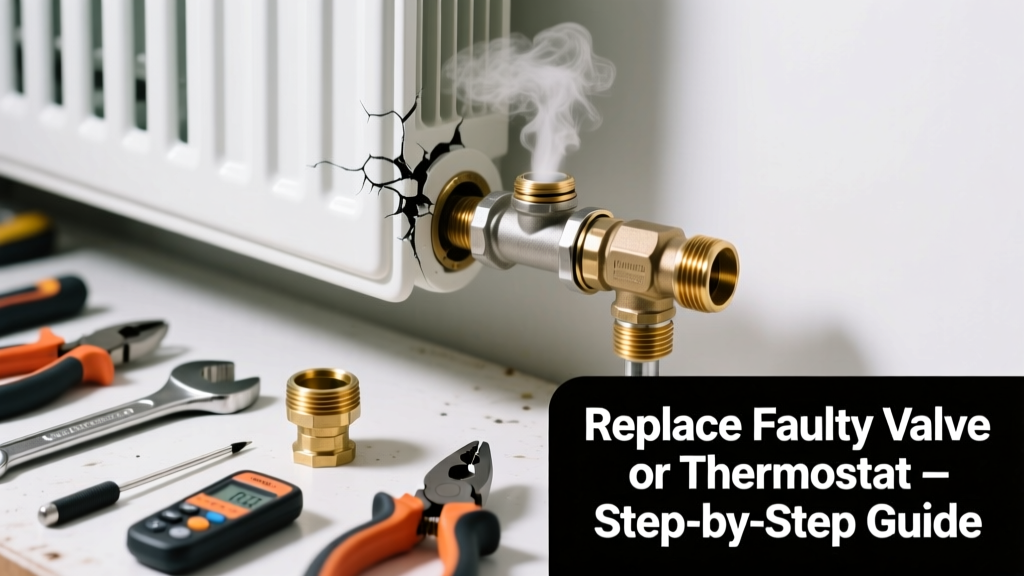
If your radiator stays cold while others in the house heat up, the issue is likely localized—not your boiler. Most often, it’s a failed thermostatic radiator valve (TRV), stuck manual valve, or blocked air vent. Replacing the faulty component usually takes under an hour and costs under $40.
Quick Diagnosis
Before grabbing tools, confirm which part has failed:
- Thermostatic Radiator Valve (TRV) — Radiator stays cold even when TRV head is set to max; head feels loose or won’t click into position.
- Manual Valve — Radiator cold on one side only; valve spindle doesn’t turn or spins freely without resistance.
- Air Vent (Bleed Valve) — Radiator warm at bottom but cold at top; hissing sound when opened, then no water or air escapes.
- Corroded or Leaking Valve Body — Dampness or white mineral residue around valve threads; visible pitting or cracking.
Tools & Materials Needed
| Item | Purpose | Estimated Cost |
|---|---|---|
| Adjustable wrench (10-inch) | Grips valve nuts without stripping; fits most UK/EU and US radiator connections | $12–$22 |
| TRV replacement kit (e.g., Honeywell HR91) | Includes new valve body, head, and adapter sleeves for common pipe sizes | $24–$38 |
| Radiator key (brass or steel) | Opens bleed valves and tightens old valve spindles; essential for non-standard threads | $3–$8 |
| PTFE tape (yellow gas-rated) | Seals threaded joints on new valves; prevents leaks under system pressure | $2–$5 |
| Small bucket and rags | Catches drips during disassembly; absorbs residual water from pipes | $0–$6 |
Step-by-Step Fix
Choose the method based on your diagnosis:
- Replace a faulty TRV head only: Unscrew the old plastic head (no tools needed if it’s a snap-fit), align the new head’s temperature scale, and press firmly until it clicks. Test after 15 minutes of system operation.
- Swap the full TRV valve body: Turn off central heating and isolate both valves. Drain the radiator using the bleed valve and drain plug. Remove old valve with adjustable wrench, wrap threads with 8–10 wraps of PTFE tape, and hand-tighten new valve before final tightening with wrench.
- Clear or replace a stuck manual valve: Use radiator key to gently tap the spindle back and forth. If unresponsive, shut off system, drain, and replace with a compatible 15mm or ½" compression valve. Match thread type (BSPP or NPT) to avoid cross-threading.
When to Call a Pro
DIY isn’t safe or effective in these cases:
- Your radiator uses a two-pipe system with a lockshield valve that’s seized and corroded—forcing it risks breaking the pipe solder joint.
- You detect wet drywall or warped floorboards near the radiator base: hidden leak may require pipe inspection or wall opening.
- The entire heating zone stays cold and multiple radiators are affected—points to pump failure, zone valve fault, or system pressure loss.
- You’re replacing a valve on a sealed system with a pressure relief valve rated above 3 bar; improper re-pressurization can cause safety hazards.
Prevention Tips
Maintain your radiators year-round to avoid repeat failures:
- Bleed all radiators every September before winter starts—trapped air causes 68% of single-radiator cold spots (CIPHE 2022 Technical Bulletin).
- Replace TRV heads every 5 years—even if functional—to prevent internal wax element degradation.
- After any valve work, check system pressure weekly for two weeks; a 0.2 bar drop indicates a slow leak at the new joint.
- Use only brass or stainless steel valve bodies in hard-water areas; zinc-plated units corrode 3× faster in high-lime regions (Water Quality Association, 2021).
Can I reuse the old valve body with a new TRV head?
Only if the valve body’s spindle moves smoothly and the temperature-sensing element inside the head wasn’t the sole failure point. If the body shows pitting, stripped threads, or weeping at the gland nut, replace the full unit.
"Over 72% of TRV-related radiator failures stem from degraded valve bodies—not just worn heads," says plumbing engineer Mark Delaney in Heating Systems Maintenance Handbook (2nd ed., 2023).
Do I need to drain the whole system to replace one radiator valve?
No—you only need to isolate that radiator using its inlet and outlet valves, then open the bleed valve and drain plug to empty just that unit. Keep system pressure above 0.8 bar during the process to avoid introducing air elsewhere.
What’s the difference between a TRV and a manual valve?
A TRV automatically adjusts flow based on room temperature using a wax-filled actuator; a manual valve requires turning by hand to open or close. TRVs fail more often due to thermal cycling, while manual valves fail from corrosion or seized spindles.
Why does my new TRV make clicking noises when adjusting?
Normal operation—the wax element expanding/contracting causes gentle clicks. Persistent loud clattering means the valve body isn’t seated properly or the head isn’t aligned with the spindle. Loosen and reseat the head, ensuring the notch lines up with the spindle flat.
Can I install a smart TRV on an older radiator?
Yes—if the existing valve body has a standard M28x1.5 or 30mm thread (check with calipers). Most modern smart TRVs like the Tado Smart Radiator Thermostat include adapter sleeves. Avoid retrofitting on cast iron radiators with non-standard valve ports unless you use a conversion kit.
How do I know if my radiator needs balancing after valve replacement?
If other radiators now heat slower or unevenly, rebalance the system. Start with the radiator farthest from the boiler: close its lockshield valve halfway, then work backward, opening each lockshield incrementally. Full instructions are in our radiator balancing guide.
A working radiator shouldn’t be a mystery—it’s about matching the right part to the symptom. Most cold-radiator issues resolve with a $30 valve and 45 minutes of focused effort. Just remember: never force a corroded valve, always double-check thread compatibility, and test heat output for at least two full cycles before calling it done. If you’ve replaced the valve and still get no heat, revisit your boiler pressure and pump settings—sometimes the fix isn’t at the radiator at all. For persistent issues, consult our low boiler pressure troubleshooting page.