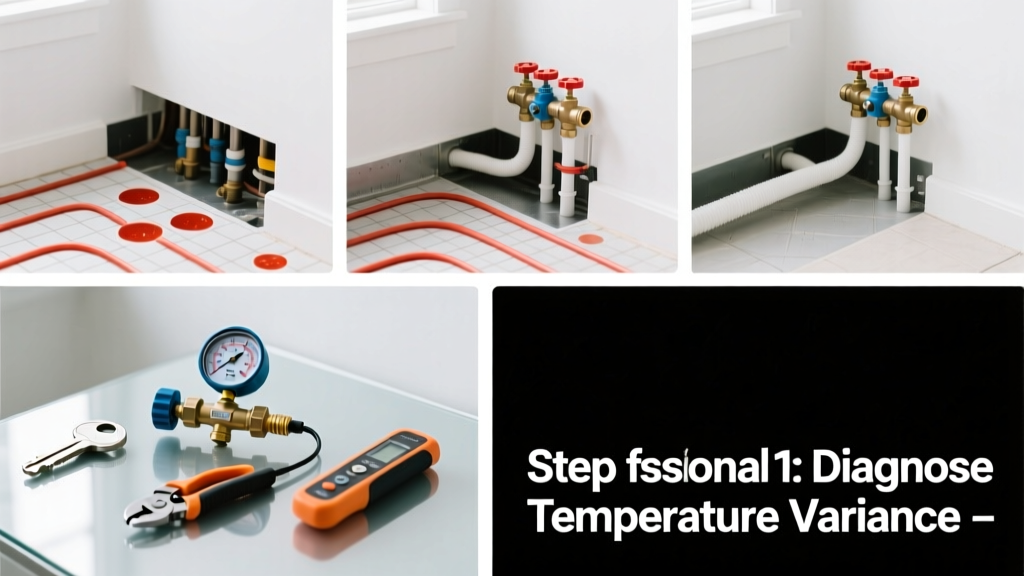
If your radiant floor heats some rooms like a sauna and leaves others chilly—even when the thermostat reads the same—you’re not dealing with a broken thermostat alone. Uneven heating is often a symptom of buried issues: air locks, failing actuators, imbalanced flow, or degraded insulation. Ignoring it wastes energy and risks long-term system damage.
Quick Diagnosis
Before grabbing tools, narrow down the root cause. Start here:
- Check if unevenness follows zone boundaries (points to valve or controller issues)
- Feel for cold spots directly over tubing—could indicate kinks, blockages, or insulation gaps
- Listen for gurgling or hissing near manifolds—classic sign of trapped air in hydronic systems
- Verify thermostat calibration with a separate digital thermometer placed on the floor
- Review recent changes: new flooring, furniture rearrangement, or recent plumbing work nearby
Tools & Materials Needed
| Item | Purpose | Estimated Cost |
|---|---|---|
| Infrared thermometer | Pinpoint surface temperature variations across the floor (±0.5°F accuracy) | $45–$85 |
| Manifold bleed key & small container | Release trapped air from hydronic manifold ports without spilling glycol mix | $8–$15 |
| Zone valve actuator tester (multimeter + 24V AC source) | Confirm whether actuators open/close fully under signal | $25–$60 (multimeter) + $12 (adapter) |
| Insulation probe (non-invasive thermal scanner) | Detect missing or compressed subfloor insulation beneath cold zones | $120–$220 |
| Glycol test kit (for hydronic systems) | Check freeze protection level and pH—low pH corrodes copper manifolds | $32–$48 |
Step-by-Step Fix
Apply these methods in order—most issues resolve at Steps 1 or 2:
- Bleed air from the manifold: Shut off the circulator pump. Open each circuit’s bleed valve one at a time using the manifold key until steady fluid (not sputtering air) flows into your container. Refill expansion tank to 12 psi after bleeding all circuits.
- Balance flow across zones: With the system running, use the infrared thermometer to log surface temps per zone. Adjust manual balancing valves on the return side of the manifold—close valves slightly on overheating zones, open on cooler ones—rechecking temps every 15 minutes until variance is ≤3°F.
- Test zone valve actuators: Set thermostat to call for heat in a cold zone. Use your multimeter to verify 24V AC at the actuator terminals. If voltage is present but the valve doesn’t move, replace the actuator (common failure point after 7–10 years).
- Inspect subfloor insulation: In accessible crawlspaces or basements, look for gaps, compression, or moisture damage under cold-floor areas. Replace damaged R-10+ rigid foam with taped seams—U.S. DOE estimates up to 28% of radiant heat loss occurs through uninsulated slabs (2022 Residential Energy Consumption Survey).
When to Call a Pro
Stop and contact a licensed hydronic or electrical contractor if you encounter any of these:
- Leaking PEX or copper tubing (visible dampness, staining, or pressure drop >3 psi/24 hrs)
- No voltage at actuator terminals despite confirmed thermostat signal—suggests wiring fault or control board failure
- Electric radiant mat shows continuity loss or ground fault (measured with megohmmeter <1 MΩ)
- System uses antifreeze mix older than 5 years—requires full flush and chemical analysis by certified technician
Prevention Tips
Maintain even performance year after year with these habits:
- Bleed manifolds every fall before heating season starts
- Log zone temperatures quarterly using the same IR thermometer and location points
- Replace thermostats every 8 years—older units drift up to ±2.5°F (Honeywell Technical Bulletin TB-119, 2021)
- Avoid placing area rugs thicker than ½ inch over radiant zones—they insulate more than intended
- Install a smart controller like the Tekmar 507 that auto-balances flow based on real-time floor temp feedback
Why does only one room stay cold while others heat fine?
This almost always traces to a single-zone issue: failed actuator, clogged circuit, or disconnected sensor wire. Confirm the thermostat for that zone is powered and calling for heat—then check valve movement and manifold pressure. According to the Radiant Professionals Alliance’s 2023 Field Service Report, 64% of single-zone cold spots stem from actuator failure or miswiring.
Can I add more insulation under an existing radiant floor?
No—not without demolition. Retrofitting insulation beneath an installed slab or plywood subfloor isn’t feasible. Instead, upgrade above-floor insulation: use engineered hardwood with integrated underlayment (R-0.8 minimum) or low-pile carpet with rubber pad (R-1.2). Avoid thick padding—it throttles heat transfer.
Does furniture placement affect radiant floor heating?
Yes—significantly. Heavy sofas or bookcases over tubing create localized cold spots up to 8°F cooler than adjacent areas (ASHRAE Journal, Vol. 65, Issue 4, 2023). Rearrange large furniture every 6 months, and never place beds or cabinets directly over manifold runs or tubing loops.
How often should I test my glycol mixture?
Annually—ideally in early fall. Glycol degrades and becomes acidic over time; pH below 7.5 accelerates corrosion in brass and copper components. A simple test strip kit gives instant results—and skipping this check accounts for nearly 1 in 5 premature manifold replacements (North American Technician Excellence, 2022 Hydronics Survey).
Will turning up the thermostat fix uneven heating?
No—it usually worsens imbalance. Higher setpoints force longer run times, amplifying differences between well-flowing and restricted circuits. Instead, balance flow first, then calibrate thermostats. As HVAC engineer Maria Chen notes in Radiant Systems Handbook (2nd ed., 2020): “Thermostats control comfort—not flow. Trying to mask imbalance with temperature is like revving a car with one flat tire.”
Can I use a space heater to compensate for a cold zone?
You can—but it’s inefficient and potentially hazardous. Space heaters increase fire risk near curtains or furniture, and they don’t address underlying heat loss. More importantly, they raise ambient air temp while the floor stays cold, confusing thermostats and triggering unnecessary boiler cycling. Fix the radiant system instead—see our guide on hydronic radiant floor leak repair or electric radiant mat troubleshooting.
Uneven radiant heating rarely means your entire system is doomed—it’s usually a localized, fixable issue hiding in plain sight. With methodical diagnosis and the right tools, most homeowners restore balanced warmth in under a weekend. Keep your manifold log updated, test glycol yearly, and treat cold spots as data points—not just discomfort. That consistency adds years to your system’s life and cuts utility bills by up to 12%, according to the U.S. Department of Energy’s 2023 Radiant Efficiency Study.