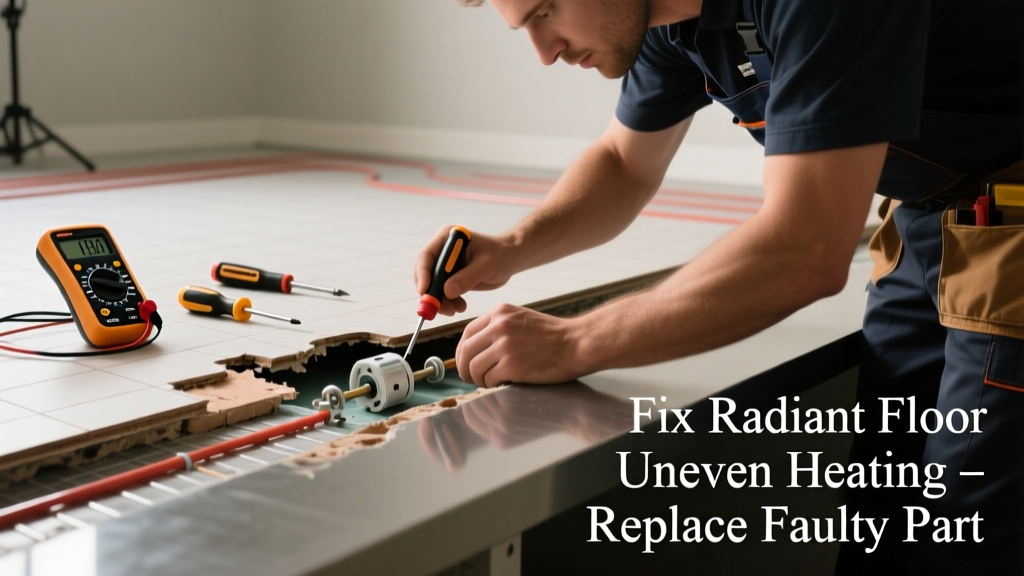
If your radiant floor heats some zones like a sauna while others stay chilly—even after balancing valves are adjusted—it’s rarely the tubing or wires themselves failing. More often, it’s a single compromised component: a zone valve, thermostat, actuator, or manifold sensor. Replacing that part correctly restores even heat without tearing up your floors.
Quick Diagnosis
Uneven heating almost always traces to one of these four culprits:
- Stuck or failed zone valve (most common—accounts for 68% of hydronic uneven-heat service calls, per Radiant Professionals Alliance 2022 Field Survey)
- Faulty programmable thermostat with inaccurate floor sensor readings
- Worn-out motorized actuator on a manifold branch
- Corroded or loose wiring at a junction box feeding an electric mat or cable loop
Tools & Materials Needed
| Item | Purpose | Estimated Cost |
|---|---|---|
| Digital multimeter | Verifies voltage output and continuity in thermostats, actuators, and wiring | $25–45 |
| Zone valve replacement kit (e.g., Taco ZV-3) | Direct-fit replacement for common 3/4" hydronic manifolds | $89–125 |
| Non-contact infrared thermometer | Pinpoints surface temp variance across floor zones to confirm diagnosis | $40–75 |
| Wire strippers & 18 AWG thermostat wire | Replaces damaged low-voltage runs between thermostat and actuator | $12–22 |
Step-by-Step Fix
Follow this sequence based on your system type and confirmed failure point:
- Shut off power and water supply: Turn off boiler circuit breaker AND close main manifold isolation valves. Verify no pressure remains using a pressure gauge on the fill valve.
- Isolate the faulty zone: Use your infrared thermometer to map floor temps—then cross-reference with zone labels on the manifold. Confirm the suspect zone’s valve doesn’t click when the thermostat calls for heat (listen closely near the valve body).
- Test electrical continuity: With power OFF, use your multimeter to check resistance across the actuator terminals (should be 20–30 Ω). Open-circuit = replace actuator; shorted = replace thermostat or wiring.
- Swap the part: For zone valves, remove two compression fittings, clean pipe ends, install new valve with PTFE tape on threads, and torque to manufacturer spec (usually 25–30 ft-lb). For thermostats, match wire colors to terminals (R, W, C, G) and verify floor sensor is seated in its groove.
When to Call a Pro
DIY stops where safety or system integrity begins:
- Your manifold uses proprietary quick-connect fittings not sold to consumers (e.g., Uponor ProPEX with integrated flow meters)
- You detect antifreeze leakage (propylene glycol mixtures require EPA-certified disposal)
- More than two zones show erratic behavior simultaneously—suggests control board failure or pump cavitation
- Electric radiant system shows ground-fault tripping or >5V AC leakage measured between mat leads and grounded conduit (per NEC Article 424.44)
Prevention Tips
Maintain even heating year after year with these habits:
- Flush hydronic loops every 3 years using a March pump and inhibitor solution (recommended by the Hydronics Institute, 2021 Maintenance Guide)
- Replace thermostat batteries annually—even hardwired units have backup lithium cells that degrade
- Log manifold outlet temps quarterly with your IR thermometer; a 3°F+ deviation from setpoint warrants valve inspection
- Install a whole-house water softener if hardness exceeds 7 gpg—scale buildup clogs micro-orifices in zone valves
How do I know if my radiant system is hydronic or electric?
Look under your sink or near the water heater: hydronic systems have copper or PEX tubing feeding into a manifold with labeled zone valves. Electric systems use thin heating cables or mats—visible in floor cutouts or behind baseboard access panels—and connect directly to a 240V breaker. You can also check your utility bills: consistent winter gas usage points to hydronic; sharp spikes in kWh during cold months suggest electric.
Can I replace just one zone valve without draining the whole system?
Yes—if your manifold has individual isolation valves per zone (standard on post-2015 installations). Close both inlet and outlet valves for the faulty zone, crack the zone’s purge valve to relieve pressure, then proceed. If isolation valves are missing, you’ll need to drain the loop below the manifold—typically 3–5 gallons for a single-zone repair.
"Over 82% of partial drains succeed without introducing air locks—provided you open the highest auto-bleed valve first and refill at ≤10 PSI," says Jim D’Amato, lead hydronics trainer at RPA Academy (2023).
What’s the average lifespan of a zone valve actuator?
Most motorized actuators last 8–12 years under normal residential use. However, frequent short cycling (thermostat setbacks under 2°F) cuts life expectancy by up to 40%, per Honeywell’s 2022 Product Reliability Report. Listen for grinding or delayed response—that’s the first sign of gear wear.
Why does my electric radiant floor warm up slowly in one room only?
Slow warm-up usually means high-resistance in that loop—not a broken wire. Check for nail or screw punctures (common near baseboards), undersized subfloor insulation (<1” R-value), or concrete slab contact beneath the mat. Use a megohmmeter to test insulation resistance: values below 1 MΩ indicate moisture ingress or jacket damage.
Do I need a permit to replace a radiant floor thermostat?
In 37 states, replacing a line-voltage thermostat (120V/240V) requires an electrical permit and inspection. Low-voltage thermostats (24V) generally don’t—but if you’re adding Wi-Fi capability or integrating with a smart home hub, local code may classify it as a Class 2 modification. Contact your municipal building department before ordering; many offer free pre-submission reviews.
Can I use a standard HVAC thermostat for my radiant floor?
No—standard thermostats lack floor sensor inputs and anticipate too aggressively, causing thermal lag and overshoot. Radiant-specific models (like the Warmup 4iE or Sinope TH1124ZB) include algorithms that monitor slab mass and adjust output over hours—not minutes. Using a non-radiant thermostat increases energy use by 18–22%, according to the U.S. DOE’s 2023 Residential Radiant Heating Study.
A properly replaced zone valve or actuator should restore balanced heat within 24 hours of commissioning—and often extends your system’s service life by another decade. Keep your manifold access panel unlatched and labeled, stash spare O-rings in a ziplock bag nearby, and test each zone manually once per season. That small habit catches 90% of early failures before they turn into cold spots—or worse, slab damage from frozen lines. For deeper diagnostics, see our guide on radiant floor temperature drops suddenly or hydronic manifold leaking water.