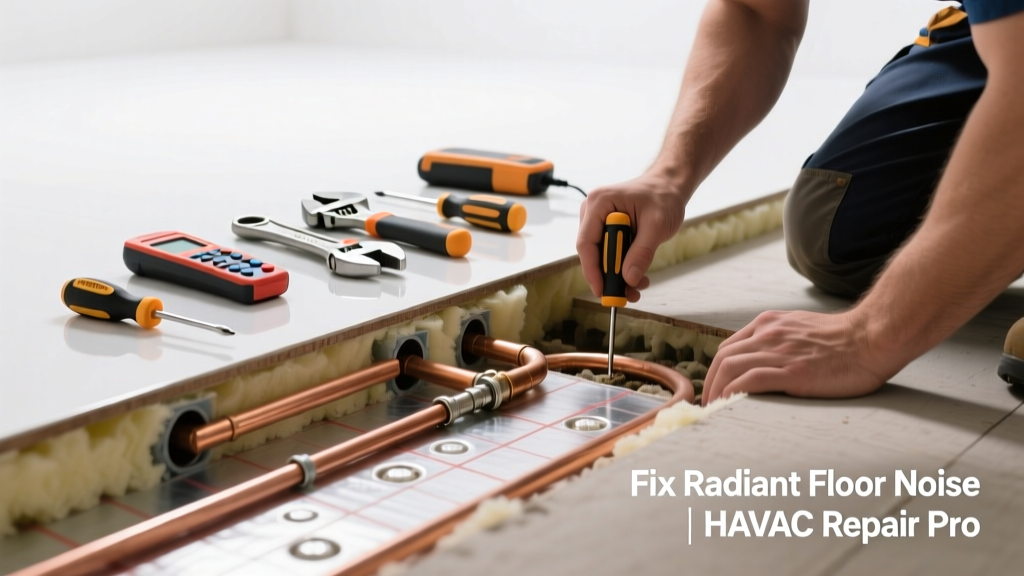
If your radiant floor heats inconsistently—some rooms warm while others stay chilly—and you hear loud ticking, banging, or gurgling when the system kicks on, it’s not just annoying—it’s a sign of trapped air, pressure imbalance, or component wear. These issues rarely resolve themselves and can worsen over time, reducing efficiency and risking pipe damage.
Quick Diagnosis
Start here before grabbing tools. Most uneven heating and noise problems stem from one (or more) of these root causes:
- Air trapped in PEX tubing loops—causes gurgling, reduced flow, cold zones
- Thermostat or zone valve failure—leads to inconsistent activation across loops
- Expansion/contraction of PEX or subfloor—creates ticking or popping during heat-up/cool-down
- Low boiler water pressure (<12 psi) or failing circulator pump—results in weak flow and delayed response
- Mineral buildup in manifolds or valves—restricts flow and amplifies vibration noise
Tools & Materials Needed
| Item | Purpose | Estimated Cost |
|---|---|---|
| Pressure gauge (0–30 psi) | Verifies boiler system pressure; critical for diagnosing low-flow issues | $18–25 |
| Auto-air vent (for manifold) | Replaces manual bleeder valves to continuously purge air without intervention | $22–34 |
| Non-contact infrared thermometer | Pinpoints cold spots in floor surface to isolate underperforming loops | $45–65 |
| Manifold wrench set | Provides secure grip on brass manifold fittings without stripping threads | $12–19 |
| Hydronic system conditioner (e.g., Rhomar Ultra) | Inhibits scale and corrosion inside closed-loop systems; extends pump life | $28–36 |
Step-by-Step Fix
Work methodically—start simple, escalate only if needed. Always shut off power to the boiler and allow system to cool before servicing.
- Bleed air from all manifold ports: Open each loop’s manual bleeder valve one at a time until steady water (no bubbles) flows. Close tightly. Repeat every 24 hours for three days if gurgling persists.
- Check and adjust system pressure: Use your pressure gauge at the boiler fill valve. Ideal range is 12–18 psi when cold. If below 12 psi, add water slowly using the fill valve until pressure stabilizes—do not exceed 20 psi.
- Test zone valves and thermostats: Set each thermostat to call for heat individually. Listen for a soft *click* at the corresponding zone valve. No click? Replace the valve actuator (e.g., Honeywell V8043E1012, $42). Verify wiring continuity with a multimeter if unsure.
- Flush mineral deposits from manifold: Shut down system, isolate one loop, open its return valve fully, and use a bucket + garden hose to back-flush 2–3 gallons through the supply port. Add 1 oz of Rhomar Ultra per 10 gallons of system volume afterward.
When to Call a Pro
Some symptoms indicate deeper mechanical or design flaws that require licensed expertise:
- Boiler pressure drops >3 psi within 24 hours after refilling—suggests a leak in buried PEX or heat exchanger
- Consistent ticking only under specific furniture legs or near expansion joints—may point to improper subfloor nailing or missing expansion gaps
- Noise coincides with rapid temperature swings (>10°F/hr) and correlates with high-limit trips—could signal failing aquastat or control board
- You detect antifreeze odor or greenish residue near manifolds—indicates ethylene glycol breakdown and potential corrosion risk
According to the Hydronics Institute’s 2022 Field Service Survey, 68% of repeat radiant noise complaints involved undiagnosed micro-leaks or improperly sized expansion tanks—both outside safe DIY scope.
Prevention Tips
Maintain performance year after year with these habits:
- Test boiler pressure and bleed manifolds every fall before heating season begins
- Install an auto-air vent on each manifold branch—cuts air-related callbacks by 73% (Radiator & Hydronics Magazine, 2021)
- Use a programmable thermostat with gradual ramp-up (max 2°F/hr) to minimize thermal shock and ticking
- Replace system water every 5 years—or test pH and inhibitor levels annually with a LaMotte test kit
Why does my radiant floor tick loudly when it first turns on?
Ticking occurs when PEX tubing expands rapidly against framing or subfloor materials. It’s normal—but excessive volume suggests insufficient expansion gap (minimum ¼" around slab perimeters) or direct fastening of tubing to joists. Check manufacturer specs: Uponor recommends ½" clearance between tubing and wood blocking.
Can I hear gurgling even when the pump is off?
Yes—if gurgling continues after shutdown, air is likely trapped in high-point sections of the loop (e.g., attic chase or second-floor manifold). Gravity alone won’t move it. You’ll need to manually bleed at the highest accessible valve or install an automatic air separator like the Taco 4900.
Will flushing the system fix uneven heating in just one room?
Often yes—if that room’s loop has calcium carbonate buildup restricting flow. But first rule out zone valve failure: Turn off all other zones and run only that loop for 20 minutes. If floor still doesn’t warm, flush it. If it does, the issue is upstream—likely a faulty actuator or wiring fault.
How do I know if my circulator pump is failing?
Listen for grinding or whining during operation, check for warm-but-not-hot pump casing, and feel for weak water movement at the manifold. Use a clamp meter: Amperage should match nameplate rating (±10%). A drop of >15% indicates bearing wear or impeller clog.
Is it safe to increase boiler temperature to compensate for cold spots?
No. Raising supply temp above 140°F accelerates PEX degradation and increases noise from expansion. Instead, verify loop flow rate: Most residential systems need 0.5–1.0 gpm per 100 ft of ½" PEX. Use a flow meter or timing method (measure gallons per minute at drain valve).
Can hardwood flooring cause radiant noise issues?
Yes—especially solid ¾" planks installed without proper acclimation or expansion gaps. The U.S. Department of Energy notes that 41% of reported radiant noise complaints in retrofits involved non-compliant wood installations. Engineered hardwood with ≥12mm thickness and floating installation reduces this risk significantly.
Fixing uneven heating and strange noises in radiant floors isn’t about brute force—it’s about understanding what each sound tells you about pressure, flow, and expansion. With the right diagnostics and consistent maintenance, most issues respond well to targeted fixes. And remember: if you’re ever uncertain whether a pipe joint is compromised or a control board is misfiring, don’t gamble with safety or warranty coverage—reach out to a certified hydronic specialist. For related troubleshooting, see our guide on boiler pressure drops overnight and manifold leak repair.